For decades, the name Alpina was synonymous with the pinnacle of Bavarian refinement. Operating out of Buchloe, Germany, this legendary boutique manufacturer carved out a unique space in the automotive landscape, taking standard BMW platforms and transforming them into sophisticated, high-performance grand tourers. Long before BMW officially brought Alpina into the corporate fold, vehicles like the iconic B10 Bi-Turbo and the breathtaking Roadster V8 served as more luxurious, often faster, and undeniably more exclusive alternatives to their M-badged counterparts.
Now that Alpina is fully integrated into the BMW Group, the era of the independent Buchloe-tuned BMW is officially over. But the imagination of the automotive aftermarket and digital design community knows no bounds.
Enter digital artist Abimelec Arellano, operating as Abimelec Design, who recently asked a wonderfully disruptive question: What if Alpina had stepped entirely outside of its comfort zone before its acquisition? What if, instead of finessing a 7 Series or an M3, the legendary tuning house had set its sights on something far more humble, yet universally beloved—a Volkswagen New Beetle?
The result of this conceptual exercise is the "B1 Turbo," a fictional creation that has captured the attention of enthusiasts worldwide. While the idea of a Volkswagen Beetle wearing Alpina’s signature pinstripes sounds comical on paper, the execution is nothing short of breathtaking.
Main Facts: The Anatomy of the Fictional Alpina B1 Turbo
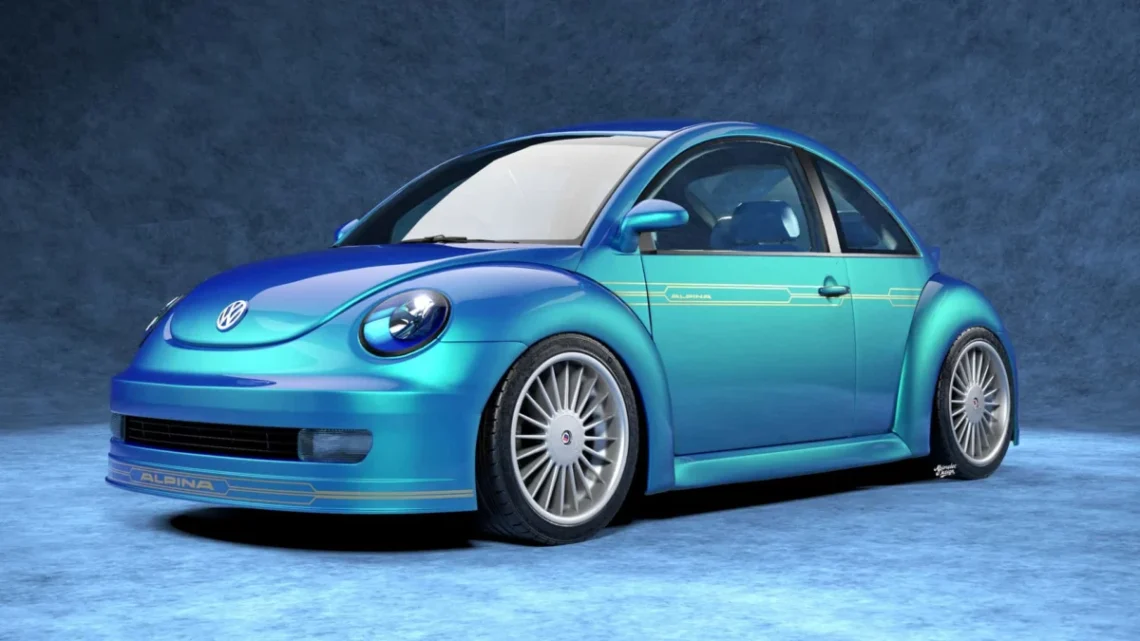
At first glance, the Abimelec Design rendering of the Alpina B1 Beetle strikes an unusual balance between executive-class elegance and playful compact styling. True to Alpina’s traditional design ethos, the modifications applied to the New Beetle are remarkably subtle, avoiding the aggressive, boy-racer aerodynamic kits often associated with aftermarket tuners.
The vehicle is finished in a deep, lustrous shade of metallic blue—a direct nod to Alpina’s signature blue paint palette. Filling out the wheel arches are the quintessential Alpina multi-spoke classic wheels, paired with ultra-low-profile tires that give the car a planted, aggressive stance. Delicate gold pinstripes sweep along the body lines, rounding out a visual identity that is unmistakably Buchloe.
Despite the platform being a Volkswagen, the vehicle looks remarkably cohesive. Underneath the digital paint, the artist envisioned a serious powertrain to match the prestigious badges: a turbocharged VR6 engine mated to an automatic transmission.
This conceptual mechanical layout bridges the gap between Volkswagen’s high-performance engineering experiments and Alpina’s penchant for effortless, high-speed cruising. While the project exists strictly in the digital realm, its roots trace back to a very real, highly exclusive encounter with one of the rarest Beetles ever built.
Chronology: From the Beetle RSi to Digital Conception
To understand how a Volkswagen Beetle could ever be associated with a high-end BMW tuner, one has to look at the timeline of inspiration that sparked the project.
The idea for the B1 Turbo did not materialize out of thin air. Instead, it was born during a visit Abimelec Arellano made to Mexico City last year. During his travels, a close friend—who happens to own one of the rarest iterations of the modern Beetle—gave Arellano the opportunity to spend considerable time behind the wheel.
The car in question was the Volkswagen New Beetle RSi, a limited-run powerhouse produced in the early 2000s. Only 250 units of the RSi were ever built, making it an automotive unicorn. Powered by a naturally aspirated 3.2-liter VR6 engine that pushed out 221 horsepower to a 4MOTION all-wheel-drive system via a six-speed manual transmission, the RSi was a serious track-ready machine wrapped in a widebody shell.
While the aggressive exterior styling and fender flares of the RSi initially caught the designer’s eye, it was the cabin that ultimately planted the seed for the Alpina rendering. Unlike standard economy-grade Beetles of the era, the RSi featured an upscale interior dripping with carbon fiber, aluminum trim, and Recaro bucket seats upholstered in thick, orange-tinted leather.
Reflecting on the experience, Arellano noted that the interior felt vastly superior to a standard Volkswagen product, drawing closer comparisons to a boutique luxury car or a high-end BMW. That lingering impression sparked a creative hypothesis: What would an ultra-luxury, grand-touring variant of the Beetle look like if handled by a master coachbuilder?
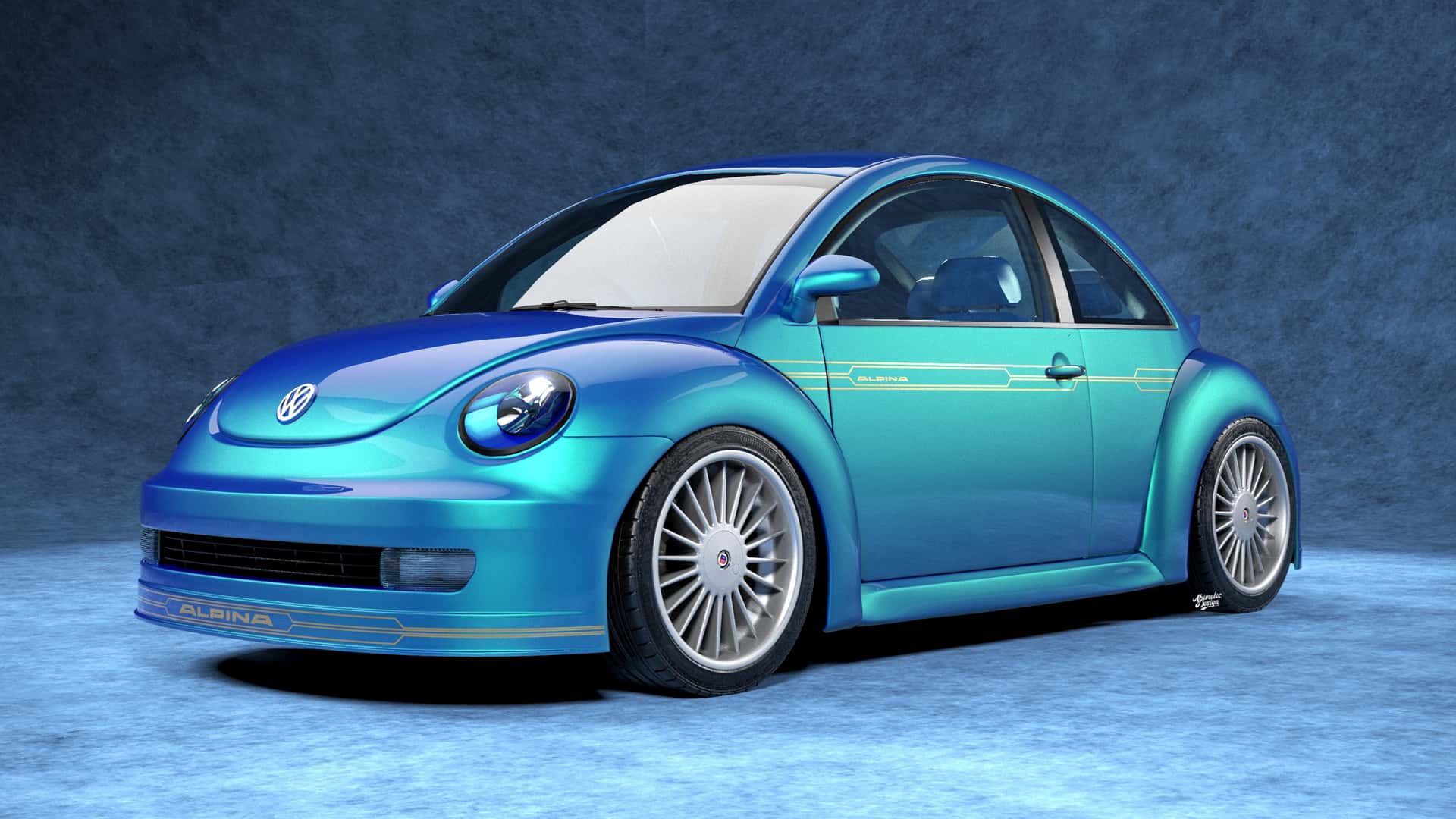
Because Volkswagen has never possessed an internal equivalent to BMW’s Alpina, Arellano chose the Bavarian tuning house as the ideal candidate for the fictional collaboration. The digital sketch was subsequently finalized and published on the artist’s Instagram page, where it quickly went viral among automotive purists and rendering fans alike.
Supporting Data: The Evolution of Alpina’s "What-If" Renderings
Abimelec Design is no stranger to automotive alternate universes. Over the years, the artist has carved out a niche by exploring "what-if" scenarios that push storied tuning houses and manufacturers far beyond their historical boundaries.
While Alpina’s corporate DNA has been strictly bound to the BMW family tree since Burkard Bovensiepen founded the company in 1965, Arellano has previously experimented with applying the tuner’s signature aesthetics to non-BMW platforms. Past digital explorations include:
- The Alpina Range Rover: Blending British off-road heritage with German executive interior appointments and classic multi-spoke wheel designs.
- The Alpina Toyota Supra: A stylistic bridge imagining how the tuning house might have massaged the A90 or classic A80 sports platforms.
- The Alpina Porsche 911 (964): Marrying Stuttgart’s iconic rear-engine sports car with Buchloe’s sophisticated grand-touring visual language.
Among this unconventional portfolio, the Beetle B1 Turbo has quickly emerged as a fan favorite. It challenges the traditional hierarchy of car tuning, proving that high-end design cues like multi-spoke wheels and restrained pinstripes can elevate even the most whimsical automotive shapes.
| Vehicle Project | Donor Platform | Fictional Powertrain / Concept | Key Design Elements |
|---|---|---|---|
| Alpina B1 Turbo | VW New Beetle | Turbocharged VR6, Automatic | Signature blue paint, multi-spoke wheels, gold pinstripes |
| Alpina 911 | Porsche 911 (964) | Twin-Turbo Flat-Six | Classic Buchloe graphics, refined leather interior |
| Alpina Supra | Toyota Supra | Twin-Turbo Inline-Six | Executive grand tourer stance, custom aero |
Official Responses and Industry Context
The unveiling of the B1 Turbo highlights a bittersweet reality in the modern automotive landscape. Alpina’s transition into an official subsidiary of the BMW Group marks the end of an independent era. BMW acquired the rights to the Alpina brand name, and future vehicles developed under the banner will be fully integrated into BMW’s production lines in Dingolfing and Munich, rather than being hand-finished in Buchloe.
Similarly, Volkswagen officially closed the book on the Beetle lineage in 2019, ending nearly eight decades of continuous production for the iconic round-bodied car. With both original entities operating in entirely different spheres—and one no longer even in production—the likelihood of an official collaboration between Volkswagen and Alpina sits at absolute zero.
When Motor1 reached out to Abimelec Arellano to discuss the project, the artist emphasized the playful, speculative nature of the work.
"Even though they obviously only tune BMWs, I’ve done a few Alpina ‘what ifs’ before, leaving the BMW brand a little bit, and people love to explore the possibility," Arellano explained via email.
Automotive journalists and digital design analysts have praised the project for its restraint. Unlike many modern digital renderings that rely on shock value, massive wings, and over-the-top widebody kits, the B1 Turbo respects the heritage of both the Beetle and Alpina. It leans into the mechanical plausibility of a boosted VR6 engine, mirroring the spirit of the factory-built Beetle RSi while elevating the vehicle’s aesthetic ambitions.
Implications: The Power of Digital Coachbuilding in Modern Car Culture
While the Alpina B1 Turbo will never roll out of a German workshop, projects like this shed light on a broader shift within automotive enthusiast culture. As modern car manufacturing becomes increasingly homogenized, constrained by stringent global safety regulations, corporate platform-sharing, and mass-market electrification, traditional coachbuilding has largely fallen by the wayside.
Independent digital designers have effectively stepped in as modern-day coachbuilders. Platforms like Instagram allow artists to revive dead nameplates, cross-pollinate rival brand identities, and explore alternative timelines that major automakers would never dare fund.
For enthusiasts mourning the loss of independent Alpina and the discontinuation of lifestyle cars like the Volkswagen Beetle, these digital exercises offer a welcome escape. They remind the automotive community of what could have been if corporate boundaries were porous and imagination ruled the drawing board.
Ultimately, a turbocharged VR6-powered, automatic-transmission Volkswagen Beetle wearing Alpina badges may only exist as pixels on a screen. But as long as digital artists continue to dream up such brilliantly absurd machines, the passion for internal combustion, classic design, and automotive storytelling remains as vibrant as ever.