For decades, the Kentucky whiskey landscape was defined by an adherence to tradition. The legal definition of bourbon required new charred oak containers, creating a near-universal industry standard that favored virgin white oak barrels above all else. While finishes in secondary casks—such as port, sherry, rum, and French oak—became common practice in the Scotch whisky sector and eventually bled into American whiskey, legacy distilleries like Four Roses remained steadfastly committed to the purity of unadorned, oak-aged bourbon.
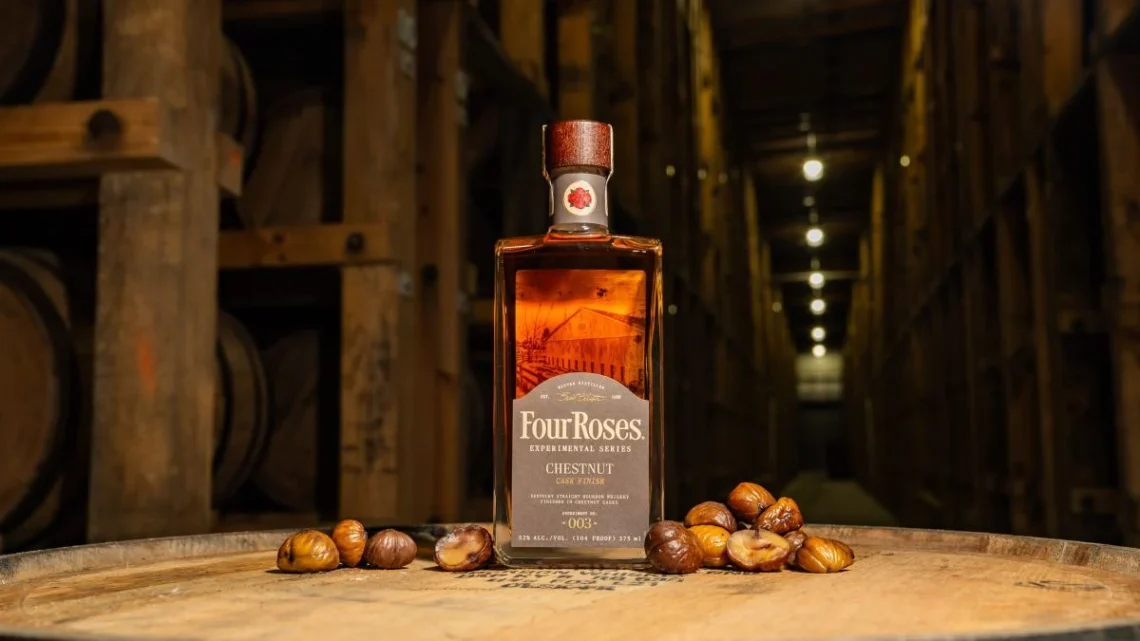
That narrative shifted dramatically this year. Four Roses, a brand globally revered for its meticulous blending traditions and complex recipe architecture, shattered its own century-old paradigm by introducing its very first cask-finished expression. Following the groundbreaking releases of the Mizunara-finished bourbon and a subsequent honey cask-finish, the historic Lawrenceburg, Kentucky-based distillery has announced the third expression in its boundary-pushing Experimental Series: Experimental Series No. 003: Chestnut.
This latest offering marries the distillery’s signature high-rye distillate with the rare, unorthodox profile of Japanese sweet chestnut wood. Clocking in at 104 proof and packaged in limited 375 ml allocations, this release represents not merely a novelty, but a calculated masterclass in wood management and flavor science.
Main Facts: Breaking Down the Chestnut-Finished Bourbon
The core details surrounding Four Roses Experimental Series No. 003: Chestnut establish it as one of the most intriguing collector-grade releases of the late whiskey calendar.
- The Base Spirit: The liquid began its maturation journey as a 6-year-old straight bourbon crafted from the distillery’s famed OBSK recipe. In Four Roses’ decoding nomenclature, the "O" denotes the Lawrenceburg distillery, the "B" represents the high-rye mashbill (60% corn, 35% rye, and 5% malted barley), the "S" stands for straight bourbon whiskey, and the "K" identifies the proprietary yeast strain responsible for rich, spicy, and full-bodied characteristics.
- The Secondary Maturation: Upon reaching its sixth year, the bourbon was transferred out of its traditional virgin American white oak barrels and introduced to 250-liter chestnut casks constructed from Japanese wood.
- The Wood Treatment: Before housing the spirit, these chestnut casks underwent rigorous preparation. They were subjected to varying levels of toasting and charring and held the whiskey for a secondary maturation period ranging between five to 11 weeks.
- Bottling Specifications: The resulting spirit was bottled at 104 proof (52% ABV).
- Packaging and Pricing: Eschewing the standard 750 ml format, No. 003 will be sold in 375 ml bottles with a Suggested Retail Price (SRP) of $55.
- Release Date and Availability: The whiskey will be available for purchase starting November 20 at the Four Roses distillery visitor center, sold on a strictly limited basis while supplies last.
Chronology: The Evolution of Four Roses’ Cask Innovation
To understand the magnitude of the Chestnut release, one must trace the historical trajectory of Four Roses and the rapid acceleration of its experimental wing over the past twelve months.
The Foundation of Complexity
Historically, Four Roses built its reputation on an intricate matrix of ten distinct bourbon recipes. Unlike most distilleries that rely on a single mashbill and yeast combination, Four Roses utilizes two distinct mashbills (Encoder B, which features a high 35% rye content, and Encoder E, which features a lower 20% rye content) alongside five proprietary yeast strains (V, K, O, Q, and F).
For generations, the distillery’s master blenders achieved complexity by marrying these recipes together in various proportions for their flagship Yellow Label, Small Batch, and Limited Edition releases, or bottling them individually for Single Barrel programs. Cask finishing—the practice of transferring mature whiskey into a secondary barrel for a supplemental period to impart unique flavors—was entirely absent from the official Four Roses portfolio. Master distillers of the past maintained that the delicate interplay of their ten recipes already provided ample nuance without the need for external cask interference.
The Turning Point: 2024
That institutional philosophy evolved under the guidance of Master Distiller Brent Elliott and his team. Recognizing shifting consumer palates and a growing appetite for boundary-pushing American whiskey, the distillery initiated a formalized Experimental Series.
- The First Milestone (Early 2024): Four Roses unveiled its maiden cask-finished bourbon: a Mizunara cask-finished expression utilizing the OBSK recipe. Mizunara—a notoriously difficult, porous, and expensive Japanese oak—infused the whiskey with exotic notes of sandalwood, coconut, and oriental spices, signaling to the industry that Four Roses was willing to play in avant-garde territory.
- The Second Iteration (Mid 2024): The distillery followed up with its honey cask-finish, a creative blend combining the OESQ and OBSK recipes to achieve a viscous, floral, and sweet profile.
- The Third Chapter (Late 2024): Today’s announcement of Experimental Series No. 003: Chestnut marks the culmination of a year defined by structural experimentation. By pivoting from traditional oak to sweet chestnut, Four Roses has officially closed out 2024 by cementing its status as an innovator capable of executing high-risk, high-reward maturation projects.
Supporting Data and Industry Context: The Rise of Chestnut in Modern Distilling
While white oak remains the undisputed king of barrel woods—mandated by law for straight bourbon and heavily favored across the spirits industry for its structural integrity and vanillin compounds—alternative woods are slowly carving out a niche.
The Chemistry and Rarity of Chestnut Wood
Chestnut wood (Castanea) possesses a fundamentally different cellular structure than white oak (Quercus). Historically, chestnut was widely used in Europe for wine and spirits maturation (notably in Italy and parts of France) before the sweet chestnut blight devastated populations in the early 20th century.
From a chemical perspective, chestnut wood is typically lower in tannins than European or American oak, but it can contribute a distinctively spicy, nutty, and dry profile to aging spirits. Because chestnut is significantly more porous than oak, wood-to-liquid interaction occurs at an accelerated rate. This necessitated the tightly controlled, relatively short secondary finishing window of five to 11 weeks implemented by Four Roses; leaving high-proof bourbon in active chestnut for years would risk over-oaking and rendering the spirit unpalatable.
Broader Industry Trends
Four Roses is not entirely alone in exploring this unorthodox medium, though it remains a rare sight in the bourbon sector. Across the globe, distillers are searching for differentiation through wood science. A prominent contemporary comparator is the recently launched Midleton Very Rare Rare Wood Collection, which made waves as the first Irish whiskey to be finished in sweet chestnut barrels.

The convergence of Irish whiskey and Kentucky bourbon both experimenting with chestnut in the same developmental window underscores a broader macro-trend: consumers are moving past standard cask finishes (like port and sherry) and demanding hyper-specific, terroir-driven wood profiles that challenge traditional flavor perceptions.
Official Responses: Insights from the Master Distiller
In official statements accompanying the release, Master Distiller Brent Elliott elaborated on the trial-and-error process that led the team to select Japanese chestnut for No. 003.
"To me, what makes this release so interesting is how chestnut wood can enhance and highlight the flavors of a bourbon," Elliott stated. "We explored a number of different wood types in our initial trials, and chestnut stood out for the unique character it brought to the spirit. The OBSK recipe had the complexity and spice we were looking for to complement those flavors, creating a bourbon that feels familiar in its foundation but offers new, distinct flavors in the glass."
Elliott’s deliberate choice of the OBSK recipe is telling. With its high rye content (35%) and the "K" yeast strain—known for contributing baking spice, rye grain, and herbal notes—the base distillate possessed the structural backbone required to stand up to the assertive, drying nature of chestnut wood without being structurally overwhelmed.
Tasting Notes
Tasting samples evaluated prior to the public launch reveal a profile that dramatically separates No. 003 from standard Four Roses offerings.
- Nose: Immediate waves of dry, tannic spice rise from the glass, underpinned by classic bourbon signatures of brown sugar, rich vanilla, and a bright, orchard-fresh note of green apple.
- Palate: The influence of the Japanese chestnut becomes prominent on the mid-palate, introducing a distinctly dry, woody spice that cuts through the underlying sweetness. Notes of maple candy and buttery caramel provide a necessary counterweight to the wood’s structural dryness.
- Finish: Long, warming, and exceptionally complex, leaving a lingering impression of spiced oak, toasted nuts, and residual fruit sweetness.
Observers note that among the three releases in the Experimental Series thus far, No. 003 displays the most pronounced rye-like character, making it an appealing pour for enthusiasts who favor high-rye bourbons and traditional ryes alike.
Implications: What Experimental Series No. 003 Means for the Future of Four Roses
The release of the Chestnut-finished bourbon carries significant implications for the brand’s trajectory, collector markets, and the broader American whiskey landscape.
1. Shifting Brand Identity
For decades, Four Roses has worn its traditionalism as a badge of honor. By steadfastly refusing to release cask-finished expressions while the rest of the craft whiskey boom flooded the market with secondary finishes, Four Roses cultivated an aura of purist integrity. However, the launch of the Experimental Series proves that heritage and innovation are not mutually exclusive. By introducing Mizunara, honey, and now chestnut finishes within a single calendar year, Four Roses has successfully positioned itself as a modern distillery capable of appealing to contemporary experimental whiskey geeks while maintaining its core heritage recipes.
2. Collector Dynamics and Secondary Market Impact
The decision to bottle Experimental Series No. 003 in 375 ml formats priced at an accessible $55 is a double-edged sword for consumers. On one hand, the lower price point and split-volume approach allow more enthusiasts to secure a bottle without breaking the bank. On the other hand, the extreme scarcity—being sold exclusively at the Lawrenceburg distillery starting November 20 while supplies last—guarantees intense secondary market demand, long queues, and immediate collector frenzy.
3. The Path Forward for Wood Innovation
By proving that high-rye OBSK distillate can harmonize successfully with alternative woods like Japanese chestnut, Four Roses has opened the door to future exploratory programs. As new mashbills recently laid down by the distillery reach maturity in the coming years, the intersection of novel base distillates and exotic barrel finishes could yield an entirely new generation of ultra-premium releases.
For now, Experimental Series No. 003: Chestnut stands as a testament to the fact that even a distillery with a history stretching back over a century can still surprise the whiskey world. For those fortunate enough to secure a 375 ml bottle at the distillery gates this November, it offers a rare glimpse into the evolving frontier of American whiskey.