Main Facts
Proper automotive maintenance is the invisible thread holding the modern transportation ecosystem together. While today’s internal combustion engines are marvels of metallurgical engineering, computer-controlled precision, and thermal management, they remain fundamentally beholden to a very old, unglamorous requirement: clean, unadulterated engine oil. Miss the foundational steps of basic upkeep, and even a luxury vehicle built by a major American manufacturer can suffer a catastrophic, premature demise.
This stark reality was recently laid bare in an episode of the popular automotive tear-down series I Do Cars, hosted by Eric Cook. The subject of the autopsy was a 3.0-liter twin-turbocharged EcoBoost V6 engine pulled from a relatively modern 2021 Lincoln Aviator. Despite having only accumulated approximately 70,000 miles on its odometer—a mere fraction of the expected lifespan for a modern premium powertrain—the engine was completely locked up, non-functional, and relegated to the scrap heap.
The root cause of this mechanical tragedy was not a design defect, a faulty batch of factory metals, or an unmitigated software failure. Instead, the autopsy revealed a textbook case of terminal vehicular neglect. Vehicle service records indicated gaping, prolonged absences in maintenance intervals, suggesting that the crossover’s previous owner routinely skipped critical oil changes and fundamental preventive upkeep.
The consequences of this deferred maintenance were written clearly across the engine’s internal architecture. Encased in a thick, baked-on layer of oil varnish and choked by accumulated metallic sludge, the 3.0-liter EcoBoost serves as a cautionary tale for luxury vehicle owners who treat high-performance machinery as "set-it-and-forget-it" appliances.
Chronology of a Breakdown: The Life and Death of a Luxury Crossover
To understand how a modern luxury vehicle’s heart can stop beating prematurely, one must trace the timeline of its operational life. The 2021 Lincoln Aviator rolled off the assembly line as a sophisticated, three-row luxury midsize crossover designed to compete directly with Europe’s finest offerings. Equipped with Ford’s potent 3.0-liter twin-turbo EcoBoost V6, it pushed out robust horsepower and torque figures, relying on complex turbocharging and variable valve timing to deliver seamless power.
However, the lifecycle of this specific Aviator was turbulent. According to documentation recovered alongside the vehicle, its short time on the road was punctuated by significant, extensive repairs. While luxury vehicles of this caliber feature complex electronic systems, air suspensions, and advanced driver-assistance features that occasionally require dealer intervention, the mechanical core of the vehicle should have remained bulletproof through its first 100,000 miles.
Instead, the vehicle’s maintenance narrative was characterized by neglect. In the world of modern forced-induction engines, oil change intervals are not flexible suggestions; they are strict chemical and thermal timelines. As the Aviator crossed through its first few years of service, the recommended oil change intervals were repeatedly bypassed.
By the time the vehicle approached the 70,000-mile mark, the degradation reached a tipping point. The engine oil, subjected to extreme heat cycling from the twin turbochargers and contaminated by unburnt fuel blow-by and combustion byproducts, began to break down. The detergent additives in the oil depleted entirely, allowing varnish to coat the internal galleries. Eventually, microscopic wear particles—combined with oxidized, thickened oil—overwhelmed the filtration system. Starved of proper lubrication and cooling, critical internal bearings seized, bringing the 3.0-liter EcoBoost to an abrupt and permanent halt.
Supporting Data: Inside the Tear-Down
When the I Do Cars channel commenced the teardown of the 3.0-liter EcoBoost, the exterior shell of the engine gave little indication of the apocalyptic scene waiting beneath the valve covers and oil pan. But as technicians unbolted the upper components, the true cost of neglected maintenance became immediately visible.
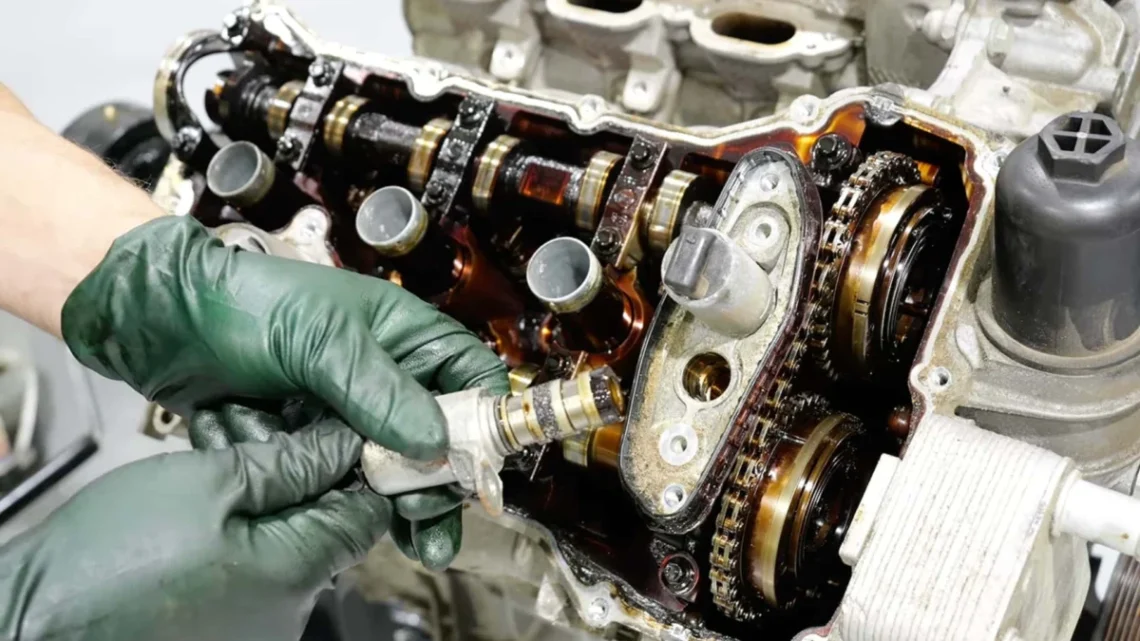
The earliest and most telling diagnostic indicator appeared at the variable cam timing (VCT) solenoids. The oil screens designed to filter debris away from these sensitive actuators were completely choked and packed with solid carbon and metallic particulate matter. In a modern engine relying on rapid, precise oil pressure fluctuations to advance or retard camshaft timing, blocked VCT screens spell immediate disaster for performance, efficiency, and stable idling.
Further disassembly exposed widespread contamination throughout the entire lubrication circuit. Silvery sludge—the unmistakable calling card of bearing material being actively ground into paste by metal-on-metal friction—was distributed uniformly across the interior surfaces. The oil filter housing, designed to trap contaminants before they recirculate, was caked in thick, metallic debris. Upon dropping the oil pan, technicians found interior surfaces glistening not with fresh lubrication, but with a thick, viscous layer of cooked oil varnish.
Interestingly, the autopsy also revealed what did not fail. Despite the severe lubrication starvation, the engine’s valve train escaped catastrophic impact damage. None of the pistons showed signs of having collided with the valves, indicating that the timing chains and guides managed to hold together just long enough before the rotating assembly locked tight. The killer was purely systemic oil starvation and the abrasive destruction wrought by oxidized oil and suspended metallic particulate over thousands of miles.
Official Responses and Industry Perspectives
While neither Ford nor Lincoln issued a direct public statement regarding this specific vehicle—given that the failure was explicitly traced to owner neglect rather than a manufacturing defect—powertrain engineers across the automotive sector have consistently emphasized the changing nature of maintenance in the modern era of forced-induction engines.
Automotive manufacturers have increasingly extended recommended oil change intervals on paper, often pointing to synthetic oil technology and advanced monitoring systems to justify 7,500-mile or even 10,000-mile windows. However, independent mechanics, master technicians, and engine rebuilders push back against these extended timelines, particularly for turbocharged engines like Ford’s EcoBoost family.
"Turbochargers spin at upwards of 150,000 revolutions per minute and operate in extreme thermal environments," notes a veteran powertrain engineer who spoke on condition of anonymity. "The oil passing through the center housing of a turbocharger is subjected to intense heat that can literally bake standard or even synthetic oil if it is left in service too long. When owners stretch intervals beyond safe thresholds, the oil cokes up inside the turbo lines, starving the bearings and contaminating the rest of the engine block."
Independent repair networks and consumer advocacy groups universally advise cutting factory-recommended oil change intervals in half—especially for vehicles operated under severe driving conditions, such as heavy city traffic, towing, short-trip commuting, or extreme ambient temperatures. For high-output engines like the Lincoln Aviator’s 3.0L V6, strict adherence to a 5,000-mile (or six-month) oil and filter change schedule is widely regarded as cheap insurance against catastrophic financial loss.
Implications: The High Cost of Deferred Maintenance
The premature death of this 2021 Lincoln Aviator’s engine carries profound implications for consumers, the used car market, and the broader culture of vehicle ownership in the 2020s.
Financial Impact on Vehicle Owners
Replacing a modern, twin-turbocharged V6 engine in a luxury crossover is a staggering financial undertaking. Between the cost of a replacement long-block (or a factory-reconstructed unit), specialized labor hours, ancillary cooling system flushes, and potential turbocharger replacements, the total bill can easily eclipse $10,000 to $15,000. For a vehicle with a market value that depreciates over time, suffering a catastrophic engine failure at 70,000 miles can instantly render the car a total economic loss, forcing owners into upside-down loan situations or expensive repairs that exceed the value of the vehicle itself.
The Used Car Market Risk
This case study also highlights the inherent dangers lurking within the used luxury vehicle market. Luxury depreciation often puts powerful, sophisticated vehicles within reach of second or third owners who may not possess the financial bandwidth—or the mechanical discipline—to maintain them properly. When service histories are incomplete, patchy, or entirely absent, buyers are essentially gambling on the internal health of a complex machine. Without a pre-purchase inspection (PPI) that includes oil analysis or borescope inspections, buyers risk inheriting deferred maintenance liabilities left behind by previous operators.
A Lesson in Mechanical Stewardship
Ultimately, the teardown of the Lincoln Aviator EcoBoost V6 serves as an unvarnished reminder of a fundamental truth: technology cannot outsmart physics. Modern engineering has yielded unprecedented power, efficiency, and refinement from smaller displacement engines, but those same engineering advancements demand higher levels of disciplined care.
As vehicles grow more complex and expensive to repair, the humble oil change remains the single most important line of defense between a car that achieves a quarter-million trouble-free miles and one that ends up dismantled on a workbench before its first major milestone.