By Automotive Industry Desk
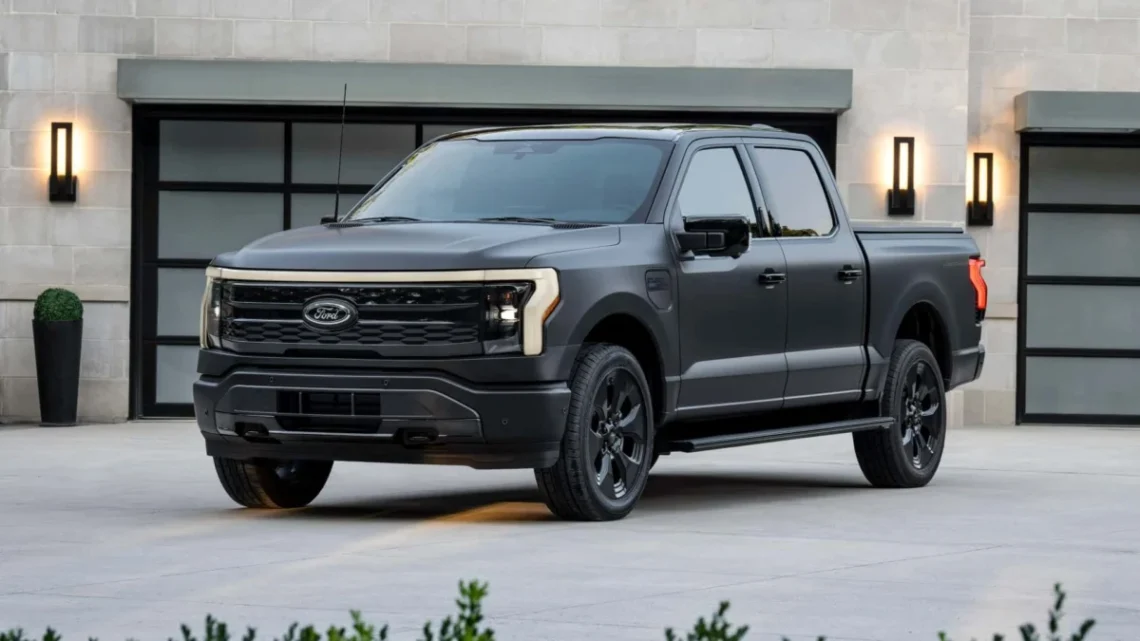
The automotive landscape is frequently defined by paradoxes, but few recent phenomena are quite as striking as the trajectory of the Ford F-150 Lightning. When the Blue Oval first introduced its fully electric full-size pickup truck in 2022, it was greeted with immense technological fanfare, yet it struggled to capture the hearts and checkbooks of traditional truck buyers in the volume Ford had originally anticipated. Fast-forward to the present day, and a dramatic role reversal has taken place. While new-car showroom excitement has cooled—culminating in Ford’s decision to sunset the current generation of the pure-electric Lightning by December 2025—the secondary market is experiencing an unexpected love affair with the vehicle.
Today, shrewd used-car buyers are snapping up pre-owned Lightnings with such enthusiasm that certain sellers are managing to offload their trucks for figures astonishingly close to their original sticker prices. As the industry looks toward Ford’s next-generation electrified utility vehicles, the F-150 Lightning serves as a fascinating case study in how steep depreciation, shifting consumer demands, and economic pragmatism can completely reshape a vehicle’s legacy.
Main Facts: The Secondary Market Rebound
The most compelling proof of the F-150 Lightning’s unexpected second act can be found within enthusiast communities and wholesale data analytics. In a recent interaction within the Ford F-150 Lightning Owners Group on Facebook, a user identified as "JF" shared a surprising financial reality: digital automotive retailer Carvana offered him, and subsequently paid him, "just a little less than we paid new" to buy back his electric pickup.
In a subsequent interview with Torque News, JF revealed that while he genuinely appreciated the truck and secured a "great deal" when he initially purchased it, his lifestyle simply did not align with the utility of a full-size pickup bed. "We wanted something smaller," JF explained, noting that the combination of his low actual utilization of the truck bed and the unexpected spike in resale values made it the optimal moment to part ways with the vehicle.
This anecdote is far from an isolated incident. Across the broader pre-owned ecosystem, used EV trucks are entering a sweet spot where early steep depreciation has paradoxically made them extraordinarily attractive. Jimmy Douglas, CEO of wholesale electric vehicle dealer Plug, noted in a recent interview with Bloomberg that while retail consumers historically struggled to justify the Lightning’s lofty brand-new sticker prices, acquiring one at a 50- to 60-percent discount off its original MSRP transforms the vehicle entirely.
"At that price point, it’s really a sweet spot," Douglas stated. "It’s an incredible truck for the money."
This dramatic shift has inverted typical automotive economics: vehicles that were once viewed as slow-movers on dealership lots are now commanding fierce attention from bargain-hunting consumers eager to pilot a high-torque, technologically advanced American pickup without absorbing the initial factory-fresh depreciation hit.
Chronology: The Rise, Stall, and Pivot of the Lightning
To understand how the F-150 Lightning arrived at its current pre-owned renaissance, one must trace its historical timeline through production hurdles, pricing adjustments, and strategic corporate pivots.
2022: The High-Profile Launch
When Ford officially rolled out the F-150 Lightning, it arrived with a wave of immense media attention and heavy political and environmental expectations. Positioned as the zero-emission variant of America’s best-selling vehicle for decades, it promised sports-car acceleration, innovative bidirectional power features (like Intelligent Backup Power), and the familiar utility of the traditional F-150 architecture. Ford initially touted an accessible entry-level price point hovering around $40,000, which generated hundreds of thousands of non-binding reservations.
2023–2024: Price Escalations and Production Adjustments
Reality, however, quickly collided with macroeconomic pressures, rising battery material costs, and supply chain bottlenecks. The promised $40,000 base price climbed rapidly, with many popular trims quickly surging past the $50,000 threshold and well into the $70,000 to $90,000 territory. These escalating costs, combined with range anxiety and towing infrastructure limitations among traditional truck buyers, caused retail demand to plateau.
Recognizing a widening gap between production output and dealership lot inventory, Ford took decisive action roughly a year ago by temporarily pausing F-150 Lightning production to recalibrate supply with the realities of consumer demand.
Late 2025 and Beyond: The End of an Era and the EREV Future
Ultimately, Ford made the strategic decision to conclude the production run of the current pure-electric F-150 Lightning in December 2025. Rather than abandoning the concept of electrified hauling, however, the automaker used the slowdown to pivot toward its next iteration: an extended-range electric vehicle (EREV) powertrain strategy designed to bridge the gap between pure battery-electric driving and the practical realities of long-distance towing.

Supporting Data: The Economics of EV Depreciation
The financial evolution of the F-150 Lightning provides a textbook example of how the broader electric vehicle market matures. When luxury and tech-heavy EVs enter the market, early adopters frequently absorb massive initial value drops—often losing tens of thousands of dollars within the first twelve to twenty-four months of ownership due to shifting federal tax credits, rapid technological iterations, and changing market subsidies.
However, once a vehicle hits a certain valuation floor—frequently cited by wholesale dealers as a 50% to 60% discount from the original MSRP—demand experiences a violent correction upward.
- The Initial Barrier: At an average transaction price well north of $60,000 to $80,000 during its peak production years, the Lightning competed directly with heavily optioned internal combustion engine (ICE) trucks that offered unrestricted towing ranges and immediate refueling convenience.
- The Secondary Market Sweet Spot: As these trucks transition to the used market, their price tags plunge into the $30,000 to $45,000 range. At this price tier, buyers who were previously priced out of the EV market suddenly find themselves evaluating a massive, dual-motor, all-wheel-drive luxury workspace on wheels that outperforms equivalent gas-powered trucks in daily commuting comfort, maintenance costs, and instantaneous torque delivery.
- The Liquidity Paradox: Because supply for these deeply discounted used units remains tighter than the overwhelming public appetite for affordable electric trucks, certain models—particularly well-maintained examples with low mileage—are bucking traditional depreciation curves, allowing sellers like JF to liquidate their assets through platforms like Carvana with minimal financial penalty.
Official Responses: Industry Leaders Weigh In
Automotive executives and market analysts have been vocal about the unique consumer psychology driving the Lightning’s second act.
Speaking with financial media outlets, industry veterans have emphasized that the failure of the original Lightning was rarely a condemnation of its engineering prowess. Rather, it was a mismatch between early-market pricing structures and the risk-averse nature of full-size truck buyers.
Jimmy Douglas of Plug summarized the sentiment of the wholesale sector succinctly:
"It was difficult for consumers to justify buying the truck at sticker price… But at 50- to 60-percent off the full price, it’s really a sweet spot; it’s an incredible truck for the money."
Ford corporate leadership has similarly acknowledged these market lessons. Rather than doubling down on a slow-selling architecture, the company has redirected its engineering efforts toward powertrain versatility. Ford’s official communications regarding upcoming truck architecture emphasize listening directly to consumer habits—recognizing that while a subset of drivers demands zero emissions for daily operations, long-haul utility and towing customers require fail-safes that eliminate charging infrastructure anxiety.
Implications: What Comes Next for Ford’s Electric Trucks?
The unexpected vitality of the used F-150 Lightning market has profound implications not only for Ford’s current vehicle inventory but also for the design and deployment of its future truck lineup.
1. The Rise of the Extended-Range Electric Vehicle (EREV)
Ford’s upcoming replacement for the pure-electric Lightning will take the form of an extended-range electric vehicle (EREV). Unlike a traditional hybrid where the internal combustion engine directly drives the wheels, the EREV architecture utilizes a dedicated onboard gas-powered generator solely to charge the high-voltage battery pack.
According to preliminary specifications released by Ford, this configuration will yield an astonishing total driving range exceeding 700 miles when both the battery pack and the gas tank are operating at full capacity. This technological bridge is expected to alleviate the primary consumer pain point that hindered the original Lightning: severe range degradation while towing heavy loads. Industry insiders anticipate that this EREV variant will hit the market well before the debut of the next-generation traditional F-150, scheduled for release by the end of the decade.
2. Affordability as the Ultimate Catalyst
The success of the secondhand Lightning market proves that consumer resistance to electric trucks has never been about an aversion to electric propulsion itself—it has always been about cost-to-value ratios. Ford’s future product announcements, such as ongoing developments surrounding budget-conscious electric platforms (like the heavily discussed sub-$40,000 vehicle concepts colloquially tied to future project pipelines), indicate that the company has internalized this lesson. To achieve mass adoption in the truck segment, utility vehicles must either match the economic accessibility of their gas-powered counterparts or offer undeniable financial value on the secondary market.
3. A Lasting Legacy for Early Adopters
For those who purchased an early F-150 Lightning and feared they were holding a depreciating asset destined for obsolescence, the current used market boom offers unexpected financial grace. As platforms like Carvana and wholesale networks aggressively hunt for inventory to satisfy surging consumer demand for discounted EV trucks, early owners are finding that their electric pioneers hold surprising residual power.
Ultimately, while the pure-electric F-150 Lightning’s initial chapter is drawing to a close, its presence on America’s roads is far from over. By finding its true economic footing in the used market, the Lightning has proven that great engineering eventually finds its audience—even if it has to take a secondhand route to get there.