Main Facts
Commercial aviation has long functioned as a barometer of luxury, technological capability, and corporate ambition. Today, Singapore Airlines—widely heralded as an industry titan and recently crowned best in-flight service provider in the Robb Report 2026 Airline Awards—has raised the bar yet again. The carrier has officially unveiled its next-generation first-class and business-class cabins, anchoring a staggering nearly $1.6 billion fleet-wide investment.
At the center of this transformation is an ultra-exclusive first-class product destined for long-haul routes aboard newly retrofitted Airbus A350-900s and cutting-edge Boeing 777-9 aircraft. Moving far beyond the traditional concept of an airline seat, these spaces function more like boutique hotel rooms in the clouds. Each suite is enveloped by curved sliding doors and high acoustic walls, guaranteeing absolute privacy.
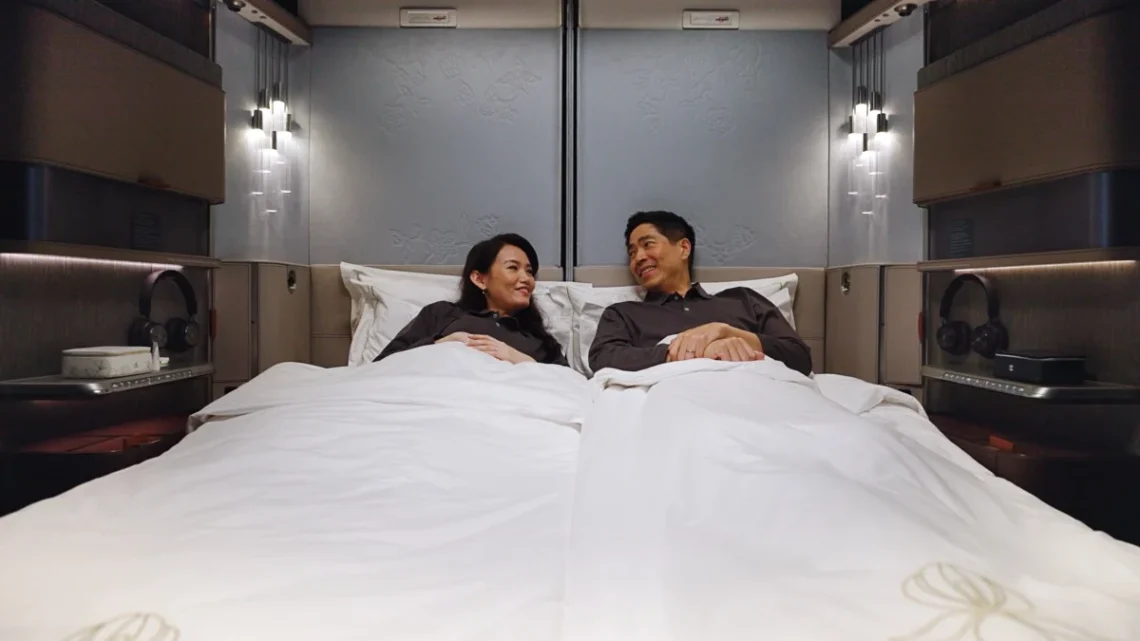
The crown jewel of the offering is the aviation industry’s largest double bed. Centrally positioned suites can be seamlessly combined when traveling with a companion, transforming into a standard queen-size bed spanning 80 inches in length and 60 inches in width. When sleep isn’t on the itinerary, the same configuration functions as a spacious two-seat sofa or a collaborative dining space.
Complementing the hardware is a meticulous approach to tactile luxury. Upholstered in supple Poltrona Frau leather, the seats feature advanced smart-cabin controls, adjustable leg rests, upper and lower lumbar supports, and custom armrests. Passengers are enveloped in 100 percent cotton bed linens, plush duvets, and bespoke mattress toppers engineered by German luxury bedding specialist Paradies.

The rest of the cabin is engineered for seamless utility and elite entertainment. Passengers can dine face-to-face across a grand table that doubles as a functional workstation, complete with integrated wireless charging pads and high-speed USB-C ports. Discreet personal storage includes a dedicated wardrobe, a sleek vanity drawer, and concealed baggage space beneath the ottoman. For entertainment, travelers are treated to a massive 32-inch 4K high-resolution touchscreen paired with studio-grade Bang & Olufsen wireless headphones.
Business-class passengers are far from forgotten in this multi-billion-dollar overhaul. The new business-class product introduces full-grain leather upholstery with bespoke custom embroidery. Seats convert effortlessly into expansive lie-flat beds stretching 79 inches long and up to 24 inches wide, accompanied by a crystalline 4K high-resolution touchscreen spanning up to 22 inches.
Chronology
To understand the magnitude of Singapore Airlines’ latest milestone, it is essential to trace the timeline of modern commercial aviation’s obsession with sky-high luxury, culminating in the rollout of these 2027 cabins.
- The Early 2000s — The Dawn of the Suite: Singapore Airlines pioneered the enclosed private suite concept on its Airbus A380 fleet, changing passenger expectations forever by proving that commercial tickets could rival private jet accommodations.
- The Late 2010s — Refining the Experience: As global competition intensified, carriers began introducing double beds and sliding doors on wide-body aircraft, pushing airlines to continuously invest in retrofits.
- The Research & Development Phase (2023–2025): Recognizing shifting consumer desires following the pandemic, Singapore Airlines initiated an intensive developmental study. The airline engaged over 5,000 frequent flyers, premium customers, and dedicated staff to map out precise ergonomic, culinary, and environmental preferences for long-haul travel.
- Late 2026 — The Unveiling: Singapore Airlines officially reveals its $1.6 billion cabin redesign to the global public, showcasing the Airbus A350-900 and Boeing 777-9 configurations alongside its award-winning service accolades.
- Second Half of 2027 — Commercial Launch: The newly retrofitted aircraft are scheduled to officially enter commercial service, welcoming their first paying passengers into the stratosphere.
Supporting Data
The economics and dimensions behind Singapore Airlines’ latest capital expenditure highlight the immense stakes involved in the ultra-luxury aviation market:

- Total Investment: Nearly $1.6 billion dedicated to overhauling all seating tiers across long-haul aircraft.
- Aircraft Platforms: Retrofitted Airbus A350-900s and brand-new Boeing 777-9s.
- First-Class Bed Dimensions: 80 inches in length by 60 inches in width (equivalent to a standard American queen-size bed).
- Business-Class Bed Dimensions: Up to 79 inches in length and up to 24 inches in width.
- Screen Sizes: A striking 32-inch 4K high-res touchscreen in first class; up to 22-inch 4K high-res touchscreens in business class.
- Customer Research Pool: Over 5,000 frequent flyers, regular customers, and airline employees consulted during the design phase.
- Target Launch Date: Scheduled to hit commercial skies in the second half of 2027.
Official Responses
The development of cabins of this caliber requires unprecedented collaboration between legacy aviation engineering and luxury lifestyle brands. Speaking on the meticulous design process, airline executives emphasized the consumer-driven philosophy behind the multi-year project.
"To bring each of these new cabins to life, we did not simply rely on internal blueprints or historical trends," noted a representative for Singapore Airlines during the global unveiling. "Instead, we tapped over 5,000 frequent fliers, valued customers, and internal staff to see exactly what modern travelers looked for while in flight—from deep, restorative relaxation to elevated, multi-course food options. Every stitch of Poltrona Frau leather and every millimeter of cabin acoustic dampening was informed by the people who spend thousands of hours in our skies."
Design partners and material suppliers have similarly lauded the project as a triumph of collaborative craftsmanship. By integrating high-end residential interior design standards—such as Paradies mattress toppers and Bang & Olufsen acoustic systems—Singapore Airlines has successfully blurred the line between residential hospitality and aerospace engineering.
Implications
Singapore Airlines’ $1.6 billion gambit is much more than a routine fleet upgrade; it is a clear tactical maneuver in an increasingly cutthroat commercial aviation arms race.

The Escalation of the Super-Suite Wars
Airlines across the globe are pouring billions into upper-tier transformations to capture high-net-worth travelers who are increasingly willing to pay premium prices for absolute privacy and comfort. Singapore Airlines is far from alone in this pursuit. Etihad Airways continues to draw global fascination with its legendary "Residence"—a multi-room private living space complete with a dedicated butler service aboard its A380s. Meanwhile, Air France has rolled out its newly redesigned La Première suites, offering ultra-exclusive, sprawling cabins for its most elite clientele.
The Evolution of In-Flight Dining and Wellness
Beyond physical seating, the competition has spilled over into holistic wellness and gastronomy. Carriers like Delta Air Lines and United Airlines have recently introduced complex, fine-dining-inspired chef’s table menus and curated wine programs to retain high-yielding business and leisure travelers. Singapore Airlines’ emphasis on restful sleep—highlighted by queen-size mattresses, Paradies bedding, and optimized cabin air and lighting control—signals a broader industry shift toward wellness-oriented travel.
The Future of Long-Haul Travel
As these newly configured Airbus A350-900s and Boeing 777-9s prepare to enter service in the second half of 2027, the psychological barrier between ground-based luxury and airborne transit will continue to dissolve. For travelers fortunate enough to secure a center suite, a 14-hour transcontinental journey will no longer feel like a test of endurance, but rather an extension of a five-star hotel stay. Ultimately, Singapore Airlines’ massive investment proves that when it comes to the future of flight, comfort is no longer an amenity—it is the destination itself.