
The "speed to power" race—the frantic, capital-intensive pursuit of AI dominance—has officially collided with the hard reality of thermodynamics. As Amazon, Google, and Microsoft accelerate their expansion into the next generation of generative AI, they are funneling approximately $750 billion into data center infrastructure across 2025 and 2026. However, this massive build-out has triggered an unintended consequence: a sharp, double-digit spike in carbon emissions that threatens to undermine the companies’ long-standing commitments to net-zero sustainability.
For years, these tech giants operated under the assumption that they could decouple growth from carbon intensity. By purchasing renewable energy credits and signing massive power purchase agreements (PPAs) for wind and solar, they maintained an image of environmental stewardship. But as the energy-hungry demands of Large Language Models (LLMs) and massive-scale inference processing take hold, the math is no longer adding up. In their 2025 environmental sustainability updates, all three companies reported significant increases in emissions, with electricity consumption emerging as the primary culprit.
The Chronology of an Energy Crisis
The current crisis did not emerge overnight. It is the result of a multi-year pivot toward AI-centric infrastructure that began in earnest around 2022.
- 2022–2023: The Foundation. Tech giants began aggressively shifting capital toward GPU-heavy data centers. Energy consumption remained manageable, and companies relied on the "greening" of the grid to offset growth.
- 2024: The Inflection Point. AI models grew exponentially in size and compute requirements. The industry began to notice that while software efficiency was improving, the sheer volume of processing was outpacing those gains.
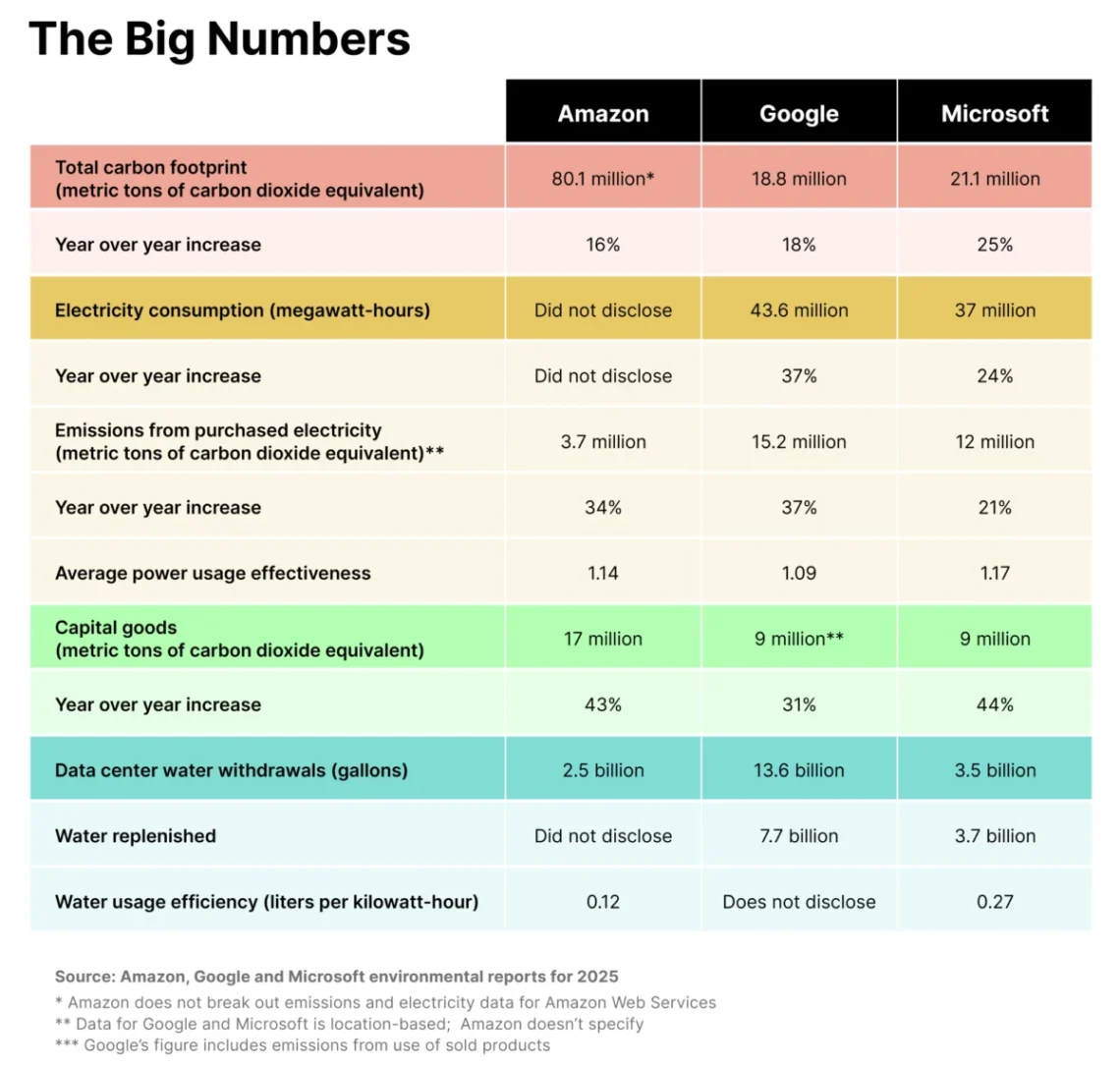
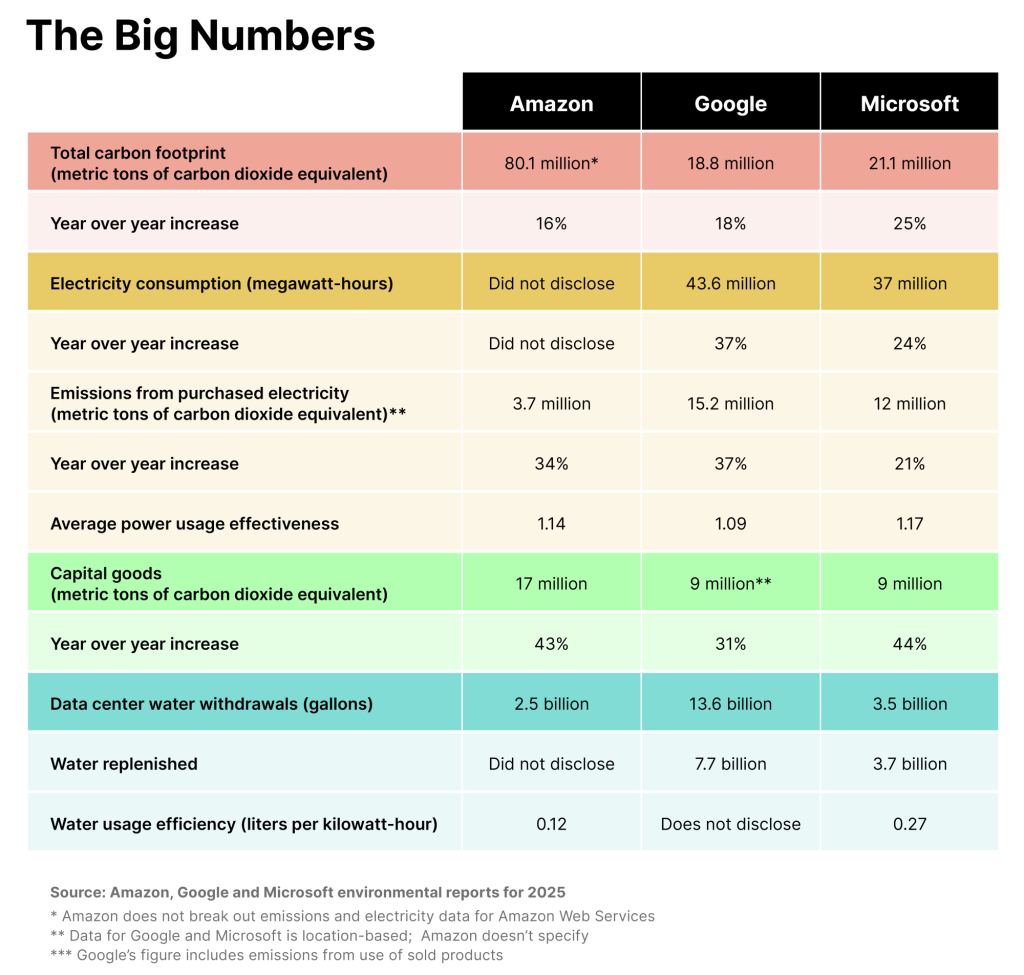
- 2025: The Surge. As reported in their June and July 2025 sustainability disclosures, the "AI effect" fully materialized. Google, for instance, saw its electricity consumption leap by 37 percent in a single year—a historical anomaly for the company.
- 2026 and Beyond: The Infrastructure Pivot. With the realization that intermittent renewables (wind/solar) cannot satisfy 24/7 "baseload" AI requirements, the focus has shifted toward nuclear energy and long-duration battery storage.
Supporting Data: The Magnitude of the Appetite
The scale of power consumption by these three corporations is now comparable to that of entire industrialized nations.
Google’s Record-Breaking Consumption
Google’s 2025 environmental report reveals that the company consumed 43.6 million megawatt-hours of electricity—roughly equivalent to the annual energy consumption of the state of Washington. Since 2019, Google’s power consumption has risen by 250 percent. Crucially, its location-based Scope 2 emissions (which measure the carbon intensity of the specific grids where data centers operate) jumped 37 percent year-over-year.
Microsoft and Amazon’s Footprints
Microsoft, while slightly more efficient in its growth curve, still reported a 21 percent increase in location-based Scope 2 emissions, with total electricity consumption hitting 37 million megawatt-hours. Amazon, known for its opaque reporting, did not disclose its overall electricity consumption in its July 1, 2025, report. However, it confirmed a 34 percent increase in Scope 2 emissions, leaving analysts to wonder about the underlying grid mix powering its global Amazon Web Services (AWS) infrastructure.

The Efficiency Metric: PUE
To manage this, the companies track Power Usage Effectiveness (PUE)—the ratio of total power used by a data center to the power delivered to computing equipment.
- Google: 1.09 (Leading the pack)
- Amazon: 1.14
- Microsoft: 1.17
While these numbers are impressive, they hide a sobering reality: even if a data center is perfectly efficient, the source of the electricity remains the primary driver of climate impact.
Official Responses: The Bottleneck Defense
In their 2025 disclosures, the companies were remarkably candid about the friction between their corporate goals and the reality of the global energy landscape.
"As the rapid evolution of AI is increasing our energy needs, the shift to clean energy is hitting major bottlenecks," Google stated in its report. These bottlenecks include:
- Grid Interconnection Delays: The lead time for connecting new renewable projects to the national grid has become a multi-year hurdle.
- Fragmented Infrastructure: Regional grid variations make it difficult to maintain a consistent "carbon-free" footprint.
- The "Always-On" Challenge: Renewables are intermittent, yet AI data centers require 24/7, high-reliability power—a requirement that wind and solar cannot satisfy without massive storage solutions.
Microsoft and Amazon have echoed similar sentiments, framing the current emissions spike as a "transition phase" while they work to bring more advanced power sources online.
Strategic Implications: Nuclear and the Road Ahead
Despite the current setback, the tech giants remain publicly committed to their 2030 net-zero targets. Their strategy has evolved from simple PPA purchases to direct investments in the energy sector itself.
The Nuclear Bet
Nuclear energy is now the centerpiece of the tech industry’s decarbonization strategy.
- Amazon has moved aggressively, contracting nearly 2 gigawatts of nuclear capacity and securing deals for two new reactor projects in 2026.
- Microsoft is betting on next-generation fusion and small modular reactors (SMRs).
- Google is prioritizing firm capacity, specifically in Ohio, to ensure that its data centers have the "around-the-clock" power that wind and solar currently lack.
- Comparison: While the "Big Three" are moving quickly, Meta remains the industry outlier, having secured agreements for up to 7.7 gigawatts of nuclear power, signaling an even more aggressive move toward dedicated carbon-free base-load energy.
The Long-Duration Storage Revolution
Because battery technology for grid-scale storage has historically been limited to four-hour windows, the tech giants are now bankrolling "long-duration" storage startups. Google, in particular, is making significant bets on thermal and chemical storage technologies capable of keeping the lights on for days, not hours. Amazon is also building out solar-plus-storage projects, having deployed 2.3 gigawatts of such capacity by the end of 2025.
The Asia-Pacific Frontier
Perhaps the most daunting challenge lies in the Asia-Pacific (APAC) region. As AI growth explodes in emerging markets, these data centers are often tethered to coal-heavy local grids. Amazon currently supports 2.2 gigawatts of clean energy in the region, but that represents a fraction of its total 40-gigawatt global portfolio. Microsoft is attempting to bridge this gap through the Southeast Asia Clean Energy Facility, which has already funneled $230 million into early-stage projects. However, the gap between current energy needs and the availability of local clean power remains wide.
Conclusion: A High-Stakes Balancing Act
The tech industry is currently caught in a high-stakes balancing act. The competitive pressure to lead in AI development is immense; falling behind in compute capacity could mean ceding the future of the global economy. Yet, the environmental cost of this lead is becoming increasingly transparent.
The next five years will be the definitive test for Amazon, Google, and Microsoft. Can they successfully scale their "carbon-free" infrastructure to match their massive compute expansion, or will the "AI revolution" be remembered as the era that stalled the progress of the green energy transition?
For now, the companies are betting that the very technology they are building—AI-driven grid optimization and advanced materials science—will eventually provide the tools to solve the energy crisis they helped create. Whether that is a realistic solution or a delay tactic remains the most critical question for the tech sector’s future.