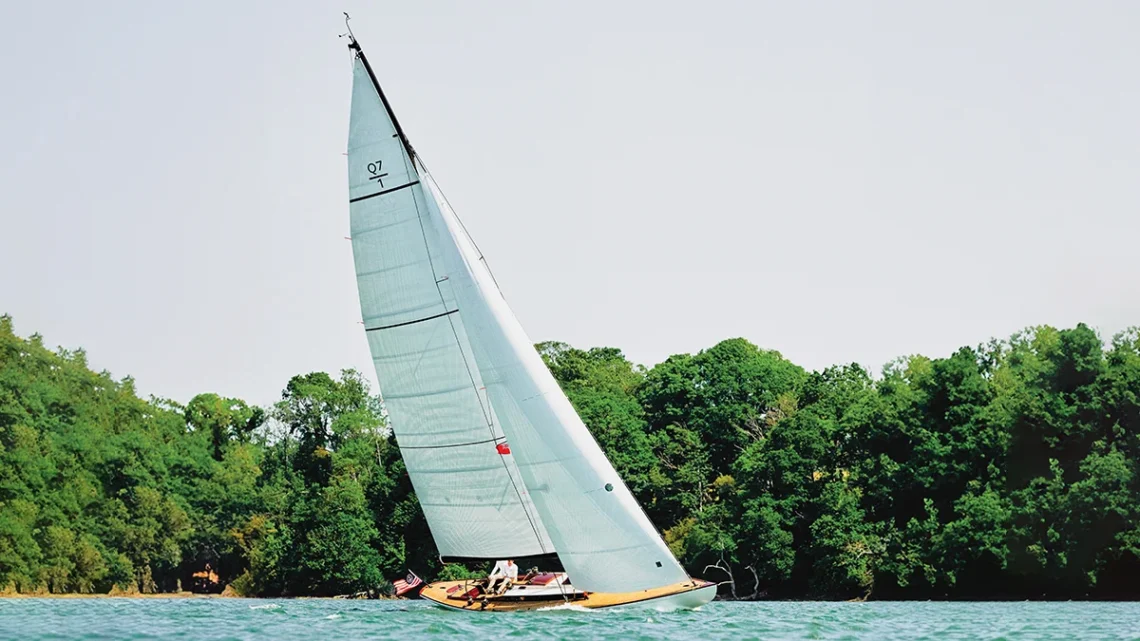
The art of classic yacht building has entered a bold new era with the completion of Victoria, the inaugural vessel of the reimagined Q-Class fleet. Conceived by Peter Silvester, founder of the San Diego-based startup Q7 Yacht Designs, the project bridges a century of nautical evolution. Victoria draws its direct lineage from Falcon, a legendary 1926 Q-Class racing sloop originally crafted by the esteemed Herreshoff Manufacturing Company in Rhode Island. Following a grueling, five-year restoration of Falcon in Maine, Silvester posed a visionary question: What would the original designers have created if they had access to a century’s worth of modern aerospace and marine technology?
The answer is the Falcon Study, executed in collaboration with renowned Dutch naval architecture firm Dykstra—famed for its work on modern J-Class yacht revivals—and built to meticulous standards by U.K.-based master craftsmen Spirit Yachts.
While Victoria maintains the breathtaking, head-turning lines of its 1920s archetype, it is fundamentally a creature of the modern age. Beneath its classic exterior lies a state-of-the-art cold-molded hull constructed from a sophisticated hybrid of traditional mahogany planking, advanced modern composites, and high-strength carbon fiber. Its contemporary rigging, state-of-the-art winches, and advanced autopilot systems allow for single-handed sailing in challenging marine conditions that would have forced its predecessor to stay securely tied to the dock.
Furthermore, the interior marries maritime utility with uncompromised luxury. Representing over 30,000 painstaking labor hours, the vessel features custom mahogany-and-veneer joinery, a fully equipped galley, a shower, fore-and-aft berths, and an electric head. To top off the bespoke experience, partnerships with luxury heritage brands Globe-Trotter and The Macallan yielded custom leather luggage and a curated collection of seven single-malt whiskies, anchored by a handcrafted whisky table that required more than 300 hours to build. Silvester’s ultimate vision extends far beyond a single floating masterpiece; he plans to commission a strictly limited global fleet of just seven hulls to ignite an international Q-Class racing circuit.
Chronology: From Rhode Island Royalty to San Diego Innovation
1926: The Birth of an Icon
In the golden age of American yachting, the Herreshoff Manufacturing Company launched Falcon, a magnificent 46-foot Q-Class racing sloop. Over the subsequent decades, Falcon carved an enviable legacy into the annals of competitive sailing. It amassed a storied racing resume, securing multiple decisive victories in elite competitions including the Chicago Yacht Club Race to Mackinac, the Silver Jubilee Series, and the prestigious Queen’s Cup. Falcon cemented its status as true Q-Class royalty, celebrated for its blistering speed, responsive handling, and timeless aesthetic beauty.
The 2020s: Restoration and Revelation
Decades later, maritime enthusiast Peter Silvester acquired Falcon. Recognizing the cultural and historical significance of the vessel, Silvester commissioned a comprehensive, five-year restoration project in Maine. Bringing the century-old racer back to peak competitive condition was a monumental undertaking, but it ignited a deeper philosophical question in Silvester’s mind. He began to wonder how naval architecture might have advanced if the original designers had modern synthetic fibers, carbon reinforcement, and automated sailing systems at their disposal.
The Conceptualization of Q7 Yacht Designs
Driven by this curiosity, Silvester established Q7 Yacht Designs in San Diego. He assembled a dream team of marine experts, partnering with the world-renowned Dutch naval architecture firm Dykstra—widely celebrated for successfully breathing new life into the historic J-Class fleet. Together, they drafted the "Falcon Study," translating the historical lines of Falcon into a digitally optimized, structurally advanced platform without sacrificing an ounce of its historic character.
Construction and Completion at Spirit Yachts
The blueprints were sent across the Atlantic to Spirit Yachts in the United Kingdom, a yard globally renowned for its mastery of modern wooden boatbuilding. Over the course of more than 30,000 labor hours, master shipwrights brought Victoria—named lovingly in honor of Silvester’s wife—to life. The vessel underwent rigorous sea trials, proving that the marriage of 1920s hull geometry and 2020s engineering could produce a yacht that is as fast as it is breathtaking.
Supporting Data & Technical Specifications
To fully understand the engineering triumph that is Victoria, one must examine the intricate blend of ancient craftsmanship and cutting-edge marine science utilized during its construction.
The Hull Architecture:Victoria utilizes a cold-molded construction methodology. This technique involves layering thin strips of traditional mahogany over structural frames, bonded with modern epoxy resins, and reinforced with advanced composites and carbon fiber. This results in a hull that is significantly stiffer, lighter, and more durable than the solid wood or early plank-on-frame builds of the 1920s, translating to superior hydrodynamic efficiency and structural integrity.
The Rigging and Sail Plan: Partnering with Quantum Sails, the design team developed a cutting-edge sail inventory. The mainsail and jib are engineered from high-tech synthetic fibers designed to withstand extreme wind loads and maintain optimal shape under stress. Visually, however, the sails mimic the appearance of traditional canvas, maintaining historical authenticity.
Labor and Craftsmanship: The vessel represents a staggering investment in human skill, requiring in excess of 30,000 labor hours from the artisans at Spirit Yachts. This includes the creation of custom deck hardware, mahogany-framed hatches, and an intricate interior layout.
Interior Amenities: Despite its identity as a high-performance day-racer, Victoria offers creature comforts thoughtfully integrated into its curved, warm mahogany interior. These include fore-and-aft sleeping berths, a functional galley, an enclosed shower, and an electric head.
The Bespoke Partnership Package:
The Whisky Table: Handcrafted as the centerpiece between two custom armchairs in the salon, this artisanal table required more than 300 hours of specialized woodworking to complete.
The Macallan Collaboration: The yacht comes packaged with a curated collection of seven single-malt whiskies, specially paired to commemorate the vessel.
Globe-Trotter Luggage: Owners receive bespoke leather luggage sets custom-tailored to fit the storage dimensions of the yacht.
Production Limits: Q7 Yacht Designs has restricted the entire project to just seven total hull allocations globally, positioning Victoria and its future sisterships as ultra-exclusive collector’s items.
Official Responses and Perspectives
The creation of Victoria has generated considerable excitement within the global maritime community. Key figures behind the project have shared their insights on what makes this reimagined Q-Class vessel a watershed moment for classic yachting.
Peter Silvester, founder of Q7 Yacht Designs and owner of both Falcon and Victoria, reflected on the emotional and philosophical weight of the build:
"Falcon really is Q-Class royalty. The boat had to be authentically Q-Class—as real to the essence of the original as we could get."
Silvester also emphasized the performance leap achieved through modern technology, humorously comparing the sailing experience of the new vessel to its predecessor:
"It’s a bit like sailing Falcon with the training wheels taken off."
Explaining the grand strategy behind limiting the production run to a tight-knit fleet, Silvester noted the transition from a solitary luxury item to a vibrant global community:
"One boat is an objet d’art. With seven, you have a chance of meeting fellow Q owners anywhere in the world."
Naval architects at Dykstra praised the project for its rigorous adherence to historical hydrodynamics, while the master shipwrights at Spirit Yachts highlighted the unique challenge of merging high-modulus carbon fiber reinforcement with traditional cold-molded mahogany aesthetics. Quantum Sails also expressed pride in engineering a sail wardrobe that successfully honors the visual heritage of 1926 while delivering the load-bearing performance required by contemporary competitive sailors.
Implications for the Future of Classic Yachting
The debut of Victoria carries profound implications for the luxury yachting sector, historic marine preservation, and competitive sailing culture. For decades, owners of vintage racing yachts faced an intractable dilemma: how to enjoy the unmatched aesthetic beauty and historical prestige of a 1920s racer without enduring the crushing maintenance burdens, fragile structural limitations, and physically punishing handling requirements of the era.
By demonstrating that modern materials—such as carbon fiber, epoxy resins, and automated winches—can be seamlessly integrated into a historically faithful hull form, the Falcon Study provides a viable blueprint for the future. It proves that maritime heritage does not have to be locked behind glass in a museum, nor does it have to be relegated to gentle, low-wind weekend harbor cruises. Instead, historic designs can be aggressively sailed, raced, and enjoyed with modern safety margins and performance parameters.
Furthermore, Silvester’s vision of establishing an international racing circuit for the seven-allocated Q7 hulls could breathe new life into one-design classic racing. Rather than competing in fragmented handicaps against vastly different modern vessels, an exclusive fleet of identical, high-performance Q-Class yachts would create a thrilling spectacle on the global regatta stage. It fosters a unique fraternity of owners who share a passion for uncompromising craftsmanship, high-speed maritime competition, and the timeless elegance of the Herreshoff legacy.
Ultimately, Victoria is more than just a magnificent private yacht; it is a bridge across a century of maritime history, proving that the pinnacle designs of the past can be successfully awakened to rule the waters of tomorrow.