
By Andrés Velasco
Published: September 18, 2026
Section: Politics & World Affairs
Main Facts
Across multiple continents, the political landscape is undergoing a profound and unsettling transformation. From the corridors of power in Europe to the dynamic republics of Central and South America, far-right political movements have secured unprecedented electoral gains, legislative footholds, and executive offices. For years, progressive and leftist analysts have offered a singular, reductive diagnosis for this global phenomenon: economic precarity. According to this orthodox narrative, stagnant wages, inflation, housing crises, and the erosion of the welfare state are driving desperate working-class voters into the arms of nationalist and populist demagogues.
However, a closer examination of political reality reveals a stark disconnect. Far-right leaders are routinely winning elections—or consolidating massive popular support—while championing vastly divergent economic agendas. Some endorse aggressive neoliberal deregulation and free-market capitalism, while others embrace state intervention, protectionism, and populist welfare spending.
The shared thread among these movements is not a unified economic prescription, but rather a mastery of cultural grievances, institutional distrust, and identity politics. By clinging to the belief that economic dissatisfaction is the sole catalyst for the far-right surge, the political left continues to misdiagnose the ailment, rendering its counter-strategies ineffective and leaving democratic institutions increasingly vulnerable.
Chronology
To understand how the current geopolitical landscape materialized, it is necessary to trace the convergence of global events, economic shocks, and political shifts over the past two decades.
-
2008–2012: The Global Financial Crisis and Eurozone Debt Crisis
The collapse of subprime mortgages in the United States triggers a worldwide recession, followed by crippling sovereign debt crises in Southern Europe. Austerity measures implemented by Brussels and national governments devastate public services. Initially, this fuels left-wing populism (such as Syriza in Greece or Podemos in Spain). However, as mainstream parties fail to deliver recovery, fertile ground is prepared for anti-establishment rhetoric of all political stripes. -
2015–2016: The European Migrant Crisis and Brexit
The arrival of over one million refugees and migrants, primarily fleeing the Syrian civil war, strains European integration frameworks. Simultaneously, the United Kingdom votes to leave the European Union, propelled by campaigns centered on national sovereignty and border control. Cultural anxiety regarding demographic change and national identity solidifies as a primary political driver. -
2018–2019: The Latin American Rightward Shift
Jair Bolsonaro is elected president of Brazil on a platform combining law-and-order authoritarianism, cultural conservatism, and market-friendly economics. This victory follows shifts in other parts of the region, signaling that Latin American electorates are increasingly disillusioned with traditional center-left governance and pervasive corruption scandals. -
2020–2022: The COVID-19 Pandemic and Institutional Stress
Global lockdowns, supply chain disruptions, and inflation generate widespread economic anxiety. Lockdowns and vaccine mandates become flashpoints for civil disobedience, allowing far-right movements to mobilize libertarian and anti-state sentiment across Western democracies. -
2023–2025: Electoral Breakthroughs Across Western Europe
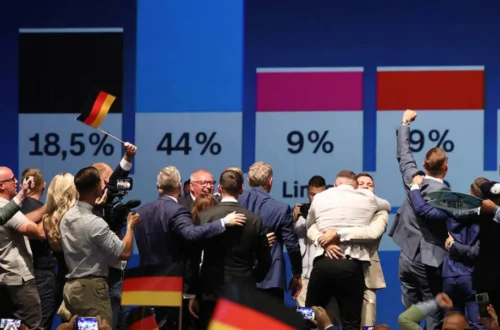
Far-right parties achieve historic milestones. In the Netherlands, Geert Wilders’ Party for Freedom wins a shock plurality in parliamentary elections. In France, Marine Le Pen’s National Rally secures unprecedented momentum in national legislative contests. Meanwhile, Alternative for Germany (AfD) polls at record highs across eastern and central German states, fundamentally altering the Federal Republic’s political equilibrium. -
A Few Months Ago (2026): The Brussels Symposium
At an academic event in the capital of the European Union, a speaker casually projects that by the time the conference convenes again, far-right governments could be holding power simultaneously in France, Germany, and the United Kingdom. In a telling testament to the normalization of this political shift, no one in the room refutes the premise.
Supporting Data
The divergence between economic performance and far-right electoral success undermines the monocausal "precarity" argument. Political scientists and economic data aggregators have tracked several key metrics that challenge conventional wisdom:
-
The Economic Variance Factor:
In countries like Germany, where social safety nets remain relatively robust compared to the Anglo-Saxon world, the AfD has surged primarily in regions experiencing rapid demographic transitions and perceived cultural dislocation, rather than sheer destitution. Conversely, in Argentina, Javier Milei rose to power during hyperinflation by promising radical libertarian restructuring, appealing to a populace exhausted by decades of Peronist economic mismanagement. The economic prescriptions of successful right-wing populists range from fierce protectionism (Le Pen in France) to anarcho-capitalism (Milei in Argentina). This proves that voters are not rallying around a coherent economic manifesto. -
Immigration and Cultural Salience:
According to multi-country European Social Survey data, voters who prioritize cultural preservation, national identity, and skepticism toward supranational institutions are up to three times more likely to vote for far-right parties than voters whose primary stated concern is personal income or taxation. -
Educational Polarization:
Modern electoral maps consistently reveal an educational divide. Non-college-educated voters in post-industrial towns frequently vote far-right, not solely due to low wages, but because they feel culturally alienated by cosmopolitan, university-educated urban elites who dominate traditional center-left and center-right parties. -
Institutional Trust Deficit:
Edelman Trust Barometer data from 2024–2026 indicates that public trust in mainstream media, national parliaments, and traditional political parties sits at historic lows across OECD nations. Far-right leaders capitalize directly on this systemic distrust, framing themselves as the sole authentic voices of "the people" against corrupt elites.
Official Responses
Political leaders, policy institutions, and intellectual figures across the globe have reacted to the persistent far-right momentum with varying degrees of alarm, denial, and strategic readjustment.
-
The Leftist and Progressive Consensus:
Mainstream progressive parties in Europe and the Americas continue to argue that the antidote to the far-right is aggressive wealth redistribution, higher minimum wages, and expanded social spending. Leaders in this camp maintain that if governments alleviate material poverty, the appeal of populist nationalism will naturally dissipate. Critics, however, argue that this approach ignores the deeply cultural and symbolic dimensions of the political shift. -
Center-Right and Establishment Adaptation:
Traditional conservative parties face an existential dilemma: whether to form sanitary cordons (isolation strategies) against the far right or to co-opt their rhetoric regarding borders and security. In several European capitals, center-right leaders have hardened their stances on immigration and integration, attempting to win back disaffected working-class voters by adopting elements of the nationalist playbook. This strategy has yielded mixed electoral results, often legitimizing far-right talking points rather than weakening their appeal. -
Far-Right Self-Assessments:
Far-right strategists and leaders are increasingly vocal about their opponents’ blind spots. In private briefings and public rallies, they emphasize that their success stems from offering a sense of belonging, purpose, and national dignity. They argue that progressive technocrats treat politics merely as an administrative exercise in resource allocation, ignoring the human need for community, tradition, and identity.
Implications
The failure of the political left—and indeed, mainstream democratic forces as a whole—to accurately diagnose the roots of the far-right surge carries profound implications for global stability and the future of democratic governance.
1. The Erosion of Democratic Norms
As far-right parties normalize their presence in parliaments and executive offices, institutional guardrails are systematically tested. Attacks on independent judiciaries, public broadcasters, electoral commissions, and civil society organizations become standard operating procedure. When democratic systems are defended purely on economic grounds—arguing that "GDP growth is good, therefore democracy is working"—they fail to inspire deep emotional loyalty when economic downturns inevitably occur.
2. The Bankruptcy of Technocratic Governance
For decades, center-left and center-right parties practiced a form of technocratic managerialism, treating politics as a problem-solving exercise best left to experts and economists. This approach hollowed out representative democracy, turning citizens into passive consumers of public policy rather than active participants in national life. The far right exploits this vacuum by restoring a sense of agency to voters, albeit through a divisive, exclusionary lens.
3. A Path Forward: Beyond Economic Reductionism
To counter the authoritarian-nationalist wave, democratic forces must abandon the comforting illusion that fixing the economy will automatically heal a fractured society. While economic justice remains an essential component of a stable polity, it must be paired with a compelling vision of civic nationalism, shared community, and renewed institutional trust.
Progressives and democrats must learn to speak credibly about borders, national identity, cultural cohesion, and public safety without abandoning their commitment to human rights and the rule of law. Until the political establishment recognizes that the crisis of the 21st century is fundamentally cultural and existential—rather than purely material—the drift toward far-right governance will continue unabated, altering the trajectory of democracies worldwide for generations to come.