Main Facts
Independent watchmaking is a realm dominated by nostalgia, where the revival of defunct historical monikers has become a reliable playbook. Yet, few contemporary microbrands execute this balancing act with the intellectual rigor and aesthetic discipline of the Elka Watch Co. Founded by Hakim El Kadiri—a veteran of the Swiss watch industry with deep roots in high-end design and product development—Elka initially surprised the market by resurrecting a dormant Dutch name. However, El Kadiri quickly anchored the venture firmly within Swiss soil.
Today, the brand takes its most evocative step yet, establishing permanent physical roots in the lakeside city of Neuchâtel by opening a flagship boutique at 16 Rue des Chavannes. To mark this milestone, El Kadiri has unveiled the Elka R Series: Tour des Chavannes, a pair of timepieces that bridges centuries of local civic history with contemporary microbrand watchmaking.
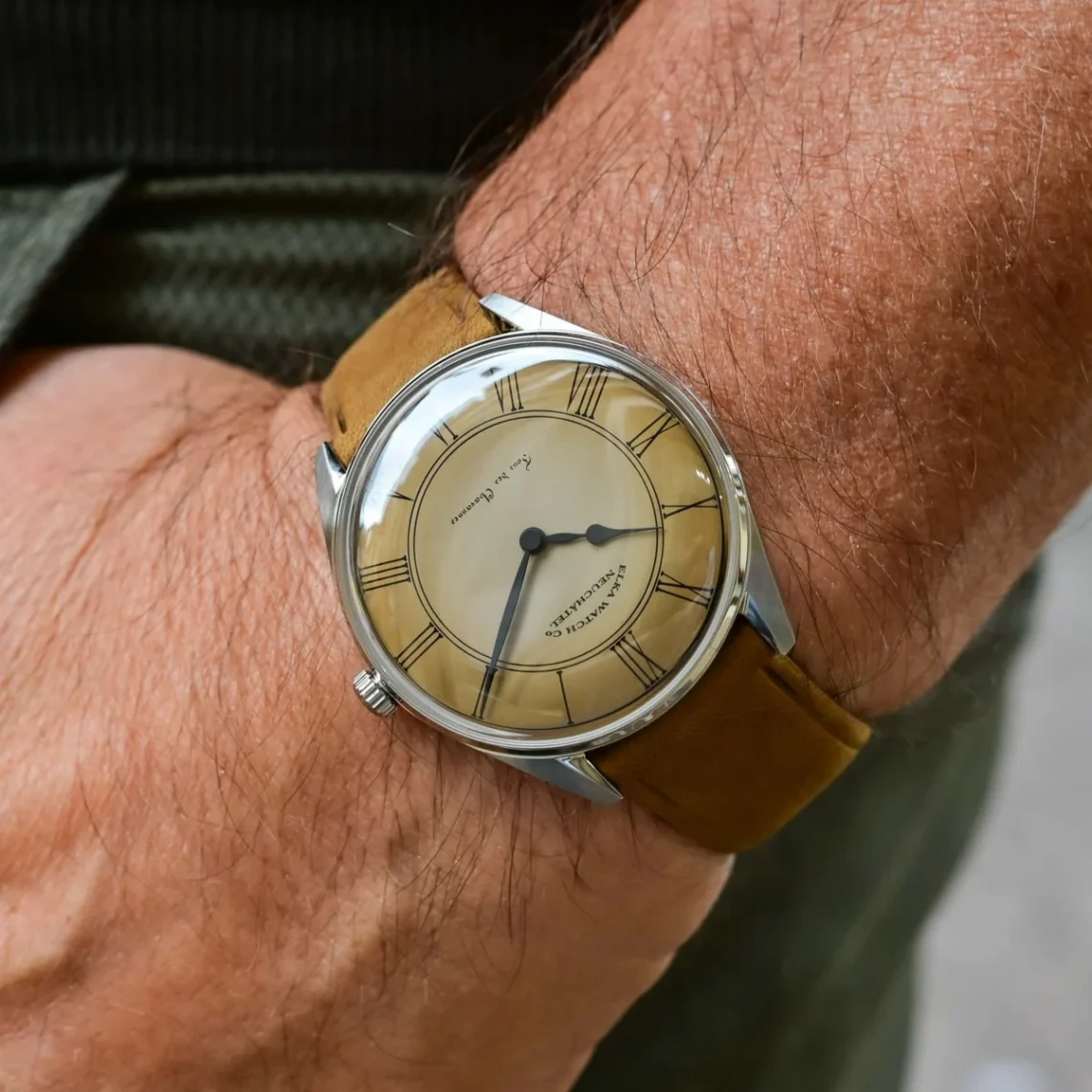
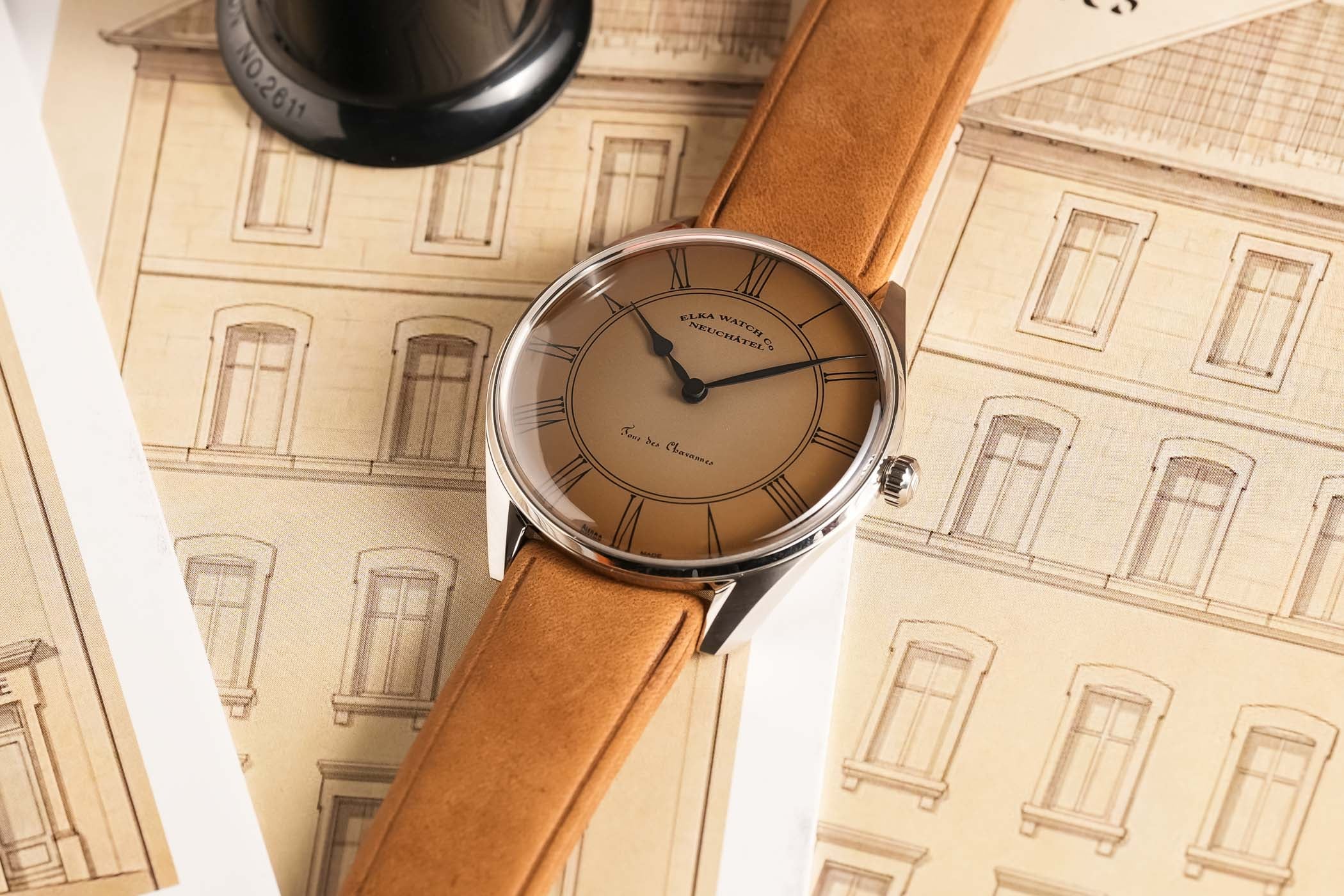
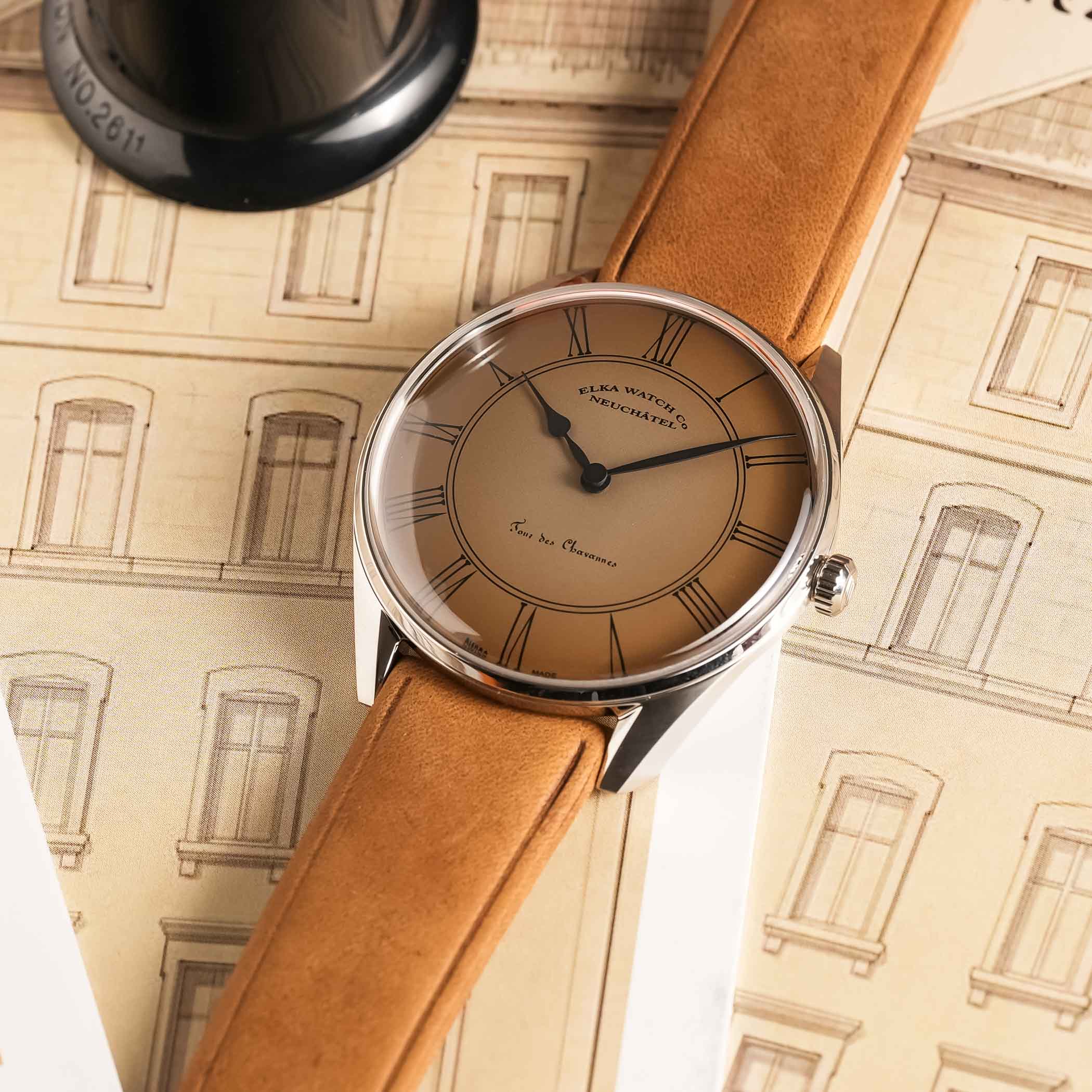
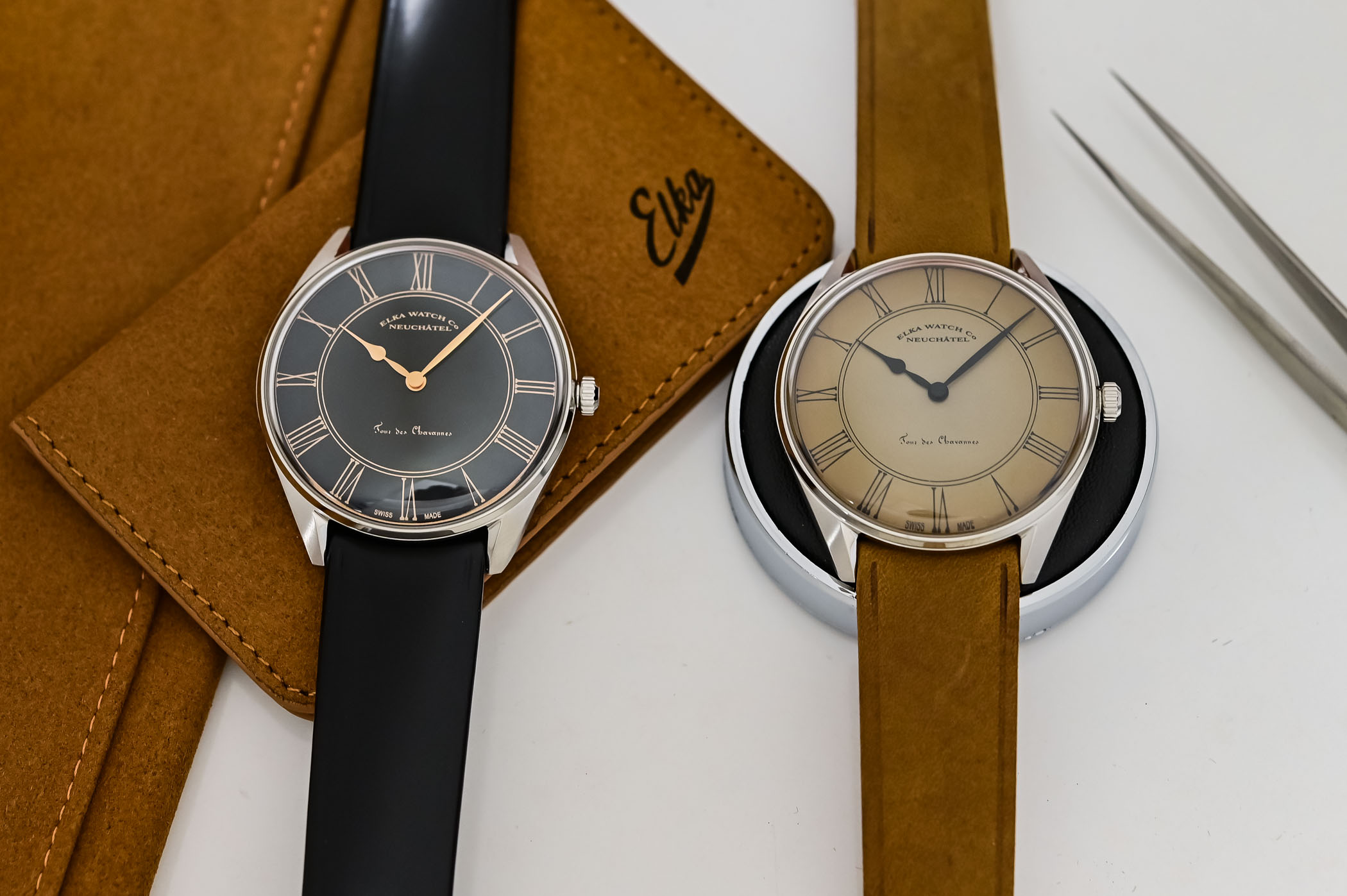
The new collection comprises two distinct references: the “Tour des Chavannes: Pierre d’Hauterive,” featuring a domed beige limestone-toned dial with blackened hands and numerals, and the “Tour des Chavannes: 1736 Edition,” presenting a sophisticated high-contrast black dial paired with rose gold-colored accents. Both models are powered by the robust, Swiss-made La Joux-Perret G101 automatic movement, offering a modern 68-hour power reserve. Eschewing central seconds hands and date windows to mirror the antique clocks that inspired them, these timepieces represent a masterclass in minimalist historicism.
Priced at CHF 1,716 (excluding taxes), the non-limited special editions are available directly through Elka’s newly minted Neuchâtel boutique and its official e-commerce platform. They represent not merely a watch release, but a manifesto for a brand that is physically and philosophically embedding itself in the cultural topography of Swiss watchmaking.
Chronology: The Life and Times of the Tour des Chavannes
To understand the emotional and historical weight of Elka’s latest release, one must journey back nearly eight centuries. The narrative of the Tour des Chavannes is a microcosm of urban evolution in the Swiss Confederation, spanning medieval fortification, penal reform, timekeeping innovation, and ultimate demolition.
1285: Construction and Defense
Erected in 1285, the Tour des Chavannes was built to close the upper terminus of the street of the same name. Its strategic purpose was to fortify the vulnerable northwestern flank of Neuchâtel’s medieval ramparts. In an era when city walls were matters of life and death, the tower stood as a stout sentinel, guarding the burgeoning civic life developing in the shadow of the nearby castle.
1531: The Javiole and Penal Reform
As the medieval era transitioned into the early modern period, the tower’s function expanded beyond pure military defense. Beginning in 1531, the structure was repurposed to house the javiole—a disciplinary prison designated for non-criminal, minor civic infractions. For over a century, the tower served as a sobering reminder of municipal law and order.
1679–1736: The Arrival of Horology
The tower’s destiny shifted toward horology in 1679, when municipal authorities installed the city’s very first clock mechanism within its stone walls. This was a significant civic upgrade, transforming a defensive and punitive structure into a communal temporal hearth. Nearly six decades later, in 1736, the tower received a dramatic aesthetic overhaul: a newly commissioned dial featuring elongated Roman numerals painted by heraldist and sign painter Samuel Müller.
1805: A Global Horological Milestone
Long before atomic clocks or internet time-servers, synchronization was a monumental human challenge. In 1805, the City of Neuchâtel achieved a major global innovation by officially distributing "mean time" directly from the Tour des Chavannes. This pioneering act of public time-distribution helped synchronize the daily economic and social rhythms of the town, cementing Neuchâtel’s status as an embryonic hub of precision time measurement.
1867: Demolition and Erasure
Despite its storied legacy, the Tour des Chavannes fell victim to urban modernization. Deemed unsanitary and increasingly obstructive to the expanding urban layout of 19th-century Neuchâtel, the ancient monument was demolished in 1867. Its stones were scattered, and its clock silenced, leaving only architectural drawings, engineering plans by Henri Ladame, and archival records to preserve its memory.
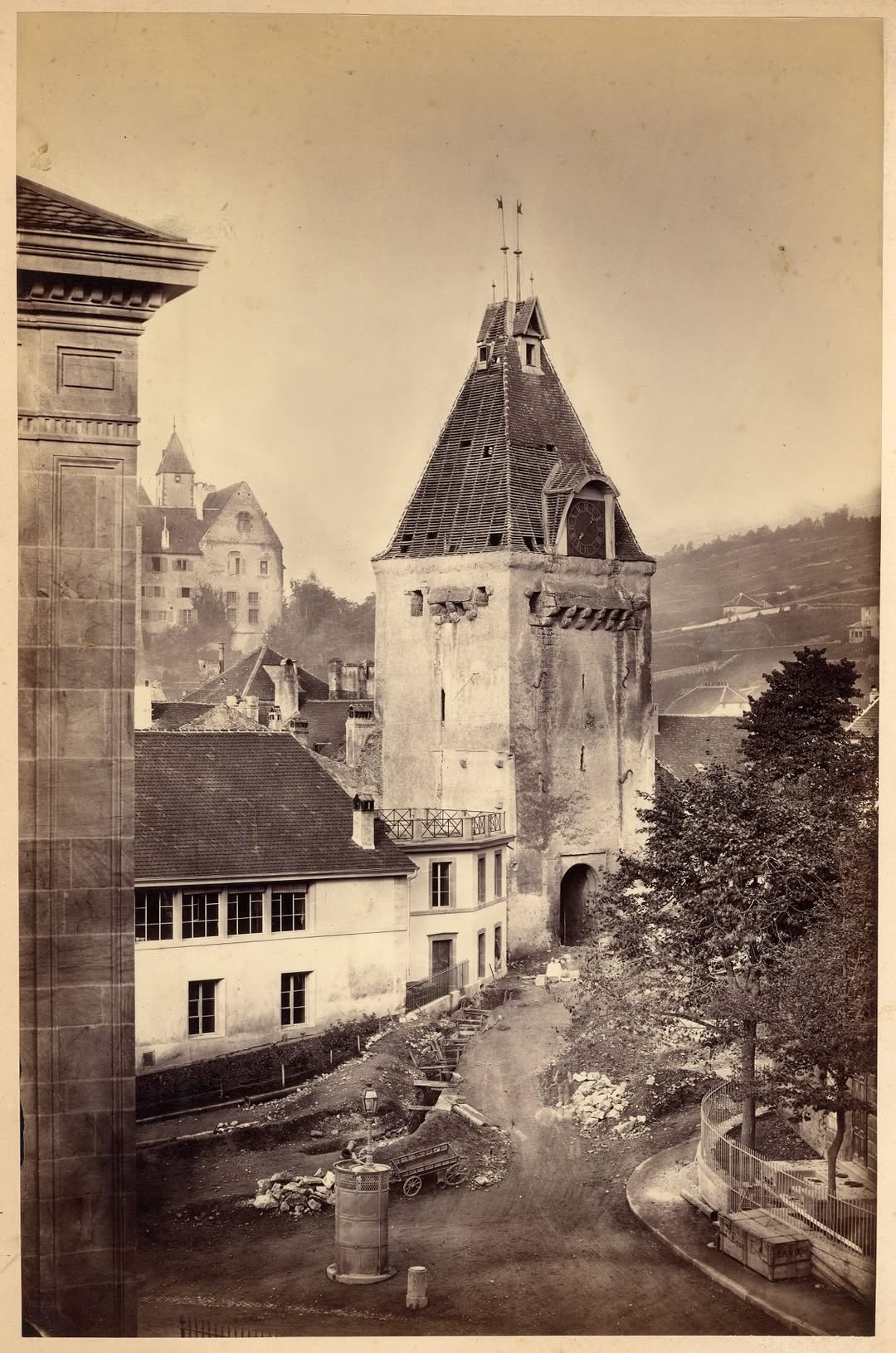
2026: Horological Resurrection
Nearly 160 years after its destruction, the Tour des Chavannes is resurrected not in stone and mortar, but in steel and sapphire. Through the vision of Hakim El Kadiri and Elka Watch Co., the structural heritage of the tower is preserved on the wrist, translating 18th-century typography and 13th-century geography into modern horological art.
Supporting Data & Technical Specifications
Elka Watch Co. has built its reputation on pairing vintage aesthetic sensibilities with thoroughly modern manufacturing tolerances. The R Series Tour des Chavannes maintains this ethos, utilizing high-grade materials and reliable mechanical engineering.
Case Architecture
- Material: Stainless steel, meticulously finished with alternating brushed and polished surfaces.
- Dimensions: 40.8mm diameter, a slim 10.8mm thickness, and a highly wearable 46.50mm lug-to-lug distance. The short, angled lugs ensure ergonomic comfort across a wide variety of wrist sizes.
- Crystal: High-dome, chevé-style box sapphire crystal treated with anti-reflective coating, thoughtfully designed to mimic the optical warmth and distortion of vintage Hesalite crystals.
- Caseback: Exhibition steel-and-sapphire caseback, allowing an unobstructed view of the decorated mechanical movement.
- Crown: Push-pull crown bearing the brand’s signature ergonomics.
- Water Resistance: 50 meters (5 ATM), suitable for daily wear and light exposure to moisture.
Dial Execution
The dials are the emotional centerpieces of the Tour des Chavannes editions, directly drawing from archival documents penned by engineer Henri Ladame and Samuel Müller’s 1736 clock face.
- "Tour des Chavannes: Pierre d’Hauterive" Edition: Features a domed, limestone-beige dial referencing the regional stone used in Neuchâtel architecture, contrasted with blackened hands and numerals.
- "Tour des Chavannes: 1736 Edition": Offers a dramatic, sophisticated black dial paired with polished rose-gold-colored hands and elongated Roman numerals, echoing the high-contrast aesthetic of the 18th-century tower clock.
- Display Layout: Pure two-hand configuration (hours and minutes), intentionally omitting seconds hands and date windows to respect antique clock designs.
Movement: La Joux-Perret G101
- Calibre: La Joux-Perret G101 automatic movement.
- Dimensions: 25.6mm diameter x 4.45mm thickness.
- Jewels: 24 jewels.
- Frequency: 28,800 vibrations per hour (4Hz).
- Power Reserve: A robust 68 hours, rendering the watch reliably "weekend-proof."
- Decoration: Fitted with Geneva stripes (Côtes de Genève), visible through the sapphire display back.
- Industry Standing: Positioned as a formidable, high-performance alternative to workhorse calibres like the ETA 2824 and Sellita SW200, offering superior power reserve and modern architecture.
Straps and Pricing
- Strap Options: Delivered on either a luxurious cognac-toned suede leather strap or a smooth black calf leather strap, equipped with a signed stainless steel pin buckle (20mm tapering to 18mm).
- Availability: Special edition production run (not strictly limited, but produced in controlled quantities), available immediately.
- Retail Price: CHF 1,716 / EUR 1,801 (excluding local taxes).
Official Perspectives and Brand Strategy
The launch of the Tour des Chavannes editions coincides with a pivotal strategic moment for Elka Watch Co.: the opening of its permanent boutique at 16 Rue des Chavannes. For founder Hakim El Kadiri, this physical retail footprint represents a graduation from digital-first microbrand status to an established, place-based horological institution.
In official statements surrounding the launch, El Kadiri emphasized that Elka’s identity cannot be separated from the geography of Swiss watchmaking. While the brand’s name nods to its Dutch historical origins, its soul, manufacturing network, and retail home are deeply entrenched in the Swiss Romandie region—specifically the triangle of Neuchâtel, La Chaux-de-Fonds, and Le Locle.
"When you walk down Rue des Chavannes today, you are walking through layers of history that defined how humanity measures time," El Kadiri noted during the boutique inauguration. "By opening our doors at number 16 and naming our new series after the lost tower, we are not just selling watches; we are acting as custodians of Neuchâtel’s civic memory. We wanted a watch that felt like a piece of the city itself—restrained, elegant, and deeply tied to the origins of public timekeeping."
Industry analysts have observed that this move signals a broader trend among successful independent microbrands. As the digital marketplace becomes increasingly saturated, brands that establish physical brick-and-mortar touchpoints in historic watchmaking capitals gain an immediate aura of permanence and authenticity. By weaving local archival research—such as Samuel Müller’s 1736 dial designs and Henri Ladame’s engineering plans—directly into the product, Elka transcends standard retro-design tropes, offering collectors a legitimate piece of localized heritage.
Implications for the Independent Watchmaking Landscape
The introduction of the Elka R Series Tour des Chavannes carries several significant implications for the broader independent and microbrand watchmaking sectors:
1. Elevating Historical Narratives Beyond the Jura Valley
While major Swiss legacy houses routinely mine their own archives for commemorative editions, independent microbrands have historically relied on generic military, aviation, or racing motifs. Elka demonstrates that local civil history—civic towers, municipal clocks, regional geology (such as the Pierre d’Hauterive limestone)—can provide a richer, more differentiated storytelling toolkit than overdone military tropes.
2. The Maturation of the Microbrand Business Model
The transition from a purely online-direct-to-consumer model to opening a physical boutique in Neuchâtel illustrates the maturation of independent watchmaking. Consumers spending upward of CHF 1,500 increasingly seek tactile, experiential engagement with the brand. By rooting itself in a physical street address that shares its name with its flagship product, Elka creates an immersive retail narrative that digital-only competitors struggle to replicate.
3. Technical Upgrades as Standard Expectations
The inclusion of the La Joux-Perret G101 movement highlights a quiet revolution in the sub-CHF 2,000 market. Modern collectors are growing fatigued by basic, entry-level movements with standard 38-to-42-hour power reserves. By integrating a modern 4Hz architecture boasting a 68-hour weekend-proof power reserve, Elka ensures that its vintage-inspired aesthetics are backed by contemporary mechanical utility.
4. Minimalism Informed by Heritage
In a market saturated with minimalist dress watches that risk feeling sterile or generic, the Tour des Chavannes proves that minimalism can be rich with character when anchored by authentic historical typography and regional color palettes. By stripping away the seconds hand and date window, Elka forces the wearer to engage with time in a more contemplative, unhurried manner—a fitting tribute to a city that helped teach the world how to synchronize its clocks.