DETROIT — For anyone who has ever owned a pickup truck or a rugged body-on-frame SUV, changing a flat tire on the side of a rain-slicked interstate or a muddy backcountry trail is a rite of passage best forgotten. It usually involves dragging a heavy, dirt-encrusted full-size spare out from the abyssal depths beneath the truck bed, wrestling with a corroded hand-crank, lying face-down in roadside gravel, and straining your lower back to lift a heavy wheel onto the hub.
Recognizing this universally despised automotive chore, Ford has developed a potential game-changer. A newly surfaced patent application reveals that the Blue Oval is engineering a clever mechanical solution: a movable, folding spare-tire mount designed to lower the wheel directly to the ground while keeping the driver completely upright and clean.
Initially spotted by the eagle-eyed researchers at Ford Authority, the United States Patent and Trademark Office (USPTO) filing—bearing the serial number 12773055 and officially dated March 18, 2024—tackles one of the most mechanically archaic and physically demanding aspects of roadside emergency maintenance. While automakers routinely file patents for concepts that never see production, this innovation sheds light on how engineers are actively rethinking utility, ergonomics, and safety in modern trucks.
Main Facts: How Ford’s Movable Spare-Tire Rack Works
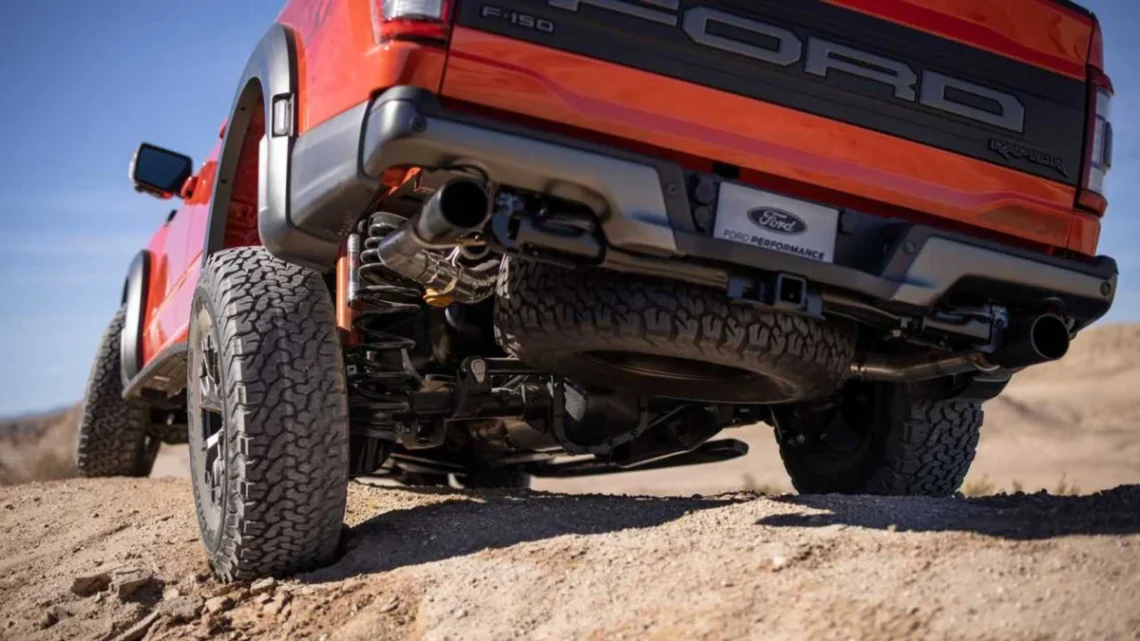
At its core, the newly patented system reimagines the traditional under-vehicle spare tire carrier. Standard pickup trucks and large SUVs typically stow their full-size spare wheels in an underbody cradle, hoisted aloft by a vertical steel cable or winch mechanism. Accessing the wheel requires inserting a segmented rod through the rear bumper, attaching it to a winch mechanism, and spinning it endlessly to lower the tire inches at a time, followed by awkward tugging to free it from safety hooks.
Ford’s innovative design abandons the simplistic vertical drop in favor of an articulating, multi-pivot folding arm assembly. According to the patent illustrations, the system is mounted directly to the vehicle’s high-strength steel frame rails.
When engaged, the mechanism does not just drop straight down; instead, it pivots and extends outward, actively carrying the spare away from the dirty underbody environment and presenting it near the ground, completely clear of the vehicle’s footprint.
This outward translation offers immediate practical benefits. By swinging the wheel clear of the truck’s underside, drivers no longer have to wedge themselves underneath a hanging vehicle component in tight spaces, deep mud, snow, or sloping highway shoulders. Furthermore, the patent outlines a built-in positioning function: the folding arm is engineered to hold the wheel steady and align it directly against the vehicle’s wheel hub while the driver threads the lug nuts. This eliminates the agonizing requirement of balancing a heavy truck tire and wheel assembly on one’s knees or feet while simultaneously trying to line up the bolt pattern.
Chronology: From Concept to Discovery
The timeline of this innovation highlights the deliberate, methodical pace of automotive research and development:
- March 18, 2024: Ford officially files patent application serial number 12773055 with the United States Patent and Trademark Office (USPTO), detailing the mechanical assemblies, folding linkages, and hub-alignment features of the movable spare-tire mount.
- Late 2024 / Early 2025: The patent winds its way through the preliminary review stages of the federal patent office, quietly logged into public intellectual property databases without immediate mainstream fanfare.
- Recent Weeks: Industry publication Ford Authority unearths the filing during a routine scan of fresh automotive intellectual property, bringing the folding spare-tire rack to the attention of wider enthusiast and mainstream automotive outlets.
- Present Day: Automotive analysts and truck owners alike debate the feasibility, durability, and eventual production potential of the design, weighing its ergonomic advantages against the realities of modern manufacturing and cost-cutting trends.
Supporting Data: The Evolution and Decline of the Spare Tire
To understand why Ford’s patent is generating significant interest, it helps to examine the broader context of how modern vehicles handle flat tires.
For decades, the full-size spare tire was an absolute given on every vehicle sold in North America. However, the automotive landscape has shifted dramatically over the last fifteen years. According to industry studies by automotive data providers, a rapidly growing percentage of new passenger cars, crossovers, and compact SUVs no longer come equipped with a spare tire at all.

Instead, manufacturers have increasingly substituted traditional spare wheels with temporary mobility kits—which typically consist of an electric 12-volt air compressor and a canister of liquid tire sealant—or have relied on run-flat tire technology. These substitutions are driven by several powerful industry pressures:
- Weight Reduction and Fuel Economy: Removing a heavy steel or alloy wheel, a jack, and a lug wrench can shave 40 to 60 pounds off a vehicle’s total curb weight. In an era governed by stringent corporate average fuel economy (CAFE) standards and carbon emissions caps, every ounce matters.
- Packaging and Interior Space: Eliminating the spare tire well allows automotive designers to carve out additional under-floor cargo storage, accommodate larger hybrid battery packs, or lower the vehicle’s floor for improved passenger room.
- Cost Savings: Omitting a fifth wheel and tire combination saves automakers substantial sums per unit on raw materials and logistics.
Despite these industry-wide trends, body-on-frame pickup trucks and large SUVs remain the steadfast holdouts for full-size spare tires. Vehicles like the Ford F-150, Ford Super Duty, Ford Expedition, and Lincoln Navigator are routinely subjected to heavy towing, payload hauling, and off-road excursions where liquid sealants and temporary inflation kits are utterly useless against sidewall punctures or catastrophic tread separations. Because these trucks must carry heavy, full-size spare tires, drivers are still subjected to the grueling physical labor of underbody spare retrieval—making Ford’s mechanical patent particularly relevant to this specific segment.
Official Responses and Industry Context
True to form, Ford Motor Company has maintained a pragmatic, measured stance regarding the publication of its patent application. When asked about the filing, representatives for the automaker reiterated standard corporate policy regarding intellectual property: patent applications are a routine and necessary way to protect creative engineering ideas and build a robust corporate portfolio.
Automotive manufacturers file thousands of patents every year for mechanical components, user-interface layouts, structural reinforcements, and aerodynamic accessories. Company spokespersons routinely emphasize that the publishing of a patent blueprint is never a formal promise or guarantee that the concept will eventually make its way into a production assembly line.
Industry analysts point out that automakers frequently patent ideas simply to stake a legal claim in a specific technology space, preventing rival brands from locking down the same intellectual property. Whether a mechanism like the movable spare-tire mount ultimately transitions from a digital blueprint on the USPTO website to a physical checkbox on a truck’s options sheet depends heavily on a strict cost-benefit analysis.
Engineering Hurdles and Market Viability
If Ford were to seriously consider bringing this folding spare-tire rack to market, engineers would have to overcome several formidable design challenges:
- Cost and Complexity: A traditional steel winch cable is cheap, lightweight, and mechanically simple. Replacing it with an articulating, multi-pivot folding arm, integrated actuators or manual linkages, and a built-in lug wrench significantly increases the bill of materials and assembly complexity.
- Environmental Exposure: Underbody components on trucks are subjected to immense abuse. They live in a brutal microclimate of road salt, flying gravel, deep mud, standing water, and road grime. Any intricate folding mechanism featuring multiple joints, pivots, and alignment pins would require robust weather-sealing and corrosion-resistant coatings to prevent seizing over years of neglect.
- Weight Penalty: Ironically, a heavy-duty mechanical rack designed to make handling a spare tire easier might add its own dead weight to the vehicle, partially undercutting efficiency gains.
Implications: What This Means for Future Trucks
Even if the movable spare-tire mount remains strictly on paper, its conceptual existence speaks volumes about the future trajectory of truck design. Modern automotive engineering is experiencing an unprecedented golden age of ergonomic problem-solving.
In recent years, automakers have realized that utility vehicles are no longer purchased solely by hardened commercial laborers willing to suffer through physical discomfort. Today’s trucks are daily drivers, luxury family haulers, and weekend adventure vehicles purchased by a remarkably diverse demographic. Consequently, features that simplify difficult or physically demanding tasks—ranging from multi-function tailgates and integrated bed steps to power-deployable running boards—have become major selling points.
Ford’s patent fits squarely into this customer-centric philosophy. If a future generation of the F-150 or Super Duty were to feature a powered or assisted swing-out spare tire carrier that doubled as a hub-alignment tool, it would instantly eliminate one of the most universally dreaded roadside tasks in motoring.
As automotive competition heats up across the truck segment—pitting Ford against heavy hitters like Chevrolet, GMC, Ram, and Toyota—every detail matters. Whether this folding rack materializes on a dealership lot or remains a fascinating footnote in the annals of the United States Patent and Trademark Office, it proves that Ford’s engineering teams are still deeply focused on solving the everyday annoyances of vehicle ownership.