In the hyper-competitive world of ultra-luxury real estate, a new phenomenon has emerged that mirrors the internet’s obsession with physical self-optimization. If "looksmaxxing"—the digital-age trend of maximizing one’s physical attractiveness through rigorous protocols—is about the body, "landmaxxing" is about the sovereign territory. It is a strategic, high-stakes race among the world’s elite to acquire, consolidate, and control as much surrounding land as possible, effectively transforming individual residential plots into sprawling, private fiefdoms.
According to Coldwell Banker Global Luxury’s 2026 Mid-Year Report, this trend is no longer a niche hobby for the eccentric; it is a full-scale market movement. Data indicates that searches for land have climbed 97 percent year-over-year, while inquiries for "one-of-a-kind" assets—including historic castles, private islands, and expansive estates—have surged by 146 percent. For the modern billionaire, the home is no longer defined by the square footage of the structure, but by the extent of the horizon they can claim as their own.

The Genesis of the Compound: A Chronology of Consolidation
The shift toward land-hoarding did not happen overnight, but rather as a reaction to the post-pandemic migration patterns of the ultra-wealthy. As high-net-worth individuals flocked to tax-friendly, waterfront enclaves in South Florida and similar global hubs, they encountered a fundamental reality: there is a finite supply of prime land.
- 2020–2022: The initial "flight to quality" began. Billionaires sought out private, expansive properties to escape urban density. The focus was on the house itself—the amenities, the home offices, and the gyms.
- 2023–2024: As inventory tightened, buyers realized that a beautiful home is only as good as its neighbor. If an unsightly development or a high-traffic construction project occurred next door, the value and privacy of the primary residence plummeted. This sparked the "defensive acquisition" phase, where owners bought adjacent properties simply to maintain the status quo.
- 2025–Present: The "Landmaxxing" era. The focus has moved from defensive purchasing to aggressive, long-term assembly. Buyers are now looking at neighborhoods with the intention of buying out the entire block, creating massive, multi-generational compounds that function as private gated communities within existing neighborhoods.
Supporting Data: The Scarcity Premium
The economic engine behind landmaxxing is simple: supply inelasticity. In prime markets like Miami’s Indian Creek Island, Palm Beach, and the Venetian Islands, you cannot manufacture more waterfront.

Coldwell Banker’s findings reveal that 40 percent of luxury real estate specialists report that buyers are now entirely indifferent to the condition of an existing structure. If a property sits on a prime piece of land, it is a target for acquisition, regardless of whether it is a historic villa or a "dated" mansion. The structure is often viewed as a temporary placeholder, to be demolished or repurposed for the ultimate prize: the dirt itself.
This has birthed the "neighbor’s premium." In the current market, it is not uncommon for a billionaire to pay 20 percent above market value—often in an unsolicited, off-market deal—just to secure an adjacent lot before it hits public listings. This "neighbor’s premium" ensures that the buyer controls the neighborhood’s aesthetic, its security protocols, and its future development potential.

Official Perspectives: The Experts Weigh In
Industry leaders are finding that their role has shifted from real estate agents to strategic consultants. "It’s about controlling their lifestyle and their surroundings," says Angel Nicolas of Serhant. "Your home isn’t just the four walls you live in; it’s the entire experience of the neighborhood around you. If you have the chance to own what’s next door, it can give you both peace of mind and flexibility for the future."
Samantha Curry of Douglas Elliman echoes this sentiment, noting that for the ultra-wealthy, land is the ultimate currency. "South Florida has become the epicenter of landmaxxing," she observes. "We have seen an unprecedented level of wealth relocating here while our inventory for trophy waterfront properties is limited. The only way to secure the scale and privacy today’s high-net-worth buyers demand is through land assemblages."

Dina Goldentayer, also of Douglas Elliman, points to the tactical nature of these deals. "When land is this limited, control is key," she says. "Unsolicited off-market offers have become standard practice in neighborhoods like Indian Creek. We aren’t just selling homes; we are selling the ability to dictate the environment."
Case Studies: The Billionaire Blueprint
The strategy of landmaxxing is perhaps best exemplified by the portfolios of the world’s most recognizable figures:

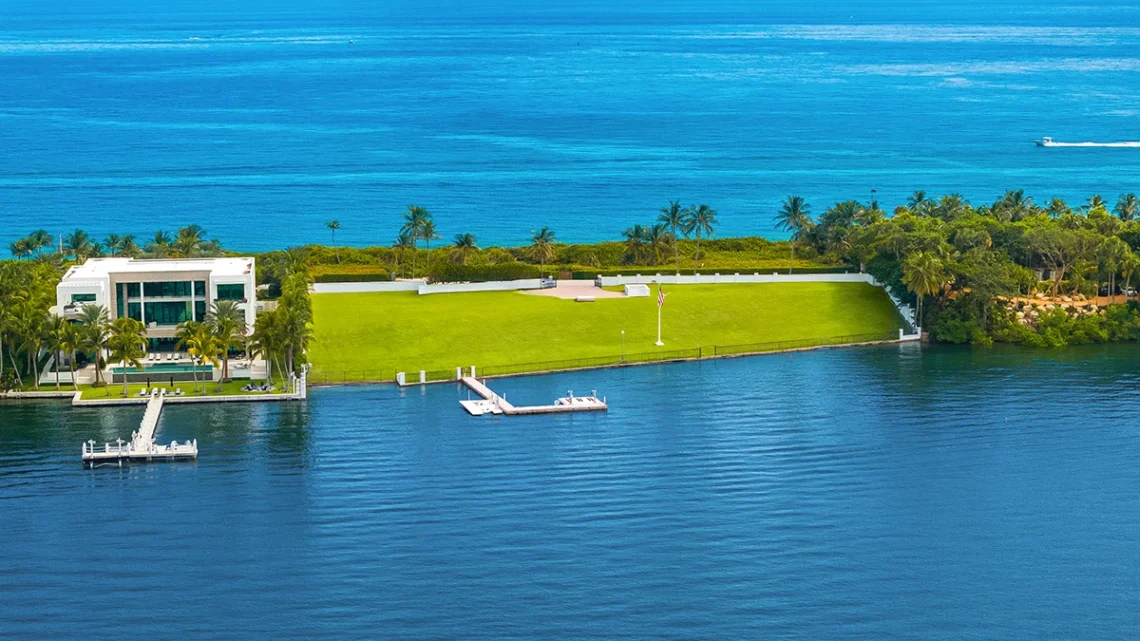
- Jeff Bezos and Indian Creek: The Amazon founder has committed approximately $234 million to consolidate three separate waterfront estates on Miami’s "Billionaire Bunker" island. By stitching these parcels together, Bezos has effectively locked down a massive stretch of prime Florida coastline, ensuring that no unwanted development can ever encroach upon his personal sanctuary.
- Ken Griffin’s Palm Beach Empire: Citadel’s founder has spent over a decade systematically piecing together roughly 25 contiguous acres in Palm Beach. This is not merely a residence; it is a long-term development project aimed at creating one of the most valuable, secure, and self-contained private residences in the world.
- The Manalapan Intervention: Perhaps the most radical example occurred recently in Manalapan, where a four-acre parcel, originally intended for a $285 million spec mansion, was pulled off the market. Rather than allowing a massive new development to change the character of the area, billionaires Larry Ellison and David MacNeil intervened, splitting the parcel between them to expand their existing estates. The home was never built; the land was simply absorbed.
The Self-Contained Lifestyle: Why Space Matters
Why the sudden, voracious appetite for more space? The answer lies in the "self-contained lifestyle." Today’s elite expect their home to be a total ecosystem. Chad Carroll of Compass notes that the threshold for a "luxury" lot has shifted drastically. "Five years ago, buyers were happy with a 20,000- to 30,000-square-foot waterfront lot," he says. "Today, they are looking for true compounds with 200-plus feet of waterfront and two or more acres."
This extra space is being utilized for a new wave of high-end amenities that were once only found in private clubs. Buyers are installing:

- Wellness Wings: Featuring infrared saunas, cryotherapy chambers, cold plunges, and medical-grade red-light therapy rooms.
- Sporting Complexes: Private padel and pickleball courts have become de rigueur, requiring significant acreage that older, smaller plots cannot accommodate.
- Guest Compounds: Rather than having guests stay in the main house, owners are building multi-family estates where family members or staff can live in proximity without sacrificing the owner’s privacy.
Implications: The Future of Property Ownership
The long-term implications of landmaxxing are profound. As the ultra-wealthy continue to hoard land, the "middle-upper" tier of the luxury market finds itself squeezed out. The consolidation of neighborhoods into single-family compounds reduces the number of available homes, further driving up prices in a market that is already supply-constrained.
Moreover, this trend represents a fundamental shift in the definition of wealth. For the 21st-century billionaire, the ultimate flex is no longer the size of the house, the number of garages, or the brand of the architecture. It is the ability to exert total control over one’s surroundings. It is the power to stop a neighbor from building a taller home, to ensure total silence, and to effectively "fence off" a piece of the world.

As landmaxxing becomes the standard for the global elite, we are witnessing the creation of a new kind of feudalism. In a world where digital space is infinite and ephemeral, the ultra-wealthy are doubling down on the one thing that remains stubbornly, beautifully finite: the earth beneath our feet. In the era of landmaxxing, the greatest luxury is not just owning a home—it is owning the horizon.