For decades, the global climate conversation was defined by the vocabulary of cooperation: emissions targets, carbon credits, and mutual aid. It was a diplomatic landscape where climate-driven disasters—like the catastrophic flooding in Mozambique in early 2026—were framed as "collective failures." In these instances, the victims were often the world’s most vulnerable, and the perpetrators were nebulous, abstract, and global. No bills were sent; no invoices were paid.
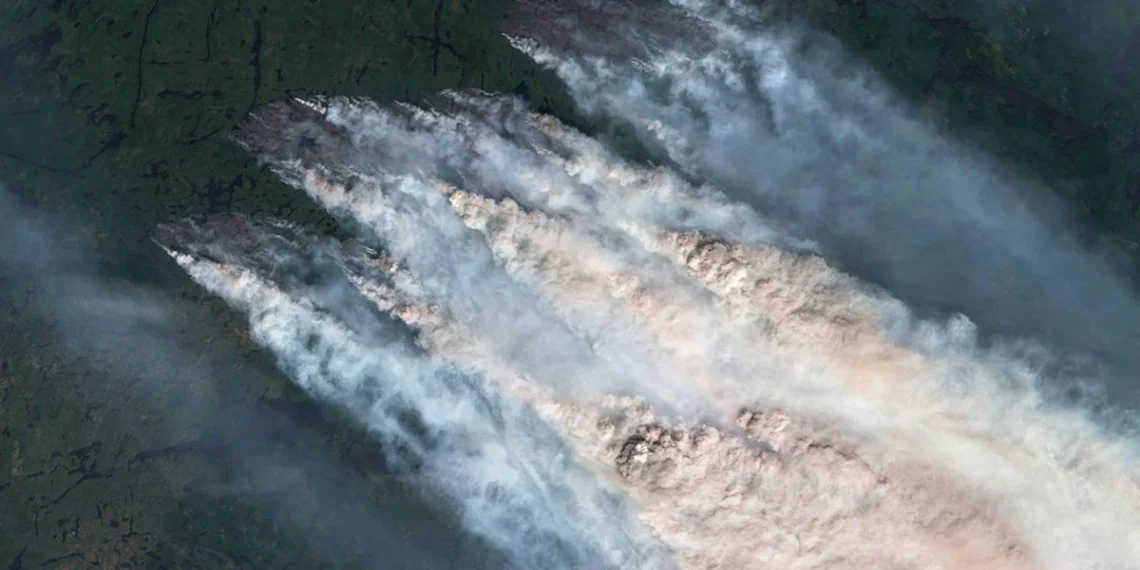
However, the geopolitical landscape has shifted violently. As thick, orange smoke from Canadian wildfires drifted across the U.S. border in 2026, obscuring the skylines of New Jersey and New York, the U.S. government abandoned the rhetoric of cooperation. President Donald Trump, citing an "unnecessary invasion" of foreign pollution, moved to levy punitive tariffs on Canada. This unprecedented act marks a dangerous transition: climate change has moved from the realm of insurance and environmental policy into the volatile arena of trade and national security.
The Chronology of a Crisis: From Smoke to Sanctions
The trajectory toward this "climate-security conflict" was not sudden, but a culmination of mounting environmental and political pressures.
- December 2025 – February 2026: Southern Africa experiences unprecedented rainfall. Mozambique’s Gaza province is devastated; 700,000 people are affected, 200,000 are displaced, and 300 are dead. World Weather Attribution confirms climate change increased the intensity of the event by 40%. The global response remains one of sympathy, not liability.
- Spring 2026: A severe wildfire season ignites across the Canadian wilderness. As the smoke drifts south, it blankets the American Northeast, coinciding with the lead-up to the World Cup, a major international sporting event hosted in the region.
- Mid-2026: President Trump declares the smoke an actionable national security threat. He frames the Canadian government’s forest management as "willful negligence."
- The Tariff Announcement: The U.S. administration moves to impose retaliatory tariffs on Canadian goods, claiming the revenue will offset the economic damage caused by the wildfire smoke.
The Paradox of Policy: The Carney Dilemma
The irony of this dispute is centered on Canadian Prime Minister Mark Carney. A former central banker, Carney spent years as the world’s most vocal advocate for climate financial risk disclosure. He coined the term "tragedy of the horizon," urging the financial sector to treat climate change as a tangible, quantifiable threat to global stability.
Now, as Prime Minister, Carney finds himself in a pincer movement. He is besieged by domestic coalitions demanding the expansion of the oil and gas sector and simultaneously pressured by a U.S. administration that is using trade coercion to force more fossil fuel extraction. The irony is stark: the man who once warned that the world must account for climate-related financial risk is now being billed for the physical consequences of that same climate reality. This episode confirms a grim prediction: science is no longer the primary arbiter of climate costs; instead, those costs are being weaponized by whichever nation wields the most coercive economic power.
Supporting Data: The Economics of Fragmentation
The decision to treat climate harm as a bilateral dispute carries severe economic risks. When a superpower decides to "bill" its neighbor for environmental damage, it accelerates the fragmentation of the global economy.
Research indicates that a "fortress" approach to climate policy—where nations prioritize self-protection over multilateral cooperation—will have profound consequences for global output. Estimates suggest that if Europe were to adopt such a restrictive position, it could lose approximately 14% of its potential economic output by 2050. Furthermore, the insurance industry is signaling alarm. Capital is increasingly being trapped behind borders as regional risk pools become too correlated to diversify. As insurance coverage retreats from high-risk zones, the cost of climate disasters will only become more localized, volatile, and difficult to manage.
Official Responses and the Precedent of Negligence
The US-Canada dispute is unique because it pits two G7 allies against one another, but the underlying logic is being scrutinized globally. Developing nations, long battered by climate events they did not trigger, are watching closely.
If the United States can levy a "smoke tariff" against Canada, the moral and legal argument for small island states to bill the world’s largest emitters for sea-level rise and extreme weather becomes significantly stronger. These nations have already approached the International Court of Justice (ICJ) for an advisory opinion. The U.S. action provides a dangerous—or perhaps, clarifying—precedent: if climate harm is an actionable interstate injury that can be quantified and priced, then the "polluter pays" principle may finally be moving from theory into aggressive practice.
Implications: A New Era of Climate-Security Conflicts
We have officially entered an era where physics and geopolitics collide. Smoke, floods, and drought-driven migration do not respect national boundaries, and as these events increase in frequency, they will inevitably trigger further "security" claims.
- The Himalayan Basin: India, Pakistan, and China are currently locked in a precarious dance over control of the rivers fed by Himalayan glaciers. As the ice retreats, the scarcity of water will turn these vital waterways into potential sites of conflict.
- The Mekong River: Six countries currently contest control over the Mekong. With changing weather patterns, the struggle for water rights is likely to escalate into a trade and security dispute similar to the U.S.-Canada tariff model.
- Migration and Dust: Senegal is already dealing with the increasing influx of Saharan dust from Mauritania, while Europe faces constant political pressure from climate-displaced populations. Each of these scenarios represents a "tariff" waiting to be levied.
Toward a Path of Adjudication
To prevent this slide into a chaotic "everyone-for-themselves" climate war, policymakers must pivot toward three urgent priorities:
1. Climate Resilience as Shared Security
The current trend of using tariffs to assign blame is a short-term political fix that obscures the long-term need for cooperation. Instead of weaponizing revenue, nations should pool resources. A portion of border levies—if they must exist—should be redirected into joint infrastructure projects, such as shared grid resilience and cross-border fire management.
2. Establishing International Adjudication
The world lacks a "common machinery" to adjudicate transboundary climate harms. We need a system grounded in science, not leverage. AI-driven models could help quantify contributions to climate harm and adaptation failures, providing an objective basis for loss-and-damage funds. Trade rules must be updated to clearly distinguish between legitimate carbon levies and coercive climate protectionism.
3. Decoupling Sovereignty from Fossil Fuel Dependency
The core of the current conflict lies in the assumption that climate costs are a result of "negligence" rather than the collective, global accumulation of carbon. By shifting the focus away from blaming neighbors, the international community must prioritize the creation of robust, global compliance markets. These markets should link emissions, market access, and, crucially, climate-adaptation finance.
Conclusion: The Smoke Clears, but the Threat Remains
The smoke over New Jersey eventually cleared, and the World Cup proceeded. But the precedent set during those weeks remains. Climate activists have long demanded that nations cooperate to prevent planetary harm; the reality, however, is that as those harms mount, governments are turning toward defensive, protectionist, and retaliatory measures.
The world’s first climate-security conflict does not inspire optimism. It reveals a global order that is increasingly ill-equipped to handle the stressors of a changing planet. Whether the international community can move beyond "billing each other at the border" and toward a more cohesive, science-based form of governance will define the remainder of the 21st century. There is still time to build a framework for climate justice, but the window for such a transition is closing as rapidly as the weather is changing.