Introduction & Main Facts
For decades, the pursuit of four-figure horsepower in the automotive aftermarket came hand-in-hand with an exhaustive list of compromises. Builders seeking 1,000 horsepower or more from a crate engine were inevitably forced to resign themselves to the stringent demands of dedicated race fuel, frequent teardowns, fragile valvetrains, and a temperament so finicky that a simple morning commute or cars-and-coffee cruise turned into a high-stakes game of thermal management and mechanical roulette. High-horsepower engines were historically designed for the strip, not the street—and certainly not for convenience.
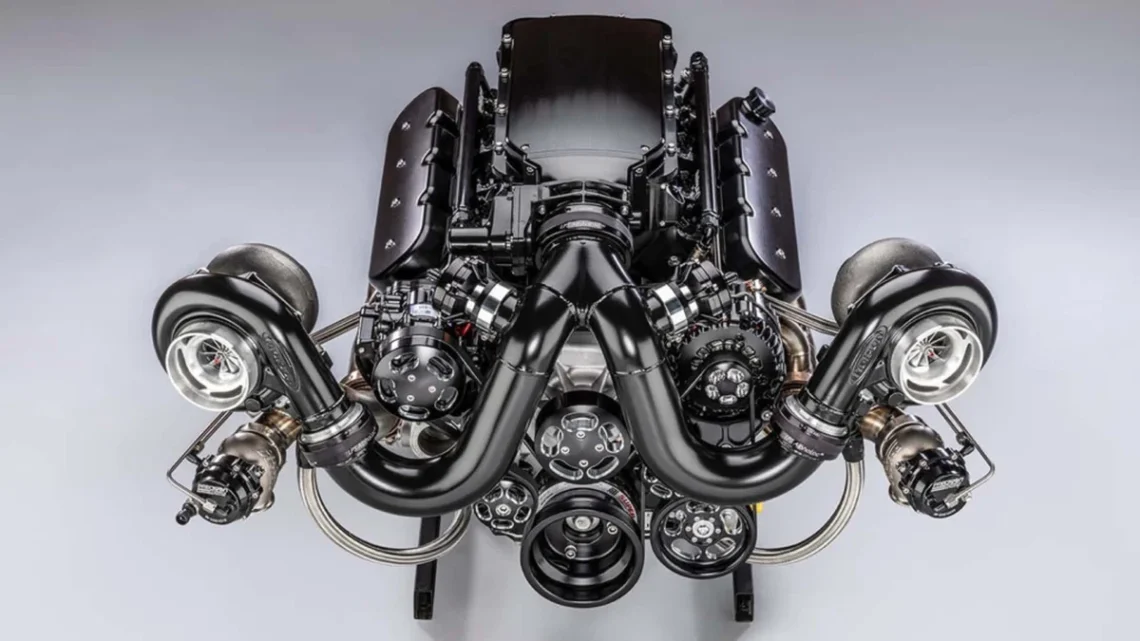
Enter Nelson Racing Engines (NRE), a powerhouse in custom engine building renowned for pushing the absolute boundaries of internal combustion. The company’s latest creation, the Intercooled Outlaw 427, shatters these traditional paradigms. Delivering an earth-shattering 1,200 horsepower on standard, everyday 91-octane pump gas—and scaling up to an astonishing 1,500 horsepower when fed high-octane race fuel—this LS-based V8 offers unprecedented output without demanding race-day maintenance.
Crafted to order and rigorously dyno-tested at NRE’s facility before finding a permanent home in a customer’s engine bay, the Outlaw 427 bridges the chasm between unruly, high-strung race engines and drivable, street-friendly powerplants. With a starting price of $41,999, it is an investment aimed squarely at builders of elite, no-compromise project cars who refuse to choose between supreme reliability and a four-digit power band.
The Anatomy of the Outlaw 427: Engineering Excellence
Despite a displacement nomenclature that might initially evoke memories of Ford’s legendary big-block V8s, the Outlaw 427 is firmly rooted in General Motors’ legendary LS architecture. Displacing 427.7 cubic inches (approximately 7.0 liters), this powerplant represents a masterclass in modern metallurgical engineering and forced-induction optimization.
The Foundation and Bottom End
To withstand the immense physical pressures of generating thousands of pounds of combustion force, NRE builds the Outlaw 427 around a heavily reinforced aluminum block equipped with iron cylinder sleeves. This provides the structural rigidity of iron where it matters most, without the excessive weight penalty of an all-iron casting. The block utilizes a robust six-bolt-per-cylinder head design, a critical upgrade over standard four-bolt LS configurations that prevents head lift under extreme boost pressures.
Deep within the crankcase lies a race-spec billet crankshaft, paired with heavy-duty forged connecting rods and custom-engineered pistons. This assembly is meticulously balanced to achieve a 9.0:1 compression ratio—a deliberate design choice that is low enough to safely mitigate destructive detonation under heavy boost on pump gas, yet high enough to maintain crisp throttle response and low-end drivability when cruising off-boost.
Cylinder Heads and Valvetrain
Airflow is the lifeblood of any high-output engine, and NRE leaves nothing to stock specification here. The Outlaw 427 features heavily ported, upgraded aftermarket cylinder heads mated to a proprietary custom camshaft profile. Every component within the valvetrain—from the springs and retainers to the pushrods and valves—is hand-selected and reinforced to endure the severe vibrational frequencies and thermal loads associated with sustained high-RPM operation.
Twin Turbos and Boost Control
The true heart of the Outlaw 427’s staggering performance lies in its forced-induction system. Nelson Racing bolts on a pair of its signature 72.0-millimeter Mirror Image Generation 2 turbochargers. These units feature advanced billet compressor wheels designed to spool rapidly and efficiently pump massive volumes of dense air into the intake tract.
Custom exhaust manifolds route exhaust gases smoothly into the turbine housings, while precision-engineered wastegates and blow-off valves work in tandem to regulate manifold pressure with surgical accuracy. An integrated intercooler drops the temperature of the compressed air charge dramatically before it enters the combustion chambers, ensuring maximum air density and thermal efficiency.
Chronology of Development: From Concept to Reality
The journey to creating a pump-gas, four-digit horsepower LS engine was neither accidental nor instantaneous. It represents the culmination of decades of trial, error, and technological evolution within the high-performance aftermarket sector.
Phase 1: The Quest for Reliable Four-Digit Power
Historically, achieving 1,200 horsepower required massive displacement, aggressive superchargers, or twin-turbo setups running extreme boost pressures paired with high-octane racing fuel (such as C16 or Q16). Engines tuned for such fuels ran rich, left heavy carbon deposits, required frequent oil changes, and suffered from fouled spark plugs if left idling in traffic. Nelson Racing Engines recognized a growing market demand among pro-touring enthusiasts and hyper-car builders who wanted modern supercar performance tucked inside classic muscle car bodies, but without the logistical nightmare of sourcing and storing race fuel.
Phase 2: Material Science and Thermal Management Breakthroughs
The breakthrough for NRE came not from a single component, but from the holistic integration of modern engine management systems, precise direct- or port-injection mapping, and advanced metallurgy. By combining six-bolt aluminum blocks with tightly toleranced billet internals, NRE solved the issue of block flex. Concurrently, advancements in intercooler core designs and turbocharger compressor aerodynamics allowed for lower intake air temperatures, which directly combats pre-ignition (detonation) and enables the engine to run safely on lower-octane 91 gasoline.

Phase 3: Dyno Validation and Commercial Launch
Before any Outlaw 427 leaves the Nelson Racing facility, it is strapped to an engine dynamometer and subjected to a punishing series of validation runs. Technicians tune the air-fuel ratios, ignition timing curves, and boost controllers under real-world simulated loads. The engine must successfully demonstrate its ability to lay down 1,200 horsepower at 7,200 RPM on standard 91-octane pump gas before it is certified for delivery. Once signed off, the engine is crated and shipped to builders worldwide, marking a new milestone in crate engine capability.
Supporting Data and Technical Specifications
To fully comprehend the engineering prowess behind the Intercooled Outlaw 427, a review of its core technical specifications reveals the sheer scale of its capabilities:
- Engine Architecture: GM-based LS V8
- Displacement: 427.7 cubic inches (approx. 7.0 liters)
- Block: Reinforced aluminum with iron cylinder sleeves (6-bolt head design)
- Rotating Assembly: Billet crankshaft, forged connecting rods, custom pistons
- Compression Ratio: 9.0:1
- Induction: Twin 72.0mm Mirror Image Generation 2 turbochargers with billet compressor wheels
- Horsepower (Pump Gas): 1,200 hp @ 7,200 rpm (on 91-octane)
- Horsepower (Race Gas): Up to 1,500 hp (with higher-octane fuel and appropriate tuning)
- Starting Price: $41,999 (built-to-order, dyno-tested)
Official Responses and Industry Reception
The announcement of the Intercooled Outlaw 427 has sent ripples of excitement throughout the automotive media landscape and the elite custom car-building community. While engine builders frequently throw around aggressive horsepower claims, Nelson Racing Engines has built a decades-long reputation for backing up its numbers with tangible dyno sheets and real-world performance on the street and track.
Industry analysts and enthusiast publications have lauded the engine for solving one of the most persistent gripes of high-end project car ownership: logistics. By eliminating the necessity of tracking down specialized fuel stations or drums of race gas just to take a Sunday drive, NRE has effectively lowered the barrier to entry for daily-drivable four-digit horsepower.
Furthermore, the pricing structure—starting at $41,999—has been a focal point of discussion. While undeniable that the cost of entry is equivalent to a brand-new mid-size sedan or a well-equipped factory crossover, industry veterans point out that building a custom, hand-assembled, twin-turbocharged LS engine to this exact specification independently would easily exceed the retail price once machining, component sourcing, and dyno tuning are factored in.
Implications for the Custom Car and Aftermarket Industry
The release of the Intercooled Outlaw 427 signals a profound shift in what enthusiasts can expect from aftermarket crate engines. As metallurgy, computer-aided design (CAD), and engine management systems continue to advance, the traditional compromises of high-performance builds are rapidly dissolving.
1. The Death of the "Trailer Queen" Compromise
For years, ultra-high-horsepower muscle cars, restomods, and pro-touring machines were relegated to trailer duty. Owners feared driving them to events due to overheating, fragile tunes, and fuel starvation. An engine like the Outlaw 427, capable of idling smoothly in 100-degree traffic on pump gas and instantly unleashing 1,200 horsepower with a press of the accelerator, empowers builders to drive their custom creations across continents without mechanical anxiety.
2. Setting a New Benchmark for LS Swaps
The GM LS platform has long been the undisputed king of engine swaps due to its compact dimensions, light weight, and virtually limitless aftermarket support. By pushing the ceiling of LS-based performance to 1,500 horsepower in a reliable, street-legal configuration, Nelson Racing Engines has elevated the humble LS into hyper-car territory, challenging exotic European multi-cylinder motors at a fraction of the cost.
3. Economic and Engineering Ripple Effects
As boutique builders adopt these ultra-high-output pump-gas engines, we can expect to see an evolution in supporting driveline components—including transmissions, driveshafts, differentials, and chassis stiffening kits—designed to harness this level of power without twisting a classic car’s frame into a pretzel. The aftermarket ecosystem must adapt to ensure that the rest of the vehicle can survive what the engine dishes out.
Conclusion: Motor1’s Take
We are not sitting here telling you that you need 1,200 horsepower for your next project car. For 99 percent of drivers, four digits of power under the hood is an exercise in absolute excess—a chaotic, tire-shredding manifestation of automotive engineering pushed to the outer limits of physics.
However, if you are going to build something completely, unapologetically ridiculous, you might as well do it right. Nelson Racing Engines’ Intercooled Outlaw 427 removes the logistical headaches, the fuel-sourcing nightmares, and the fragility typically associated with hyper-horsepower builds. It is a masterpiece of modern engineering that proves you can, in fact, have your cake, eat it too, and burn rubber all the way home on standard 91-octane pump gas.