
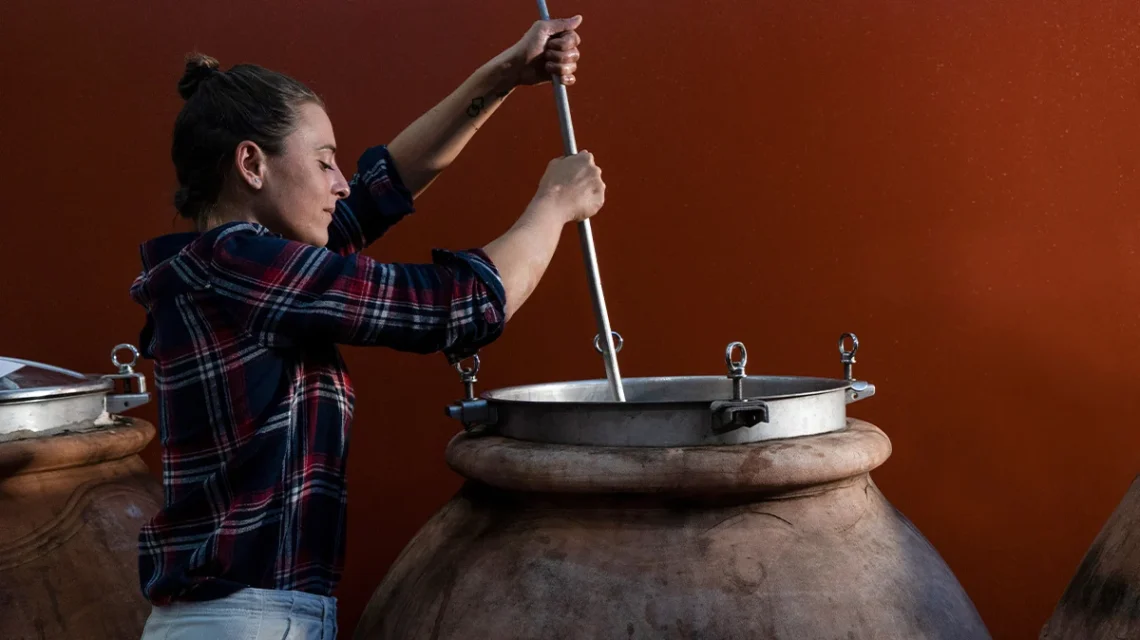
For centuries, the gleaming stainless-steel tank and the toasted oak barrel have reigned supreme as the gold standards of wine production. Oak, in particular, has defined the global fine-wine lexicon, lending familiar notes of vanilla, clove, and sweet smoke while softening robust tannins through gentle, micro-oxygenation.
Yet, across the sun-drenched hills of Tuscany, a quiet revolution is taking root. A vanguard of the region’s most forward-thinking estates is bypassing modern technological interventions and looking backward—all the way to antiquity—to revive a vessel that predates modern enology by millennia: the terra-cotta amphora.
What began as a fringe experiment among a handful of natural-wine purists has blossomed into a sophisticated, region-wide movement. Today, Tuscany’s premier winemakers are utilizing clay vessels not as a gimmick, but as a precise instrument to capture unadulterated expressions of terroir, highlighting the pure, unmasked voice of native grapes like Sangiovese.
Main Facts: The Renaissance of Clay
The resurgence of terra-cotta in modern Tuscan winemaking represents a fascinating bridge between ancient heritage and contemporary viticultural science.
- Historical Roots: Tuscany boasts a rich heritage of clay extraction and ceramic crafting that dates back to the Etruscans, who utilized local pits to produce fine terra-cotta vessels for wine storage and transport.
- The Physics of Clay: Unlike stainless steel, which is completely inert and airtight, or oak, which actively contributes chemical compounds, flavors, and aromas, terra-cotta occupies a unique middle ground. Its microscopic porosity permits a measured, continuous exchange of oxygen—similar to oak—while remaining chemically neutral.
- Terroir Transparency: Because terra-cotta does not impart wood-derived tannins, vanillin, or heavy toast characteristics, it allows the true aromatic, mineral, and structural profile of the grape variety and vineyard site to emerge unobstructed.
- Cellar Evolution: Leading estates are no longer treating amphorae as isolated science projects. Instead, they are integrating them into core production lines, leading to broader structural changes in regional winemaking, such as reduced sulfur usage and the phasing out of stainless-steel tanks.
Chronology: From Etruscan Innovation to Modern Revival
To understand how terra-cotta returned to the modern Tuscan cellar, it helps to trace the timeline of wine vessel evolution and the recent shift toward historical methods.
- Pre-Roman & Roman Antiquity: For thousands of years, civilizations across the Mediterranean—including the Etruscans in central Italy and the Georgians in the Caucasus—fermented and aged wine almost exclusively in large clay vessels buried in the earth or stacked in cellars.
- The Industrial and Oak Eras: As trade routes expanded and barrel-making techniques advanced, wood became the preferred medium for aging due to its durability, stackability, and the desirable flavor profiles it imparted. By the mid-to-late 20th century, temperature-controlled stainless steel revolutionized the industry, offering maximum hygiene and freshness control.
- The Turn of the 21st Century: A small group of pioneering natural winemakers began experimenting with revived ancient techniques, importing Georgian qvevri or sourcing local Italian clay to challenge the homogenization brought on by heavy oak usage.
- The Present Day (2020s): What started as isolated trials have matured into rigorous, institutionalized programs at top-tier commercial and estate wineries. Winemakers are mapping the exact physics of clay, pairing high-elevation vineyards with bespoke local vessels, and permanently altering their cellar ecosystems.
Supporting Data & Technical Mechanics: Why Terra-Cotta Works
To appreciate why estates are investing heavily in custom clay vessels, one must examine the distinct mechanical and chemical properties of terra-cotta compared to its industry rivals.
The Porosity and Oxygen Exchange
Oak barrels allow oxygen to interact with the wine, softening angular tannins and aiding in color stability. However, oak also transfers volatile organic compounds like lactones and phenols. Terra-cotta offers a controlled, porous breath of oxygen similar to wood, but without the aromatic footprint. As Marilisa Allegrini, owner of San Polo in Montalcino, notes: "Unlike oak, it does not impose another aromatic layer on the wine, while its porosity still allows a measured exchange with oxygen."

Thermal Inertia
Clay possesses high thermal mass, meaning it heats up and cools down very slowly. During fermentation, this natural insulation helps regulate internal temperatures smoothly, preventing dangerous heat spikes that can kill native yeasts or strip delicate aromatics, all without requiring heavy glycol-chilling jackets common in stainless-steel setups.
Micro-Textural Impact
A common critique of natural winemaking in terra-cotta is a perceived "grittiness" or unwanted sediment. However, modern producers emphasize that texture is controllable. Elena Casadei of Le Anfore di Elena Casadei explains that achieving a clean, precise mouthfeel is a matter of patience and natural settling:
"We aim to achieve clean, precise wines through time, natural settling, and careful management throughout the entire winemaking process, intervening as little as possible. For me, minimal intervention does not mean accepting imprecision."
Official Responses and Producer Insights
The shift toward amphora is best understood through the voices of the winemakers who work with the material daily. Their approaches range from scientific experimentation to deeply philosophical pursuits of cultural heritage.
Marilisa Allegrini (San Polo, Montalcino)
At San Polo, the estate contrasts its traditional Rosso di Montalcino (aged in large oak casks) with the San Polo Amphora Vignamasso Toscana IGT, both made from 100 percent Sangiovese harvested from neighboring high-elevation vineyards.
"Both wines share the mineral-driven character and lively acidity we associate with our vineyards, but their aromatic and textural profiles are quite different," Allegrini observes. "Oak tends to soften the wine while contributing sweet-spice notes, whereas amphora allows the savory character of our terroir to come forward more clearly, with a very different texture."
This experimentation has yielded unexpected operational benefits. Because terra-cotta is less porous than oak and entirely neutral, San Polo’s team discovered they could significantly reduce sulfur dioxide additions during winemaking.

Alessio Gorini (Avignonesi, Montepulciano)
As COO of Avignonesi—one of the foremost champions of Vino Nobile di Montepulciano—Alessio Gorini views amphorae as dynamic micro-laboratories. The estate produces specific IGT bottlings like Da’Di Rosso and Da’Di Bianco, utilizing distinct methods for each. The red undergoes a three-month skin-contact fermentation in Tuscan terra-cotta, while the white ferments without skins in ceramic amphorae.
"At Avignonesi, amphorae are first and foremost small laboratories for learning," Gorini states. He notes that the vessels give winemakers an unfiltered reading of the grape variety. Without wood masking the edges, variables such as whole-cluster fermentation impacts, native tannins, and variable acidity become glaringly clear. "Amphora helps us understand the identity of a grape and the consequences of individual winemaking decisions with unusual clarity."
Elena Casadei (Le Anfore di Elena Casadei)
For Elena Casadei, working with clay is both a localized celebration and a global homage. Operating across Tuscany and Sardinia, she utilizes local Impruneta clay amphorae alongside traditional Georgian qvevri—vessels protected by UNESCO cultural heritage status.
"I love the idea of making wine in Tuscany using Tuscan earth itself," Casadei says. Reflecting on her introduction to the medium by her father, Stefano, she adds: "I find it incredible that one of the oldest winemaking tools in history can still feel so contemporary today. Working with amphorae has taught me to observe, to taste, to wait, and above all to accept that not everything has to be the same every time."
Broader Implications: Shaping the Future of Fine Wine
The renaissance of terra-cotta amphorae in Tuscany is much more than a nostalgic nod to antiquity; it signals a fundamental philosophical shift in fine winemaking.
- Redefining "Quality" in the Cellar: For decades, heavy oak influence was heavily correlated with high-end, premium pricing in global wine markets. By proving that unmasked, highly transparent terroir-driven wines can command equal or greater respect, amphorae are helping reshape consumer palates toward purity and precision over oak dominance.
- Operational Transformation at Scale: What began as small-scale trials are graduating into structural overhauls. San Polo’s decision to completely phase out stainless steel in favor of a triad of concrete, oak, and amphora demonstrates that ancient materials are viable for commercial-scale luxury production.
- Climate Resilience and Adaptability: As rising global temperatures threaten to over-ripen grapes, yielding heavy, high-alcohol wines, winemakers are searching for methods to preserve freshness and acidity. The natural insulating properties of clay and the brisk, linear profiles it maintains offer a vital tool for adapting to changing climatic realities.
Ultimately, Tuscany’s embrace of terra-cotta proves that the path forward for fine wine often lies buried in the past. By marrying ancient craftsmanship with modern viticultural mindfulness, the region’s top estates are ensuring that their wines speak not of the barrel they rested in, but of the very earth from which they were born.