By Jeffrey Frankel
Cambridge | September 25, 2026
Main Facts
The United States political system is suffering from a profound and deepening crisis of governance, characterized by unprecedented polarization, legislative gridlock, and a complete breakdown of bipartisan consensus. While conventional political discourse frequently attributes this decay to runaway economic inequality and the unchecked influence of capital, a deeper and more insidious driver is at play: epistemic divergence.
Different segments of the American electorate no longer merely disagree on policy priorities or economic philosophies; they inhabit entirely separate realities defined by mutually exclusive sets of “facts.”
This fracturing of shared objective truth has rendered traditional democratic compromise nearly impossible. Consequently, any viable strategy to restore the health of American democracy cannot begin with economic redistribution—though that may be a downstream result. Instead, reform must start at the root of the problem: a widespread deficit in critical-thinking skills and media literacy across the populace.
Chronology: The Evolution of Modern American Polarization
To understand how the American political landscape arrived at this juncture of cognitive segregation, it is necessary to examine the historical trajectory of media, technology, and political strategy over the last several decades.
1. The Era of the Shared Broadcast (1960s–1980s)
For decades following World War II, the American electorate relied on a relatively centralized media ecosystem. A handful of major television networks (ABC, CBS, NBC) and major metropolitan newspapers provided a standardized baseline of news. While political bias certainly existed, citizens across the ideological spectrum generally consumed the same baseline facts regarding national events, economic indicators, and foreign policy developments. Disagreements were anchored in how to interpret these facts, not whether the facts themselves were authentic.
2. The Deregulation and Cable Expansion (1987–1990s)
The dismantling of the Fairness Doctrine in 1987—a Federal Communications Commission policy that had required holders of broadcast licenses to present controversial issues of public importance in a balanced manner—paved the way for the rise of partisan talk radio and 24-hour cable news. Networks quickly realized that outrage and ideological validation were more profitable than dry, objective reporting. This era planted the seeds for audience fragmentation.
3. The Digital and Social Media Revolution (2000s–2010s)
The advent of high-speed internet and social media platforms accelerated the fragmentation exponentially. Algorithms designed to maximize user engagement inadvertently created "echo chambers" and filter bubbles. Users were no longer just choosing a cable news channel; they were entering bespoke information ecosystems curated by algorithms that rewarded confirmation bias and punished cognitive dissonance.
4. The Post-Truth Era and Institutional Collapse (2016–Present)
By the mid-2010s, the erosion of trust in legacy institutions—including academia, mainstream journalism, the judiciary, and scientific bodies—reached a critical threshold. Political actors discovered that appealing to emotion and identity while discarding verifiable evidence was an exceptionally effective mobilization tool. The COVID-19 pandemic and subsequent national crises starkly demonstrated that even basic public health measures and economic data could be partisanized, cementing the reality that millions of Americans live in fundamentally different informational universes.
Supporting Data and Analytical Perspectives
While economic anxiety and income inequality remain central themes in contemporary political science, data suggests that cultural and epistemic divides are equally, if not more, predictive of political behavior.
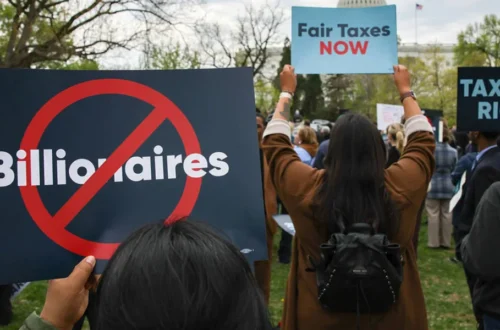
- The Growing Wealth Gap: According to Federal Reserve data, the top 1% of American households control over 30% of the nation’s wealth, while the bottom 50% hold less than 3%. Proponents of the inequality-first thesis argue this disparity breeds the resentment fueling populist movements on both the left and the right.
- The Epistemic Rift: According to studies by organizations such as the Pew Research Center, Republicans and Democrats not only prefer different policies; they frequently report entirely contradictory perceptions of basic economic realities, crime rates, and demographic trends. For instance, voters often believe the national economy is shrinking when it is growing, or vice versa, purely based on which party holds the White House.
- Media Trust Deficit: Gallup polling indicates that trust in mass media to report the news "fully, accurately, and fairly" has hovered near historic lows, with fewer than 35% of Americans expressing a "great deal" or "fair amount" of trust. Trust is heavily stratified by party affiliation, further entrenching partisan divides.
The Mechanism of Epistemic Polarization
When two groups operate from different sets of facts, democratic deliberation ceases to function. In a functioning democracy, negotiation relies on a shared framework: “We both agree on X (the data), but we disagree on how to respond to X (the policy).”
In modern America, the dynamic has shifted to: “I reject your X entirely, and my leaders provide me with Y, which suits my worldview better.” This renders compromise not merely difficult, but morally perilous to voters who view any concession to the opposition as a surrender to falsehood.
Official Responses and Institutional Reactions
Political leaders, educational reformers, and civil society organizations have begun responding to this crisis of institutional trust and cognitive divergence, though approaches vary widely across the political spectrum.
Legislative and Policy Approaches
Lawmakers on Capitol Hill remain deeply divided on how to address the symptoms of polarization:
- Democratic Proposals: Progressive and moderate Democrats frequently emphasize systemic reforms, such as voting rights legislation, campaign finance reform to limit dark money, and antitrust scrutiny directed at major technology companies to curb the monopolization of information.
- Republican Proposals: Conservative lawmakers generally focus on allegations of bias within social media platforms and educational institutions, advocating for "free speech" protections online, curriculum transparency in K-12 schools, and deregulation to combat what they describe as "cancel culture" and institutional groupthink.
Educational and Civic Initiatives
Outside of traditional partisan politics, a growing coalition of educators, psychologists, and nonprofit leaders is championing "media literacy" and "epistemic hygiene" initiatives.
- Curriculum Overhauls: Several states have introduced legislation requiring high schools to teach media literacy—specifically instructing students on how to evaluate sources, spot logical fallacies, verify digital imagery, and distinguish between news reporting, opinion, and sponsored content.
- Bridging Organizations: Grasscuts organizations such as Braver Angels and the National Institute for Civil Discourse are scaling programs that bring citizens from opposing political backgrounds together to dialogue not on hot-button policy issues first, but on shared human experiences, slowly rebuilding interpersonal trust.
Implications for the Future of American Democracy
The realization that political dysfunction is rooted in epistemology rather than mere economics carries profound implications for the future of the United States and global democratic governance.
1. The Limits of Economic Redistribution Alone
If policymakers focus solely on wealth redistribution—such as wealth taxes, universal basic income, or expanded social safety nets—without addressing the underlying cognitive fractures, the political system will likely remain dysfunctional. A wealthy electorate that operates in separate informational realities will simply find new cultural and epistemic battlegrounds over which to polarize. Economic security is necessary, but insufficient, for democratic health.
2. The Imperative of Cognitive Skill-Building
Addressing the crisis requires a generational investment in critical thinking. Educational systems must pivot away from rote memorization and toward rigorous analytical training. Citizens must be equipped to ask:
- What is the source of this claim?
- What evidence supports it?
- What are the financial or political incentives of the person making it?
- Am I accepting this information simply because it aligns with my preexisting beliefs?
3. A Long-Term Road to Recovery
Rebuilding a shared factual baseline will not happen overnight. It requires sustained effort from educators, technologists, journalists, and civic leaders. Technology platforms must be held accountable for algorithmic architectures that prioritize outrage over accuracy, while consumers must demand higher standards of intellectual rigor from their media sources.
Conclusion
The American political system is not broken because the nation lacks resources, nor is it irreparably doomed by economic inequality alone. It is broken because the connective tissue of a shared reality has frayed. Only by confronting this epistemic crisis head-on—by fostering critical thinking, demanding intellectual honesty, and rebuilding institutional credibility—can the United States chart a path back toward functional, representative democracy.