For decades, the name Furuno has been synonymous with heavy-duty commercial marine electronics and high-end systems built for large cruising yachts and professional sportfishers. Known for robust engineering and uncompromised performance, the brand carved out its reputation in the blue-water offshore market. However, as boating demographics shift and vessel designs evolve, the demand for enterprise-grade navigation technology scaled down to smaller vessels has grown exponentially.
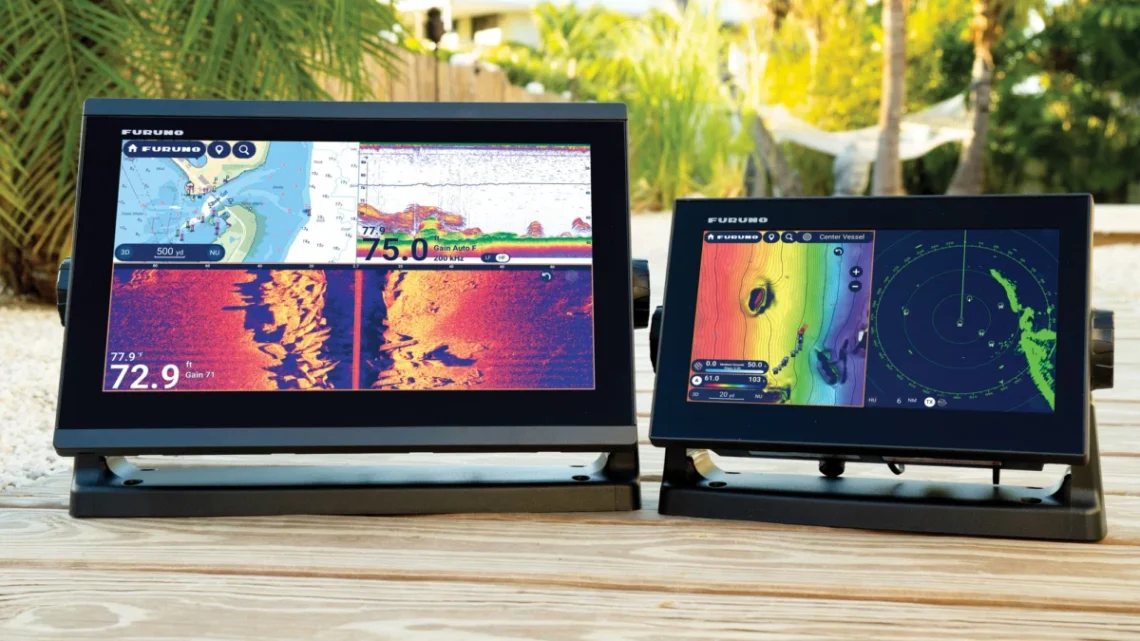
Addressing this market shift, Furuno has introduced two new families of compact, multitouch multifunction displays (MFDs): the TZMap and the TZtouchE. Available in tidy 9- and 13-inch footprints, these units pack advanced technologies—including AI-driven routing and Doppler-based collision avoidance—into accessible form factors. Ranging in price from $1,600 to $3,010, these displays bridge the gap between commercial-grade dependability and the spatial constraints of smaller center consoles, skiffs, second-station towers, and secondary staterooms.
Main Facts: What You Need to Know
The launch of the TZMap and TZtouchE series represents a strategic pivot for Furuno, bringing high-end features traditionally reserved for their flagship TZtouchXL series down to a more attainable price point and smaller physical envelope.
- The Lineup: The series comprises two distinct product families—TZMap (standalone units) and TZtouchE (networkable units)—each offered in 9-inch and 13-inch configurations.
- Pricing Structure:
- TZMap Displays: Retails from $1,600 to $2,400.
- TZtouchE Displays: Retails from $2,200 to $3,010.
- Core Processing Power: Despite the price difference, both series share identical high-performance processors, enabling advanced capabilities like AI Routing across all four models.
- Cartography & Updates: Both lines come pre-installed with NOAA vector charts for U.S. coastal waters and fully support TZ Maps by Timezero. Over-the-air (OTA) updates for cartography and operating systems are supported natively via Wi-Fi.
- Third-Party Integration: Utilizing HTML5 architecture and Furuno’s NavNet Command Center interface, the displays can natively control over 35 third-party marine systems, ranging from advanced battery-charging arrays to thrusters.
Chronology: Real-World Testing on the Water
The practical capability of these scaled-down screens was recently tested under real-world, high-stakes conditions on Florida’s Indian River.
As late evening transitioned into pitch darkness, Capt. Jeff Gauthier was navigating his Hewes Bayfisher 18 back to his home port of Stuart at a swift 30 knots. Operating in tight, low-visibility coastal channels at planing speeds is a scenario that tests the limits of both human reaction times and marine electronics.
During the run, Gauthier’s networked configuration—consisting of a Furuno TZtouch13E MFD paired with a DRS4D-NXT radar—suddenly triggered Doppler-based visual and auditory alerts. The system flagged a dangerous, moving or stationary target dead ahead in the center of the channel.
Reacting instantly, Gauthier adjusted his course to clear the hazard. Out of caution, he circled back to investigate the ominous red splotch rendered on his 13-inch display. Sweeping his spotlight across the water, he discovered the root ball of a massive palm tree protruding just above the waterline, surrounded by a dense, submerged mass of timber and root structure.
"It probably saved me a hole in my boat," Gauthier later remarked. For an entry-level footprint display, successfully preventing a high-speed structural collision in the dark served as a powerful proof of concept.
Supporting Data & Technical Specifications
While the TZMap and TZtouchE series share identical hardware processors, external dimensions, and streamlined operating system architectures, Furuno has deliberately structured the software boundaries and networking protocols to differentiate the two families based on user requirements.
TZMap: The Streamlined Standalone
Priced between $1,600 and $2,400, the TZMap series is engineered strictly as a standalone navigation system.
- Fish-Finding: Features integrated TruEcho Chirp, continuous-wave, and Chirp Side-Scan fishfinders. However, it cannot interface with downstream, high-power black-box sonars.
- Radar Limitations: Restricted to compatible Furuno analog and digital radome-enclosed radars. It does not support larger open-array radar sensors.
- Target Audience: Designed for smaller craft—such as bay boats and skiffs—where owners have no requirement for heavy open-array radars or complex, multi-station networks.
TZtouchE: The Networkable "Essential"
Priced from $2,200 to $3,010, the TZtouchE ("E" standing for Essential) mirrors the physical appearance of the TZMap line but unlocks advanced networking and sensor capabilities.
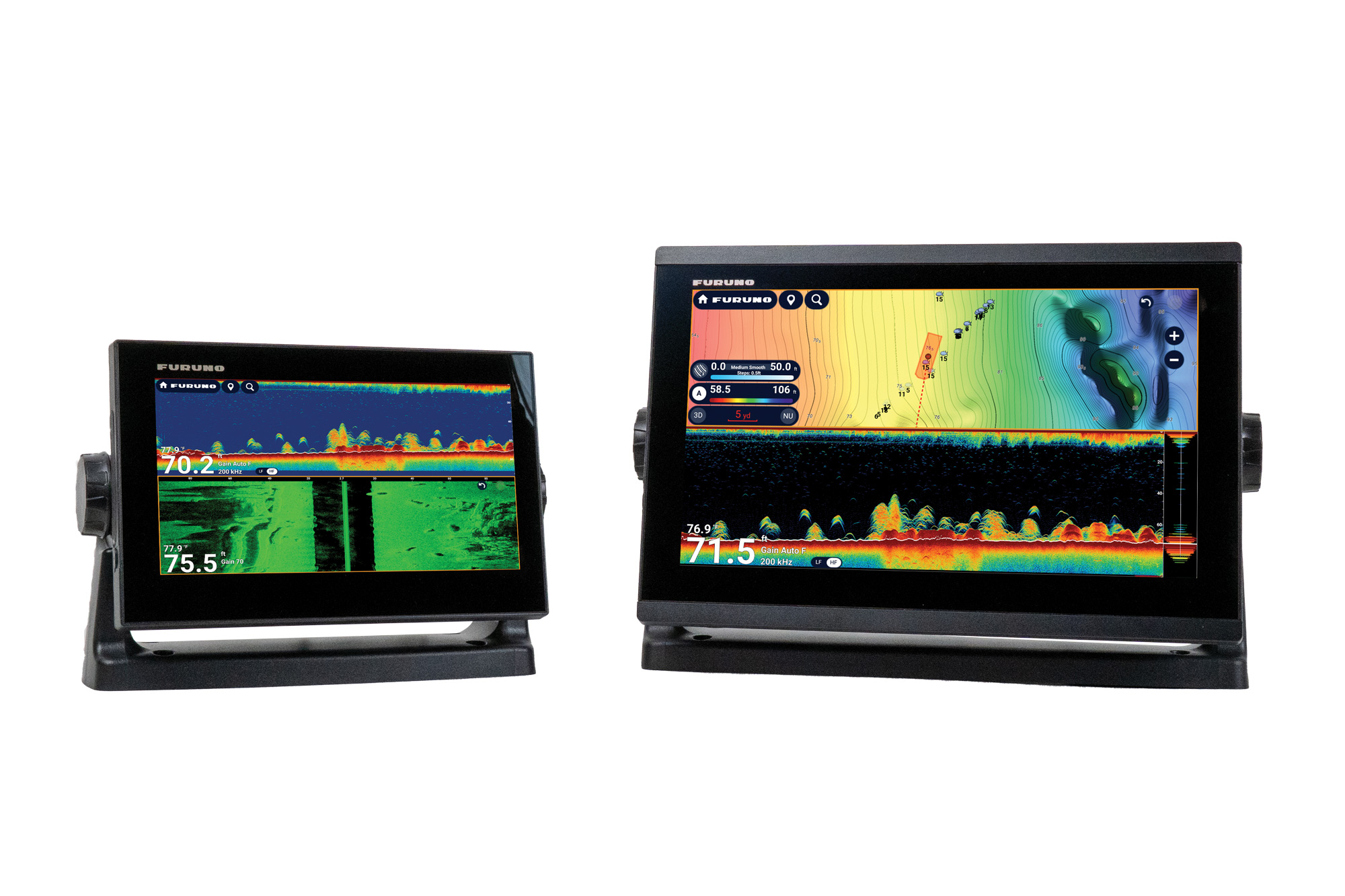
- Network Integration: Can be seamlessly dropped into an existing Furuno TZtouchXL network, functioning in tandem with larger MFDs while maintaining a minimal footprint.
- Sonar Capabilities: Supports advanced multibeam black-box sonars, including Furuno’s CSH10 omni sonar—a critical asset for sportfishing captains utilizing tower stations.
- Radar Compatibility: Fully compatible with both radome-enclosed and high-performance open-array radars, offering superior range, target separation, and situational awareness.
- Advanced AI Safety Features: Includes AI Routing, alongside Furuno’s proprietary Risk Visualizer and AI Avoidance Route systems, which leverage advanced Doppler processing to automatically chart safe courses around hazards.
Cartography and Environmental Forecasting
All four MFD models support TZ Maps (a product of Timezero, a Furuno sister company). Initial cartography pricing starts at $150 for TZMap units and $265 for TZtouchE displays, with an annual $20 subscription fee taking effect after the first year.
Crucially, the TZ Maps package bundles free meteorological and oceanographic data feeds directly to the screen. Mariners gain access to real-time wind, wave, and precipitation forecasts, alongside angler-centric telemetry such as sea surface temperatures (SST) and chlorophyll concentrations.
"If there’s chlorophyll near a temperature break, chances are pretty good you’re going to do some good pelagic fishing," notes Tim Moore, Furuno’s East Coast general manager.
Official Responses and Strategic Vision
According to Furuno leadership, the development of the TZtouchE and TZMap lines was driven by a desire to strip away unnecessary complexities while retaining core operational reliability.
"We broke it down to the essentials you would need to get a great-working little unit and just give you what you need without overcomplicating things," explains Tim Moore, Furuno’s East Coast general manager. "We’re just trying to give people a less-expensive option, and by doing that, we try to design away any complexities."
Moore notes that the engineering team made deliberate assumptions about how these smaller screens would be deployed in the field. For instance, because the TZMap is intended for smaller vessels, engineers omitted open-array radar support on the premise that skiff and center-console owners rarely install heavy, high-power antenna arrays on their hardtops or consoles.
Conversely, the TZtouchE was designed with multi-station flexibility in mind. By keeping the processor powerful while shrinking the physical display, Furuno has opened up new installation vectors.
"A lot of these trawler owners want to put less-expensive, smaller MFDs down in their staterooms," Moore says, highlighting how large-vessel owners are utilizing the "E" series as auxiliary monitoring stations below deck, while offshore captains mount them in tuna towers for quick data reference.
Implications for the Marine Electronics Market
The introduction of the TZMap and TZtouchE series carries several notable implications for recreational boaters, commercial operators, and competing marine electronics manufacturers:
- Democratization of Advanced Safety Tech: Features like AI-driven route plotting and Doppler-based collision avoidance—once exclusive to high-end, bridge-class electronics suites—are now accessible to owners of smaller boats operating on tighter budgets.
- Flexible Multi-Station Architecture: By allowing the TZtouchE to integrate directly into existing TZtouchXL networks, Furuno provides large-yacht owners with a cost-effective way to add secondary glass to flybridges, towers, and crew quarters without sacrificing processing speed or network synchronization.
- Hardware Constraints vs. Value Engineering: While the omission of thermal-imaging and daylight camera support on these specific models may deter owners of mega-yachts looking for standalone auxiliary screens, it represents a calculated trade-off. For the target demographic of coastal cruisers and serious anglers, the savings in hardware cost far outweigh the absence of specialized thermal optics—especially since larger networked displays on the vessel can handle those tasks if required.
Ultimately, whether an operator is dodging semi-submerged timber in a shallow river channel at night or tracking pelagic gamefish offshore, Furuno’s new ecosystem proves that heavy-duty technological muscle can successfully travel in small packages.