Main Facts
London’s luxury real estate market is no stranger to historic grandeur, stately manors, and properties with impressive pedigrees. However, few residences can boast a lineage quite as celestial or uniquely royal as The King’s Observatory in Richmond. For the very first time since its royal inception over 250 years ago, this Grade I-listed architectural masterpiece has officially been listed for sale.
Priced at £18 million (approximately $24 million) through Charlie Willis London, the estate offers a rare intersection of British monarchy, scientific history, and modern ultra-luxury living. Situated on nearly seven secluded acres within Richmond’s historic Old Deer Park—right next to the world-renowned Kew Gardens—the property spans roughly 7,300 square feet of meticulously restored living space.
Atop the structure sits its original, fully preserved astronomical dome, offering future residents the exact vantage point once used by King George III to gaze at the stars. Beyond its rich heritage, the offering includes expansive grounds shaped by legendary landscape architects, historical artifacts spanning centuries, and pre-approved planning permission to expand the estate to an astonishing 19,000 square feet, complete with underground parking for up to 17 vehicles.

Chronology: A Timeline of the King’s Observatory
To understand the immense cultural and historical value of the property, one must journey back more than two and a half centuries through British science and monarchy.
- 1769: Commissioned by King George III and designed by prominent neoclassical architect Sir William Chambers, the observatory is built specifically to allow the monarch, his family, and invited scientists to observe the rare Transit of Venus—an astronomical event where the planet passes directly between the Sun and Earth.
- Late 18th to 19th Century: The building quickly transitions from a royal viewing platform into a premier international center for scientific advancement. It becomes globally renowned for pioneering work in astronomy, precision timekeeping, and geomagnetism.
- The 20th Century (Meteorological Era): The observatory is absorbed into the British Meteorological Office, serving as a critical hub for weather research and forecasting data.
- World War II Era: Renowned meteorologist James Stagg works out of the observatory. Stagg would later achieve historical fame by providing the exact weather forecast that allowed General Dwight D. Eisenhower to greenlight the D-Day landings in June 1944. A plaque commemorating his time at the site remains inside the building today.
- 1980: The Meteorological Office officially vacates the facility, ending more than two centuries of continuous scientific operation.
- 2010s: Property developer Robbie Brothers acquires the neglected historic structure, embarking on an arduous, multi-year restoration project in close collaboration with historic preservation authorities.
- 2018: The painstaking residential conversion is officially completed, transforming the former scientific research hub into a high-end four-bedroom private home while strictly preserving its architectural integrity.
- Present Day: For the first time in its 255-year history, the estate makes its public debut on the open market, listed at £18 million.
Supporting Data & Architectural Overview
The transition from a working observatory and meteorological station into a high-end private residence required an extraordinary touch of architectural sensitivity. Property developer Robbie Brothers spent years ensuring that contemporary luxury enhancements did not compromise the soul of the building.
The Residence
- Total Living Space: Approximately 7,300 square feet across the existing structures.
- Bedrooms: Four luxurious bedrooms, each balancing period charm with modern comforts.
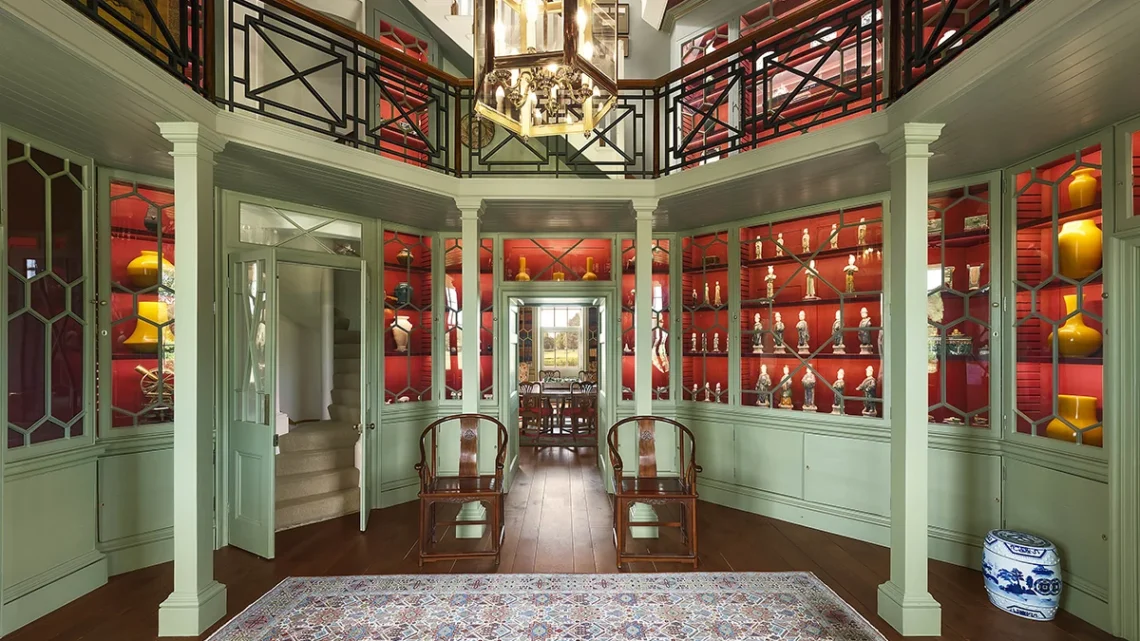
- The Library: Features original, towering 18th-century Georgian bookshelves custom-fitted to house a collection of roughly 6,000 volumes.
- The Dining Room: Embellished with exquisite hand-painted wallpaper meticulously modeled after an 18th-century panoramic view of Canton (modern-day Guangzhou, China).
- The Dome: The crown jewel of the property remains the original, functional observatory dome upstairs, retaining a direct physical connection to George III’s astronomical pursuits.
- Living Areas: The primary sitting room boasts sweeping, uninterrupted views across the estate’s sprawling, private parklands.
The Grounds and Landscape
- Acreage: Nearly seven pristine acres nestled within Richmond’s Old Deer Park.
- Historical Landscaping: Early iterations of the grounds feature foundational design touches originally penned by the celebrated 18th-century landscape architect Lancelot "Capability" Brown.
- Modern Enhancements: Contemporary garden layouts and restorative outdoor features were expertly overseen by acclaimed modern landscape designer Kim Wilkie.
- Outdoor Features: The property includes a long, private gated drive, an expansive ornamental lake, a historic stone boathouse, and various ancillary structures that bear silent witness to the site’s scientific past.
Potential Expansion Metrics
- Approved Planning Permission: The sale includes valuable, hard-to-achieve municipal permits allowing for an additional 10,000 square feet of development.
- Proposed Additions: Plans allow for expanded primary living quarters, dedicated staff housing, and a state-of-the-art underground subterranean parking garage capable of housing up to 17 vehicles.
- Ultimate Footprint: If fully realized, the completed estate would span a staggering 19,000 square feet.
Official Responses and Market Perspectives
The listing of the King’s Observatory has sent ripples through the upper echelons of the London prime property market. Historic preservationists, elite real estate brokers, and local historians have all weighed in on the significance of the sale.

Charlie Willis, founder of the eponymous boutique real estate agency handling the listing, emphasized the absolute rarity of the offering. "There are very few properties in the world—let alone in the heart of London—that can offer a living connection to 18th-century royalty combined with such monumental scientific heritage," Willis noted. "This is not merely a home; it is a custodian-level piece of British history. To walk through these rooms is to walk alongside monarchs, astronomers, and wartime heroes like James Stagg."
Architectural historians have similarly praised the 2018 restoration. Preservation groups monitoring the Grade I-listed structure have expressed relief that the sensitive conversion avoided the pitfall of hyper-modernizing a treasured landmark. By retaining elements like the 6,000-volume Georgian library, the hand-painted Canton wallpaper, and the iconic rooftop dome, the development team successfully bridged the gap between museum-grade preservation and livable comfort.
Furthermore, local authorities in Richmond have monitored the property’s transition closely. Given its proximity to the historic Kew Gardens and the sweeping green expanses of Old Deer Park, the granting of planning permission for an underground subterranean garage and expanded living quarters represents a delicate balance between modern ultra-prime lifestyle demands and strict heritage conservation laws.

Implications: What This Means for London’s Ultra-Prime Market
The public offering of the King’s Observatory carries several noteworthy implications for the high-end real estate sector in the United Kingdom:
1. The Redefinition of "Luxury" in London
For decades, ultra-prime London real estate—particularly in boroughs like Kensington, Chelsea, and Richmond—has been dominated by newly built mega-mansions or traditional Victorian and Edwardian townhouses. The King’s Observatory redefines luxury by introducing historical pedigree as the ultimate amenity. In a market where billionaires and global ultra-high-net-worth individuals (UHNWIs) increasingly seek unique lifestyle statements, owning a building where a British king studied the cosmos offers a narrative that money alone usually cannot buy.
2. The Rise of "Trophy-Asset" Conversions
The successful transformation of a scientific institution into a residential masterpiece highlights a growing trend among elite developers: adaptive reuse of non-residential historic properties. As central and suburban London spaces become increasingly scarce, converting architectural landmarks, churches, power stations, and—in this case—observatories into private homes represents the pinnacle of bespoke development.

3. Future Expansion and Subterranean Engineering
The inclusion of planning permission for 10,000 additional square feet—specifically featuring a 17-car underground garage—signals where the ultra-prime market is heading. Discerning buyers at the $20 million-plus level demand robust security, massive vehicle collections, and extensive staff accommodations. The ability to expand a historic 18th-century property discreetly underground without altering its protected exterior facade represents a masterclass in modern engineering meeting historic preservation.
As the King’s Observatory searches for its first private owner outside of the Crown and scientific institutions, it stands ready to write its next chapter. Whether it remains a tranquil sanctuary for a history-loving family or undergoes its next grand evolution via its approved expansion plans, this stellar Richmond estate has firmly cemented its place as one of the most remarkable properties ever to grace the London market.