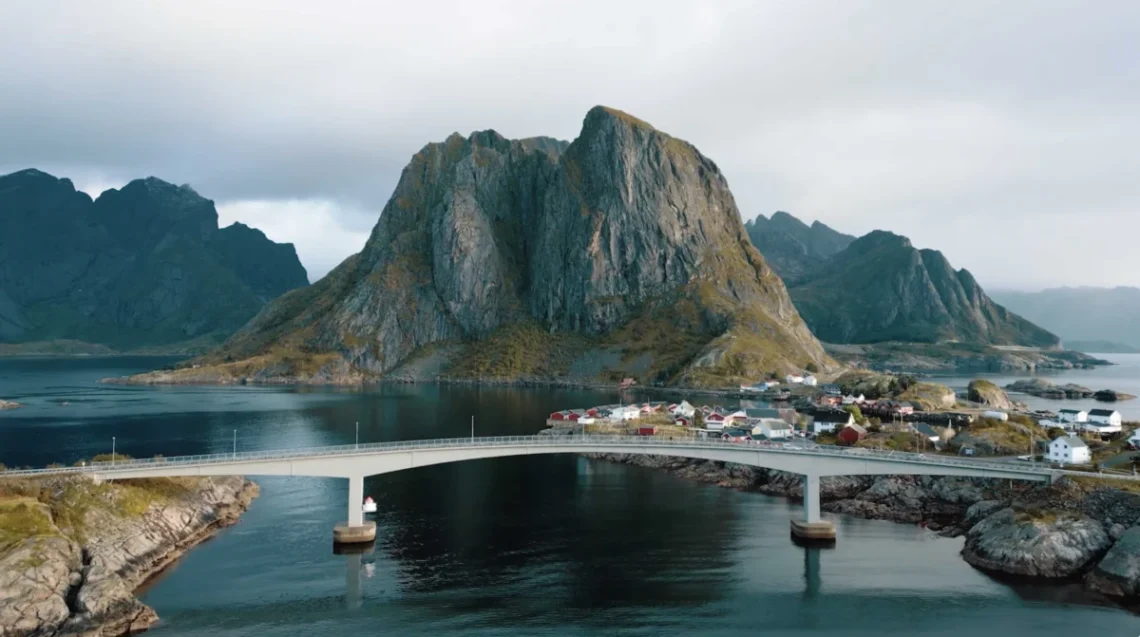
In the remote southwestern reaches of Norway’s Lofoten archipelago, 68 degrees north of the Arctic Circle, the weather does not merely change—it performs. On a late September afternoon, hiking guide Audun Rasmussen stood on a mountain face, 2,000 feet above the churning Norwegian Sea, and grinned through a gale. "Now you know what it’s like to be in the eye of a storm," he shouted over the howling wind.
Below us, the world was obscured by a thick, heavy fog that clung to the jagged, glacial-carved peaks. For the nearly one million visitors who flock to Lofoten annually, these spiky mountains and pristine beaches are the primary draw. But for those who venture beyond the hiking trails, there is a quieter, more profound discovery to be made—not in the height of the summits, but in the depths of the local plate.

The Crucible of Holmen Lofoten
At the edge of the village of Sørvågen, a cluster of mustard-colored wooden cabins, known as rorbuer, juts out into the Atlantic. Once a bustling center of the cod industry, this site has been reborn as Holmen Lofoten, a unique culinary destination and hotel that has been redefining Arctic hospitality since 2007.
The architecture is elemental: corrugated roofs topped with tufts of insulating grass, wooden walkways connecting weathered decks, and large picture windows that frame the brutal, beautiful shoreline. Inside, the design is deliberately sparse, ensuring the wild, shifting landscape remains the focus. It is here that Ingunn Rasmussen, a fisherman’s daughter and sister to Audun, has cultivated a space where travelers can "log off and reconnect with their natural roots."

"I wanted to build a space that felt like home," Ingunn explains, reflecting on her return to the family site after years abroad. Her mission was to restore the historical integrity of the cabins while creating a hub for modern, sustainable culinary exploration.
A Chronology of a Culinary Expedition
The heart of Holmen’s cultural output is "Kitchen on the Edge of the World," a four-times-a-year gastronomic event launched in 2018. During the author’s four-day stay—the 30th edition of the program—the kitchen was helmed by Matt Orlando, the California-born, Copenhagen-based chef formerly of The Fat Duck and Per Se.

Day 1: The Icebreaker
The experience began with a reception in the living room above the kitchen, an space adorned with foraged flora and raw, sculptural elements. Guests—a diverse assembly ranging from a geologist from Brunei to a retiree from Melbourne—were introduced through a series of "local story" cocktails. Using vermouth infused with blackcurrant leaves and Campari steeped in yarrow flowers, mixologist Mia Hjorth Hansen set the tone: this was to be an exploration of the Arctic’s autumnal palette.
Day 2: Foraging and Philosophy
The following morning, the kitchen became a collaborative laboratory. Chef Orlando and his sous chef, Tom Siebeler, worked with ingredients sourced from within a few miles: reindeer ribs from local Sámi herders, hedgehog mushrooms, and wild herbs like chickweed and sheep sorrel. The focus was on "land stewardship," a theme central to the event’s guest chefs, which have included pioneers like Ana Roš of Hiša Franko and Simon Rogan.

Day 3: The Deep Dive
The group ventured to the fishing village of Napp to visit the Lofoten Seaweed Company. Co-founders Angelita Eriksen and Tamara Singer, a women-led team, demonstrated the meticulous process of hand-harvesting seven types of seaweed from the powerful tidal currents of the Nappstraumen. This was a masterclass in the shift toward a more diversified agricultural movement in a region historically dominated by cod.
Day 4: Reflection at the Edge
The final day involved a boat trip to an abandoned fishing village, where nature had reclaimed the landscape. Amidst the waterfalls and reindeer moss, the group engaged in communal cooking over a fire, crafting pinnebrød (bread on a stick) and reflecting on the experience of "attentional elasticity"—the psychological shift that occurs when one moves from vast vistas to the microscopic details of subarctic flora.

Supporting Data: The Ecology of the Arctic Plate
Lofoten’s productivity is a result of a rare climatic "perfect storm." The interaction between the warm Gulf Stream and the freezing Arctic waters creates a nutrient-dense marine environment. Meanwhile, the region’s long daylight hours during the growing season trigger an intense growth cycle in plants, while the sea spray provides unique salinity to the coastal pastures where the famous Lofotlam (lamb) grazes.
According to Bjørg-Elin Kærn, a specialist with the agricultural organization Love Food, this ecosystem is under pressure but remains a model for sustainability. "Lamb, stockfish, and seaweed are all remarkably sustainable ways of producing food," Kærn notes. "But conservation only works when the people living on the land can make a good living. When a restaurant chooses these local products, it keeps the whole system alive."

Official Perspectives and Local Implications
The growth of tourism in Northern Norway presents a paradoxical challenge. While visitor numbers are rising, the infrastructure and the environment face significant strain. The local government has responded by banning wild camping, restricting visitors to designated grounds to protect the fragile tundra.
Ingunn Rasmussen is vocal about the need for a shift in tourism philosophy. "Our hope is that people come to Lofoten for the right reasons," she states. "Ultimately, that will be what helps us protect the islands and our way of life."

The industry’s reliance on the skrei (Arctic cod) migration—a thousand-year-old tradition evidenced by the iconic hjeller (drying racks) that dot the landscape—is also evolving. As migration patterns shift due to climate change and offshore fishing pressures, the local economy is increasingly looking toward diversified artisanal production. Small-scale farmers, seaweed harvesters, and cheesemakers are now considered as essential to the tourism economy as the mountain guides.
The Future of "Slow" Travel
The implications of the Holmen model are clear: the future of tourism lies in the "interweaving" of the visitor experience with the land’s production. By inviting guests to participate in the act of gathering—whether it is foraging for herbs, carving birch wood, or watching a chef pressure-cook fish bones into noodles—the barrier between "consumer" and "steward" is dissolved.

Matt Orlando, whose own zero-waste restaurant Esse in Copenhagen is a Michelin-starred testament to circularity, believes this is the future of fine dining. "Thinking on the fly and exploring the potential in things you’ve never worked with is where the coolest ideas come from," he says.
For the traveler, the lesson is one of profound presence. In a world of digital noise, the act of sitting by a wood-fired oven, surrounded by the smell of charring birch and the taste of locally foraged mushrooms, forces an engagement with the reality of a place. It suggests that the most meaningful souvenirs are not things bought, but an understanding of how a community lives in harmony with an unforgiving, yet life-giving, landscape.

As the fog rolls in once more over the Sørvågen shoreline, it becomes clear that Lofoten is not just a destination for the adrenaline-seeking hiker. It is a classroom for the conscious traveler, proving that the true "eye of the storm" is not found in the chaotic winds of the mountain peaks, but in the quiet, nourishing heart of the kitchen table.