MUNICH — For decades, the Federal Republic of Germany’s political stability rested upon an implicit, highly successful social contract: high-value, precision manufacturing would provide secure, well-remunerated jobs, robust export revenues, and broad-based national prosperity. In turn, stable political institutions would translate these economic dividends into enduring social cohesion.
Today, relentless competition from an industrializing and technologically advancing China—coupled with structural shifts in global energy markets and supply chains—has shaken that foundational bargain to its very core.
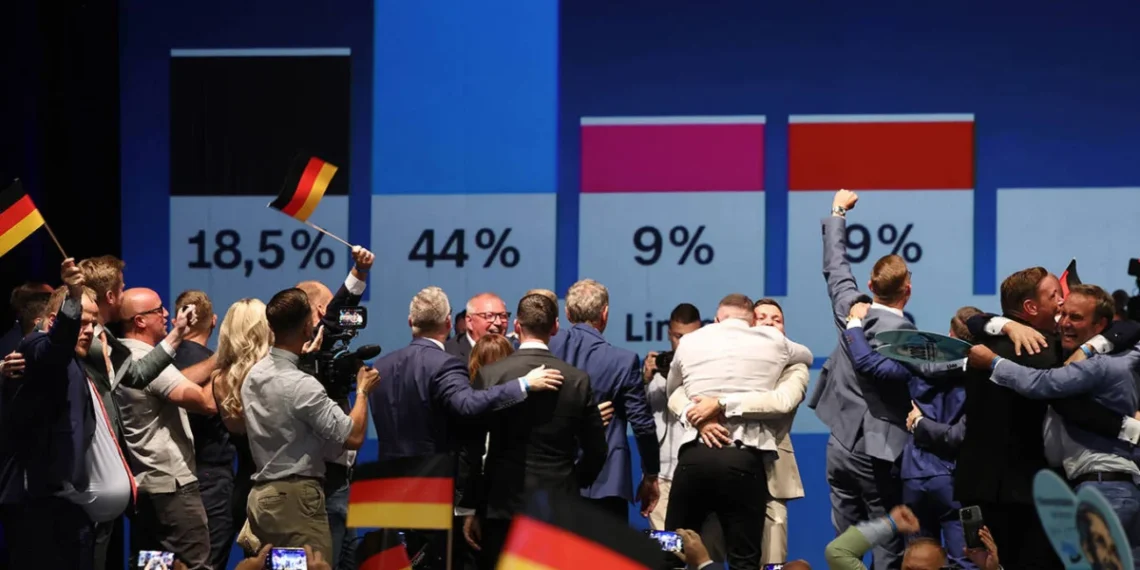
On September 6, 2026, that economic vulnerability translated into a political earthquake that may well mark a definitive turning point in modern German postwar history. In the state election of Saxony-Anhalt, the far-right populist party Alternative für Deutschland (AfD) surged to an unprecedented 43.8% of the vote. Falling just three seats short of an absolute majority, the AfD more than doubled its vote share from the previous election in 2021.
The ramifications of the vote extend far beyond the borders of Saxony-Anhalt. The far-right’s massive gains came almost entirely at the expense of the center-right Christian Democratic Union (CDU), the state’s incumbent governing force and the political home of federal Chancellor Friedrich Merz. The CDU suffered a catastrophic collapse, plunging from 37.1% in 2021 to a meager 17.2%.
As policymakers in Berlin grapple with the results, economists and political analysts alike are asking whether Germany’s traditional political center can adapt quickly enough to arrest the economic anxieties fueling the populist surge.
Chronology of a Political Shift: From Economic Anxiety to Electoral Earthquake
To understand the seismic events of September 2026, it is necessary to examine the cascading economic and political pressures that have built up across eastern Germany over the past several years.
- 2021–2022: The Energy Shock and Inflationary Pressures: Following the outbreak of the war in Ukraine and the abrupt cessation of cheap Russian pipeline gas, Germany’s energy-intensive industrial base faced an unprecedented cost shock. While the federal government scrambled to subsidize energy bills, manufacturing sectors in eastern states like Saxony-Anhalt felt the squeeze immediately, leading to widespread anxiety over job security and living standards.
- 2023–2024: The Chinese Industrial Challenge: German automotive and mechanical engineering giants—long accustomed to dominating global markets—began losing significant market share in China to domestic electric vehicle (EV) manufacturers and high-tech machinery producers. Concurrently, heavily subsidized Chinese green tech began flooding European markets, undercutting traditional German mid-sized enterprises (Mittelstand).
- 2025: The Merz Administration and Structural Reform Debates: Following federal elections, Chancellor Friedrich Merz assumed office with a mandate to cut red tape, rein in public spending, and revitalize Germany’s competitiveness. However, implementing structural reforms proved politically divisive, leading to public fatigue and a sense that traditional parties were failing to protect regional economies.
- Early 2026: The Saxony-Anhalt Campaign: As the state election campaign heated up, the AfD focused its messaging relentlessly on local deindustrialization fears, declining public services, and opposition to federal immigration and climate policies. Mainstream parties struggled to offer a compelling counter-narrative that addressed both economic stagnation and community identity.
- September 6, 2026: The Election Breakthrough: The AfD secures 43.8% of the vote in Saxony-Anhalt, capturing rural districts and mid-sized towns alike, while the CDU falls to 17.2%. The result shatters long-standing political taboos regarding the viability of far-right dominance in state legislatures.
Supporting Data: The Anatomy of a Collapse
The numbers emerging from the Saxony-Anhalt electoral commission paint a stark picture of demographic and political realignment.
| Political Party | 2026 Vote Share (%) | 2021 Vote Share (%) | Change (Percentage Points) | Estimated Seats (2026) |
|---|---|---|---|---|
| Alternative für Deutschland (AfD) | 43.8% | 20.8% | +23.0% | 41 (Short of 44 for majority) |
| Christian Democratic Union (CDU) | 17.2% | 37.1% | -19.9% | 16 |
| Social Democratic Party (SPD) | 9.5% | 8.4% | +1.1% | 9 |
| Sahra Wagenknecht Alliance (BSW) | 8.8% | N/A | New Entry | 8 |
| The Greens (Die Grünen) | 5.1% | 5.9% | -0.8% | 5 |
| Others / Independents | 15.6% | 27.8% | -12.2% | 14 |
Key Economic Indicators Driving the Vote
- Industrial Output: Manufacturing output in eastern Germany dropped by an estimated 4.2% year-on-year in the first half of 2026, driven by weak external demand and high domestic production costs.
- Mittelstand Confidence: According to Munich-based economic institute surveys, business sentiment among small and medium-sized enterprises in Saxony-Anhalt reached a ten-year low in August 2026, with 62% of respondents citing regulatory burdens and Chinese competition as primary existential threats.
- Real Wages: Despite nominal wage increases, cumulative inflation since 2021 has left households in eastern states feeling a tangible squeeze in purchasing power, fueling a pervasive sentiment of relative economic deprivation compared to western counterparts.
Official Responses and Political Reactions
The outcome in Saxony-Anhalt has triggered emergency consultations across Berlin and state capitals, laying bare deep divisions over how to respond to the rise of the radical right.
Speaking from the Chancellery in Berlin, Chancellor Friedrich Merz addressed the press with a mix of sober reflection and defensive determination.
"The result in Saxony-Anhalt is a clear, unmistakable warning signal to all democratic forces in our country," Merz stated. "Citizens are worried about their economic future, the transformation of our industries, and the cohesion of our society. We must listen, but we must also deliver practical solutions rather than empty rhetoric. The answer to populism is not mimicry; it is competent governance, lower taxes for our businesses, and a renewed commitment to industrial strength."
Merz explicitly rejected any future cooperation with the AfD, reaffirming the traditional Brandmauer (firewall) maintained by mainstream democratic parties. However, critics within his own party have begun questioning whether the federal government’s current economic austerity measures are exacerbating regional grievances.
Meanwhile, AfD co-leader Alice Weidel hailed the result as a historic breakthrough for the party and a stinging rebuke of Berlin’s ruling coalition.
"The voters of Saxony-Anhalt have spoken courageously and clearly," Weidel declared at a press conference in Magdeburg. "They have rejected the deindustrialization policies dictated by Brussels and Berlin. They have said no to uncontrolled mass migration and failed energy experiments. This election proves that the old party cartel is finished in the East, and the AfD is ready to assume governmental responsibility."
From the political left, Social Democratic (SPD) leaders emphasized the urgent need to protect workers’ rights and expand public investment in infrastructure. Representatives of the Sahra Wagenknecht Alliance (BSW)—which performed strongly in its regional debut—positioned themselves as a left-conservative alternative, criticizing both the federal government’s economic policies and its stance on international trade and foreign policy.
Broader Implications: Germany’s Economic and Democratic Future
The shockwaves of the Saxony-Anhalt election force a fundamental re-evaluation of Germany’s macroeconomic strategy and its political architecture. Several critical themes define the road ahead:
1. The Crisis of the Export-Led Growth Model
For decades, Germany’s economic engine relied on exporting complex machinery, chemicals, and automobiles to the world, with China serving as both a primary market and an indispensable link in global supply chains. As Chinese manufacturers rapidly climb the value chain—particularly in electric mobility, battery technology, and renewable energy equipment—German firms are finding themselves squeezed between high domestic input costs and agile, state-supported foreign competitors. Without a comprehensive national strategy to boost domestic innovation, digitize public administration, and secure affordable energy, the deindustrialization of regions dependent on traditional manufacturing risks becoming permanent.
2. The Widening East-West Divide
The election highlights the persistence of structural disparities between eastern and western Germany. Despite massive financial transfers since reunification, eastern states often lack corporate headquarters, venture capital ecosystems, and deep-rooted institutional networks. This economic periphery has proven particularly fertile ground for political radicalization, as voters feel alienated from political elites concentrated in western urban centers like Berlin, Frankfurt, and Düsseldorf.
3. Challenges for Coalition Governance
With the traditional center-right and center-left parties capturing smaller combined vote shares, forming stable, functioning regional governments is becoming increasingly difficult. The emergence of strong third and fourth parties—such as the BSW and the Left—further fragments parliaments, raising the specter of difficult, ideologically heterogeneous coalitions or minority governments prone to gridlock.
4. Implications for European Integration
As Europe’s economic heavyweight struggles with domestic political fragmentation and industrial transformation, the capacity of the European Union to pursue ambitious green and digital transitions may be impaired. Disagreements over trade policy toward China—balancing the desire to protect European industries through tariffs against the fear of retaliatory measures—will likely intensify within the European Council as Berlin seeks to safeguard its export-driven enterprises.
Conclusion
The September 6 election in Saxony-Anhalt is much more than a routine regional contest; it is a symptom of a deep-seated structural crisis testing the resilience of Germany’s democratic institutions. As the implicit bargain of postwar prosperity—good jobs, steady growth, and social peace—frays under the weight of global competition and energy shocks, the political center faces an unforgiving test.
Whether Chancellor Merz and other democratic leaders can recalibrate Germany’s economic model to meet the challenges of the twenty-first century—without sacrificing social cohesion or yielding ground to populist extremes—will determine not only the future of Germany, but the stability of the European project as a whole.