Welcome to Taste Test, where every week our critic Jonah Flicker explores the most buzzworthy and interesting whiskeys in the world. Check back each Sunday for his latest whiskey review.
The whiskey industry is currently navigating a period of profound recalibration. While industry analysts often attempt to frame the cooling market with optimistic terminology, the reality on the ground is stark: consumer demand has softened, and the surplus of aged inventory has forced a strategic retreat among some of the sector’s largest players. Several major distilleries have hit the pause button on production, attempting to bring supply back into equilibrium with the current reality of the market.
At the center of this turbulence is MGP (Midwest Grain Products), the Indiana-based powerhouse that acts as the engine room for a significant portion of the craft whiskey landscape. With a notable glut of aged spirits sitting in warehouses and a shifting consumer appetite, the contract-distilling giant has faced significant headwinds. Yet, amidst this contraction, one of its marquee acquisitions—Penelope Bourbon—is charting a counterintuitive path. Rather than retreating, Penelope is aggressively expanding its footprint, launching a new "Classic Series" that signals a shift toward foundational, high-quality expressions.
The Evolution of Penelope: From Boutique Label to MGP Powerhouse
Founded in 2018 by New Jersey natives Mike Paladini and Danny Polise, Penelope Bourbon was born out of a passion for whiskey and a desire to create a brand that felt both accessible and refined. Named after Paladini’s daughter, the brand initially gained traction by sourcing high-quality juice from MGP, utilizing expert blending and finishing techniques—often involving unique wood treatments like Amburana—to differentiate themselves in a crowded marketplace.
By 2023, the brand’s meteoric rise culminated in a $100 million acquisition by MGP. This was a strategic masterstroke by the parent company: rather than continuing to sell raw whiskey to a rising star, MGP opted to bring the brand under its own corporate umbrella, effectively capturing the full value chain of Penelope’s success.
However, the acquisition occurred just as the industry began to show signs of fatigue. MGP has recently curtailed production at several of its facilities to address dismal sales figures and the mounting inventory of unsold whiskey. Despite this macro-level caution, Penelope has remained a beehive of activity, continuing to release a steady stream of expressions. While some of these have been met with lukewarm reception, their latest move—a return to the roots of Kentucky bourbon—suggests a pivot toward long-term sustainability.
A Return to Basics: The New Classic Series
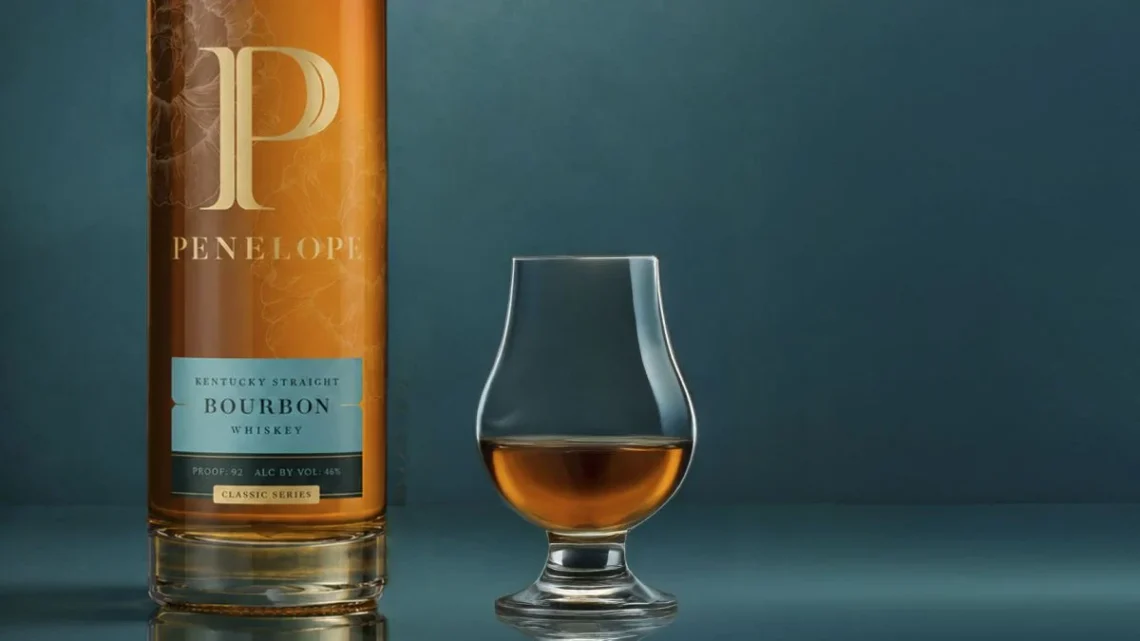
The newly launched Classic Series serves as a departure from the experimental finishes that defined Penelope’s early years. For the first time in its history, the brand has introduced a large-scale straight Kentucky bourbon. While the brand has dabbled in limited releases previously, this represents their first genuine attempt to compete directly in the "everyday drinker" category.
The technical specifications of this bottle are telling. Departing from the brand’s signature four-grain mashbill sourced from Indiana, the new Kentucky Bourbon utilizes a traditional three-grain recipe: 78 percent corn, 10 percent rye, and 12 percent malted barley.
The Source of the Spirit
While the brand has been characteristically opaque regarding the specific distillery responsible for the liquid, the industry consensus points toward the Lux Row facility in Bardstown. As a subsidiary under the MGP umbrella, Lux Row provides the ideal infrastructure for this shift to Kentucky-made liquid. The lack of an age statement confirms that the whiskey is at least four years old—a standard, reliable maturation window—and it is presented at a sturdy, versatile 92 proof.

Competitive Landscape: Taking on the Titans
The "Classic Series" is not just another bottle; it is a direct challenge to the entry-level dominance of Kentucky’s legacy distilleries. For years, the shelf space under $50 has been held captive by titans such as Jim Beam, Four Roses, Wild Turkey, and Heaven Hill. By entering this arena, Penelope is betting that its reputation for quality, combined with a familiar, high-quality profile, can lure consumers away from the "old guard."
The flavor profile is a testament to the success of this strategy. Upon tasting, one is immediately greeted by the foundational pillars of premium bourbon: a rich tapestry of vanilla, maple, and honey, underpinned by subtle notes of oak and black pepper. The mid-palate offers a delightful stone fruit sweetness, with clear, bright notes of peach and caramel that linger through the finish.
At 92 proof, the spirit avoids the harshness of lower-proof offerings while maintaining enough structural integrity to hold its own in a cocktail. Whether shaken into a Boulevardier or stirred into a classic Old Fashioned, this bourbon proves that it is more than just a sipping whiskey—it is a workhorse for the home bartender. The accompanying Classic Series Rye, featuring a 93 percent rye mashbill, further rounds out the brand’s new focus, offering a robust alternative for those who prefer a more traditional Manhattan profile.
Strategic Implications: Why Now?
One must ask why a brand would launch a new series in a cooling market. There are several theories. First, the economics are undeniable; by shifting to a Kentucky-based, high-volume model, Penelope may be capitalizing on favorable production costs within the MGP-owned ecosystem. Second, the brand may be looking to simplify its identity. With an extensive portfolio—ranging from golf-themed bottles to exotic cask finishes—Penelope risked diluting its brand equity. The Classic Series acts as an "anchor," grounding the brand in traditional, recognizable quality.
Finally, there is the matter of market positioning. As consumers tighten their belts due to economic uncertainty, they are moving away from "prestige" bottles and toward reliable, high-value, everyday sippers. By pricing this expression at $45, Penelope is positioning itself as an affordable luxury—a move that is essential for survival in the current climate.
Verdict: A Solid Addition to the Home Bar
Penelope did not need to launch this series. With a vast inventory of Founder’s Reserve and experimental wood-finished bottles, they already possessed a robust portfolio. However, the decision to prioritize a classic, accessible Kentucky bourbon proves that the brand is listening to the pulse of the market.
This bottle is versatile, fairly priced, and undeniably tasty. It avoids the gimmicks that often plague modern craft whiskey, focusing instead on the essential harmony of corn, rye, and malted barley. Whether you are a long-time fan of the brand or a skeptic of the recent influx of new labels, the Penelope Classic Series is worth a spot on your shelf.
Score: 87/100
As we look toward the future, the success of this series will likely serve as a barometer for the industry at large. If consumers respond favorably to this return to form, we may see other brands follow suit, pulling back from the brink of experimental excess to rediscover the timeless appeal of a well-made, reasonably priced Kentucky bourbon. In a time of industry-wide uncertainty, Penelope has managed to find clarity in the glass.