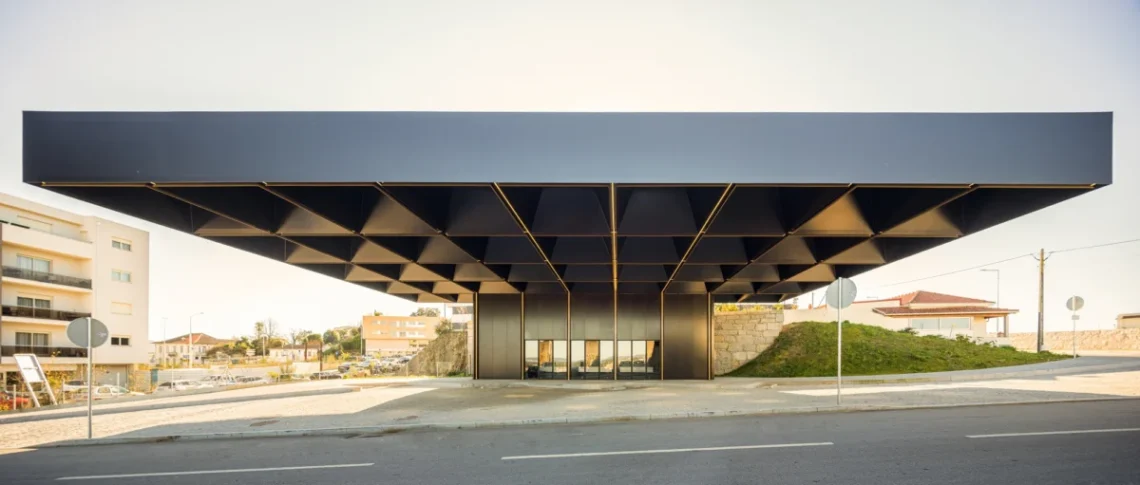
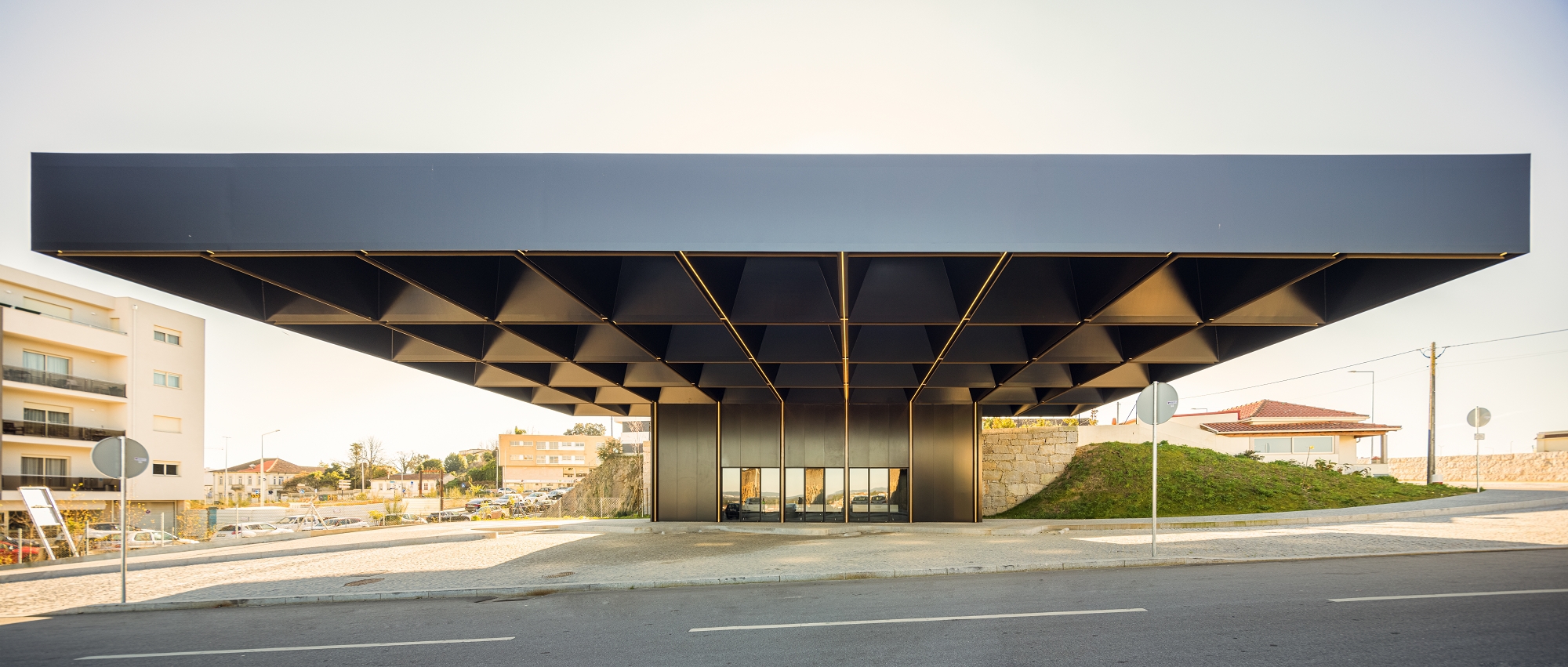
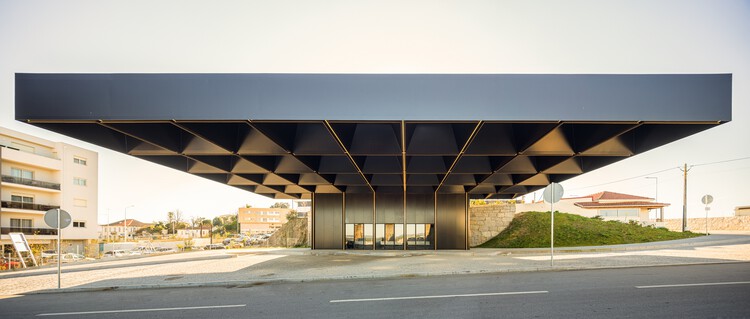
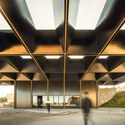
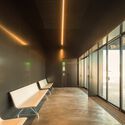
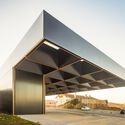
In the rapidly expanding northern precinct of Lousada, Portugal, a striking new architectural landmark is redefining how civic infrastructure, culture, and transit intersect. Designed by the renowned architecture studio spaceworkers and curated by Susanna Moreira, the Intermodal Hub of Lousada emerges as a masterclass in modern municipal design. Captured through the lens of celebrated architectural photographers Fernando Guerra (FG+SG), the project bridges the gap between raw industrial materiality and refined public functionality.
Constructed primarily from exposed concrete and characterized by striking linear geometries and dramatic lighting, the hub serves as a central anchor for the town’s surging growth. The site itself is situated in an increasingly active zone marked by new residential developments, modern cultural venues, and a heavily reinforced road network designed to streamline traffic and pedestrian flow. Rather than treating public transit as a purely utilitarian necessity, spaceworkers has transformed the intermodal station into an architectural extension of Lousada’s vibrant cultural district.
The project forms part of a broader municipal strategy to decentralize and enrich the urban fabric, fostering seamless transitions between private vehicles, public buses, cycling paths, and pedestrian corridors. By embedding thoughtful design within everyday civic transit, Lousada has positioned itself at the forefront of contemporary urban planning in northern Portugal.
Chronology: The Evolution of Lousada’s Northern District
To understand the significance of the Intermodal Hub, one must examine the systematic transformation of Lousada’s northern territory over the past two decades. What was once a peripheral agricultural and low-density residential zone has evolved into the municipality’s primary cultural and infrastructural frontier.
Early 2000s: The municipality identifies the northern sector of Lousada as a key zone for future civic expansion, initiating preliminary master-planning for extended roadway networks and public housing clusters.
The Cultural Anchor (Mid-2010s): The establishment of the local Music Conservatory injects a sudden burst of creative energy into the area, drawing students, families, and faculty members on a daily basis and exposing a desperate need for upgraded civic infrastructure.
The Romanesque Era (Late 2010s to 2020s): The inauguration of the Romanesque Interpretation Center serves as a monumental turning point. This major cultural institution transforms the district into a regional tourist and educational destination, permanently altering the spatial dynamics and identity of northern Lousada.
Commission and Design Phase (Mid-2020s): Recognizing the convergence of heavy traffic, educational foot traffic, and cultural tourism, municipal authorities commission spaceworkers to design an intermodal hub capable of unifying these disparate urban currents.
Completion and Opening (Late November 2026): The Intermodal Hub of Lousada officially opens its doors to the public, setting a new benchmark for municipal transit architecture and seamlessly knitting together the surrounding residential, cultural, and transit networks.
Supporting Data & Architectural Specifications
The Intermodal Hub of Lousada is as fascinating from an engineering and material perspective as it is from a conceptual standpoint. The project leverages heavy structural elements to establish a sense of permanence while maintaining a welcoming, open spatial flow.
Project Name: Intermodal Hub of Lousada
Architecture Office: spaceworkers
Curator: Susanna Moreira
Photography: Fernando Guerra | FG+SG
Primary Construction Material: Exposed architectural concrete, engineered steel framing, and specialized acoustic and thermal glazing.
Site Context: Northern expansion zone of Lousada, immediately adjacent to the Music Conservatory and the Romanesque Interpretation Center.
Functional Scope: Combines bus bays, passenger waiting lounges, ticketing facilities, bicycle storage lockers, digital transit schedule boards, and integrated pedestrian concourses.
Environmental Integration: Incorporates passive solar design principles, highly optimized LED architectural lighting to enhance safety and spatial depth, and permeable hardscaping to manage local stormwater runoff.
The integration of concrete is particularly noteworthy. Far from appearing heavy or oppressive, the material is molded into sleek, cantilevered planes that play with light and shadow throughout the day. At night, integrated linear lighting systems transform the terminal into an inviting beacon for commuters and culture enthusiasts alike.
Official Responses and Architectural Intent
Speaking on the conceptual framework behind the project, the design team at spaceworkers emphasized that public infrastructure should never be treated as an afterthought.
"The planned intervention is located in the northern area of Lousada, a growing zone where new residential clusters, cultural spaces, and an expanded road network are being proposed to integrate with existing infrastructure," noted the architects in their official design statement.
The studio explained that the site’s unique energy—bolstered by the intellectual and artistic gravity of the Music Conservatory and the Romanesque Interpretation Center—demanded an architectural response that went beyond basic logistics.
"This new cultural hub has contributed to the revitalization of the area and to Lousada’s northern expansion, reinforcing its identity as a key cultural district," the architects added.
Local municipal leaders have similarly lauded the project for transforming a logistical challenge into a source of civic pride. Representatives from the Lousada municipality noted during the inauguration that the hub successfully balances the demands of modern mobility with the aesthetic dignity required for a gateway to the town’s expanding cultural quarter. Rather than isolating commuters in concrete boxes, the station encourages pause, social interaction, and visual engagement with the surrounding landscape.
Implications: Redefining the Modern Civic Gateway
The completion of the Intermodal Hub of Lousada carries significant implications for mid-sized European towns facing rapid suburban and cultural growth. As urban centers outside major metropolitan areas expand, they often struggle with the fragmentation of space—disconnecting new cultural monuments from the practical realities of daily transit.
By fusing transit logistics with architectural excellence, spaceworkers has provided a blueprint for how smaller municipalities can scale gracefully. The hub demonstrates that investing in high-end design does not merely serve an aesthetic purpose; it actively alters human behavior. Commuters waiting for a bus are now invited into spaces that mirror the dignity and spatial sophistication of museums or libraries. Furthermore, by anchoring the hub directly to regional cultural assets like the Romanesque Interpretation Center, Lousada encourages multi-modal, sustainable tourism, encouraging visitors to ditch private automobiles in favor of integrated public transit networks.
Ultimately, the Intermodal Hub of Lousada stands as a testament to the power of thoughtful public architecture. It proves that even the most pragmatic civic necessities can be elevated into profound works of art, cementing Lousada’s status as a forward-thinking municipality where culture, community, and mobility seamlessly converge.