
In the landscape of modern luxury, men’s jewellery has long been relegated to the periphery—a realm of minimalist bands, simple chains, or mass-produced accessories. New York-born, London-based entrepreneur Ryan Bernell is looking to shatter that paradigm. With the launch of Alexandria in November 2025, Bernell has embarked on an ambitious mission: to establish a new category of high-end, historically charged jewellery that mirrors the gravity and grandeur of history’s most formidable figures.
By assembling a coalition of master craftspeople—many of whom are the final guardians of near-extinct decorative arts—Bernell is creating what he describes as "high jewellery for the modern conqueror."
The Genesis of an Empire: Main Facts and Vision
The philosophy behind Alexandria is rooted in a fundamental frustration. After a decade of experience in high-end men’s fashion consulting, Bernell found himself unable to source jewellery that met his exacting criteria. He sought pieces that were undeniably masculine and bold, yet possessed the intricate beauty, comfort, and historical weight usually reserved for museum archives or royal regalia.

"I felt like I had developed an eye for detail and a taste for beauty," Bernell explains. "I was looking for men’s rings that I loved, but there were no options that combined masculinity with elegance and daily wearability. I wanted a statement piece that was well-crafted—so I decided to build it myself."
The brand currently anchors its reputation on three flagship designs, each dedicated to a titan of antiquity: Genghis Khan, Alexander the Great, and Julius Caesar. These are not mere accessories; they are architectural feats, crafted in the UK, utilizing materials and techniques that many industry experts deemed impossible to execute at this scale.
A Chronological Pursuit of Excellence
The path to Alexandria’s launch was not an overnight success story, but a calculated, years-long pursuit of artisan mastery.

- 2015–2024: During his tenure in men’s fashion, Bernell cultivated his aesthetic vision while searching for a market gap. His personal study of history—initially sparked as a teenager reading biographies to build self-confidence—provided the thematic framework for his future brand.
- Early 2024: The search for master craftspeople began in earnest. Bernell scoured the UK to find experts in grand feu enamelling, guilloché engine turning, traditional goldsmithing, and lapidary work.
- November 2025: Alexandria is officially founded in London. The brand debuts its initial collection, introducing the world to the "Khan’s Dominion," the "Alexander the Great" ring, and the "Face of Rome" ring.
- Present Day: The brand is expanding its bespoke services, with future collections exploring themes such as Achilles, Babylon, and the Persian Empire under Cyrus the Great.
Technical Mastery: The Anatomy of a Masterpiece
To understand Alexandria, one must look at the technical specifications of its output. Bernell treats each ring as a "new universe," requiring a depth of research that borders on archaeological study.
The Face of Rome
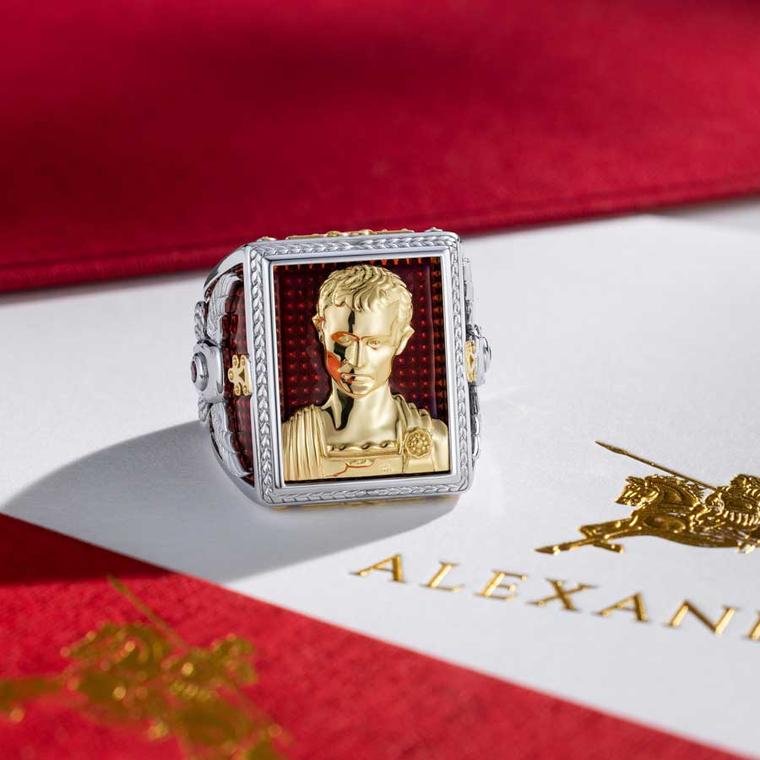
Inspired by the 16th-century bust of Julius Caesar by Andrea Ferucci, this ring is a masterclass in Roman iconography. The central likeness is rendered in three-dimensional gold, set against a backdrop of rich red grand feu enamel. The enamel is kiln-fired at 800°C, layered over a complex, geometric guilloché pattern to catch the light. The shoulders of the ring are shaped to evoke the scutum (the Roman legionary shield), bridging the gap between historical accuracy and contemporary design.
The Khan’s Dominion
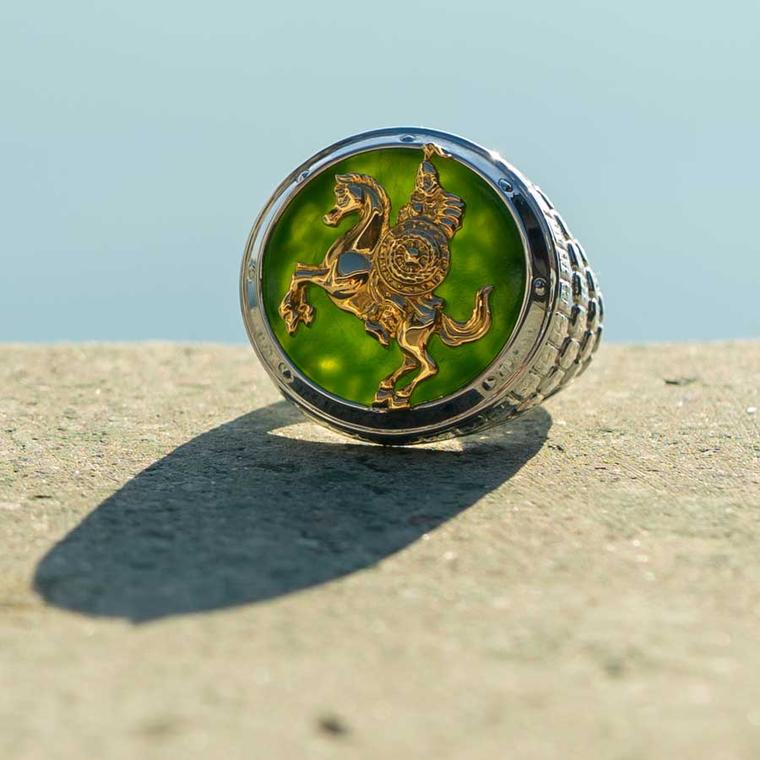
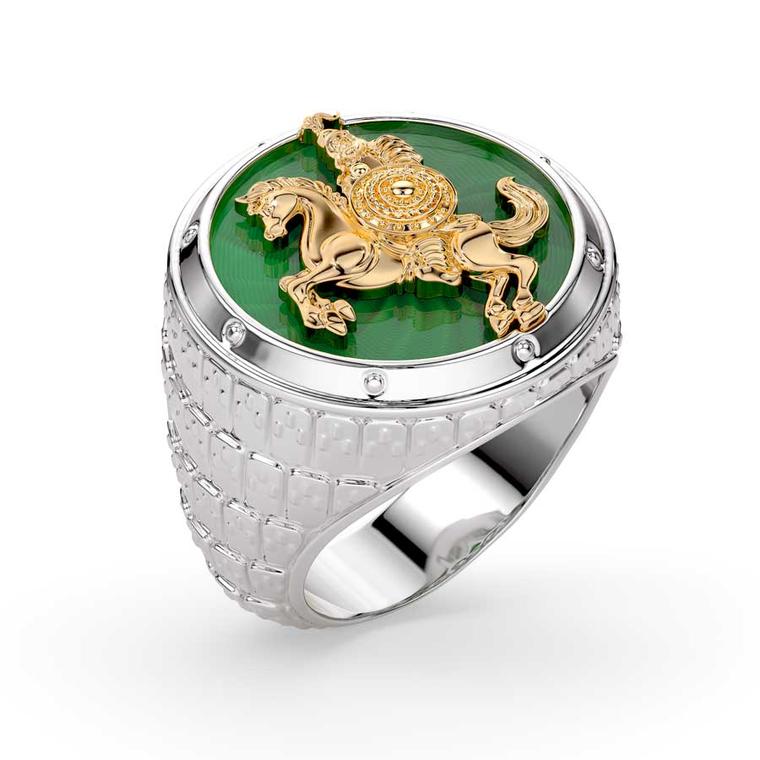
This piece highlights the brand’s obsession with material provenance. It features translucent, A+-grade Siberian nephrite jade—the same source historically favored by the Mongols for its vibrant apple-green hue. The ring’s circular face mimics a Mongolian shield, complete with rivets and cascading sides reminiscent of 13th-century armour.
The Alexander the Great Ring
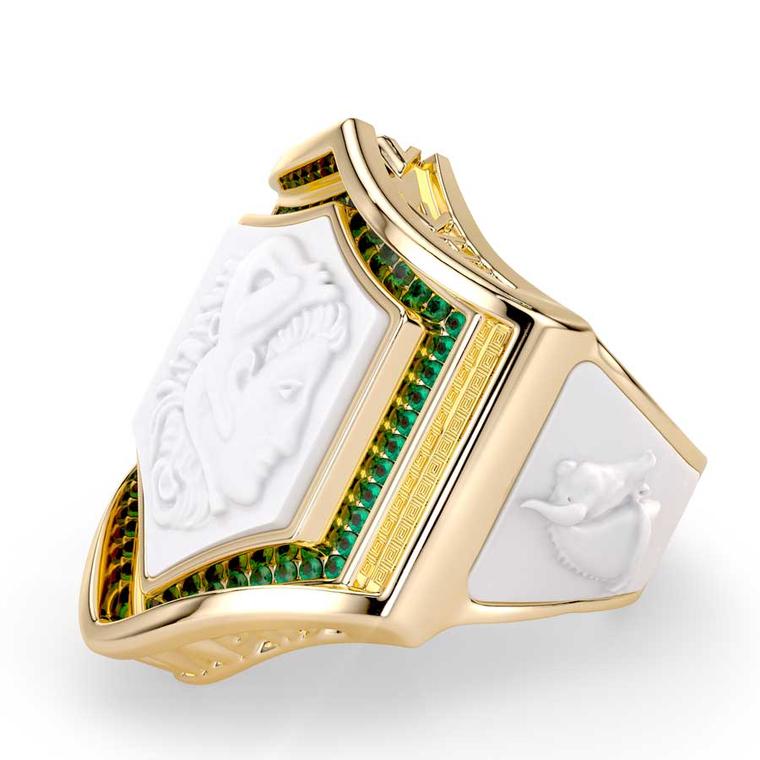
Drawing from ancient Greek drachm coins, this ring utilizes a hand-carved white agate cameo. The detail extends to the sides, featuring cameos of Zeus and Bucephalus (Alexander’s legendary horse), set within a frame of emeralds and gold.
The "Jazz" of Jewellery: An Artistic Philosophy
When asked about his background, Bernell points to his roots as a jazz musician. Growing up in a musical family, he spent his youth mastering the drums and guitar. He draws a direct parallel between the improvisational complexity of jazz and the technical rigor of his jewellery.
"Jazz is a wonderful art form that’s becoming extinct, much like the jewellery-making techniques we employ," says Bernell. "It’s about the subtleness of the blends and how crucial it is that every component is precise. It contributes to a perfect yet complex whole that appears effortless."
This philosophy of "effortless complexity" defines the Alexandria workshop. Bernell actively seeks out the last remaining artisans in the UK who still practice these dying arts, providing them with a platform to perform at the limits of their ability.
Implications for the Luxury Market
The arrival of Alexandria signals a shift in the high-end jewellery sector. Historically, "high jewellery" has been a predominantly female-focused market, characterized by floral motifs and precious stones. By injecting the market with "conqueror-themed" narratives—bold, historical, and unapologetically masculine—Bernell is testing the appetite of a modern demographic that values provenance and craftsmanship over mere brand recognition.
Why Craftsmanship Matters
Bernell’s decision to pursue "impossible" manufacturing feats—such as guilloching a flat sheet of 18-carat gold and wrapping it around three sides of a ring—serves as a challenge to the broader industry. By proving that these techniques can still be executed, he is forcing a conversation about the decline of traditional artisan skill in an age of 3D printing and mass production.
"When I set out to create Alexandria, I spoke to experts who raved about Fabergé pieces but lamented that nothing made today comes close," Bernell notes. "I saw that as a challenge. We didn’t always know if the final pieces would come together, but we persevered. Now, we have a blueprint."
The Path Ahead: A Workshop for the Future
The long-term ambition for Alexandria is not merely to sell rings, but to preserve a dying heritage. Bernell’s dream is to establish a dedicated, centralized workshop where the disparate artisans he has tracked down can collaborate under one roof.
For the modern client, this translates into an increasingly personalized experience. Beyond his collection pieces, Bernell has launched a bespoke service, allowing clients to have their own stories and heritage translated into jewellery and objets d’art.
As the brand scales, the themes will only grow in ambition. With plans to delve into the histories of Achilles and the architectural wonders of Babylon, Alexandria is positioning itself as a historical repository in wearable form.
A New Standard
In a world saturated with ephemeral fashion trends, Ryan Bernell is betting on the permanence of history. Alexandria is not simply selling a product; it is selling an association with greatness. Whether or not these pieces will be viewed by future generations with the same reverence as the artifacts they pay homage to remains to be seen. However, in his role as a "modern conqueror," Bernell has clearly staked his claim on the future of men’s luxury, one hand-carved cameo at a time.
As Bernell succinctly puts it: "I am honouring historical characters, making jewels to the highest standard, worthy of these great men. I ask myself whether Julius Caesar, Alexander the Great, or Genghis Khan would wear one of my rings. I hope they would."