
For years, the corporate boardroom has viewed climate action through a lens of political trepidation. As the U.S. political landscape grew increasingly polarized, many companies adopted a "silent strategy," fearing that public commitments to sustainability would alienate conservative consumers or trigger backlash from political figures. However, a groundbreaking new study suggests that this corporate anxiety may be based on a misunderstanding of the American electorate.
According to a comprehensive survey of 2,000 U.S. voters conducted by the Center for Climate and Energy Solutions (C2ES), in partnership with communications agency maslansky + partners and the nonprofit Potential Energy Coalition, the partisan divide on climate is far more nuanced—and porous—than conventional wisdom suggests. When companies frame their climate initiatives through the right narrative, they can command broad, cross-partisan support, effectively turning environmental responsibility into a bridge rather than a wedge.
The Main Facts: Reframing the Climate Narrative
The core finding of the survey is that the perceived "culture war" surrounding environmental, social, and governance (ESG) goals is not as black-and-white as headlines might imply. While the Republican-Democrat split on climate science remains a statistical reality, the consumer appetite for corporate environmental stewardship is remarkably robust across both aisles.
Approximately 75% of all respondents agreed that corporations hold a fundamental responsibility to mitigate their impact on the environment. Perhaps most surprising to industry analysts was the breakdown of this sentiment: while Democratic support was expectedly high, more than two-thirds of Republican voters expressed the same agreement. This suggests that the barrier to corporate climate action is not necessarily the goal itself, but the language used to describe it.
The data indicates that when companies articulate their climate initiatives as a matter of efficiency, innovation, and long-term business resilience—rather than strictly ideological advocacy—they resonate with a much wider demographic. The survey highlights a "hidden consensus" that businesses should be good stewards of the earth, a sentiment that transcends the traditional battleground of national climate policy.
A Chronology of Polarization: The Road to 2026
To understand why this disconnect between corporate perception and consumer reality exists, one must look at the recent history of ESG in the public square.
The Rise of ESG (2020–2022)
In the immediate post-pandemic era, ESG initiatives enjoyed a period of relative consensus. Companies across the automotive, tech, and retail sectors made bold, public pledges to achieve net-zero emissions. For a brief window, these commitments were viewed as "table stakes" for modern, responsible capitalism.
The Political Backlash (2023–2024)
As economic headwinds mounted and inflation became a central campaign issue, the political environment shifted. Climate initiatives began to be framed by some political figures as "woke" corporate activism. This led to a cooling effect; many companies began to "green-hush," quietly pulling back from public climate commitments to avoid becoming targets of legislative or social media campaigns.
The Current Pivot (2025–2026)
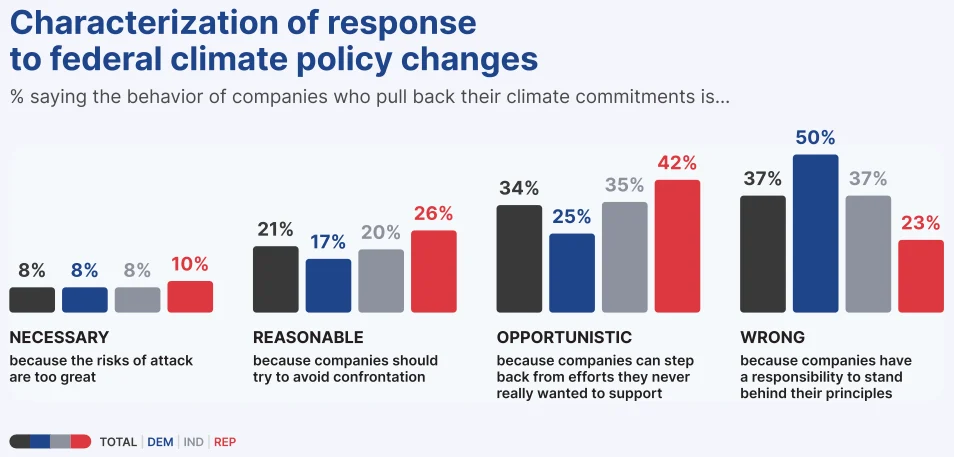
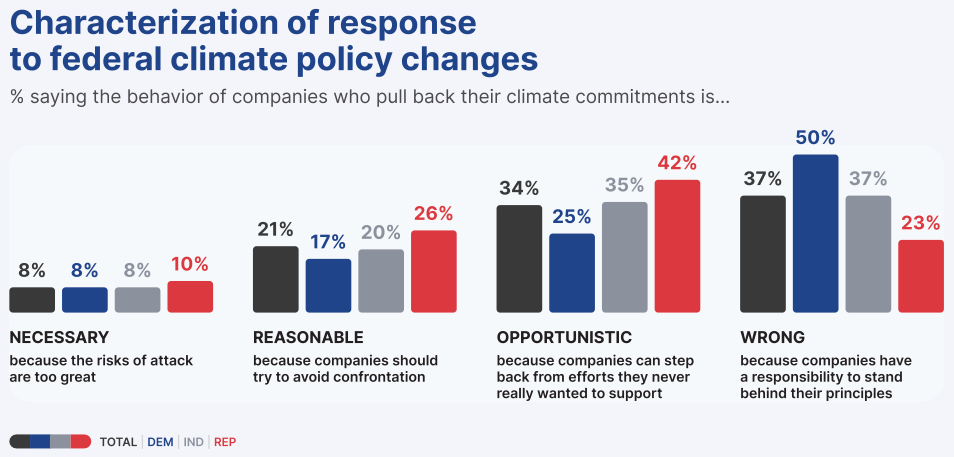
The current survey captures a pivotal moment of maturation. We are seeing a shift where voters are becoming increasingly critical of companies that "flip-flop." When companies backtracked on their climate commitments in response to political pressure, 71% of all voters—and 65% of Republicans—labeled the move as "opportunistic" or "wrong." This suggests that while voters may be wary of aggressive political signaling, they possess an even stronger distaste for corporate cowardice or perceived lack of integrity.
Supporting Data: By the Numbers
The survey provides a detailed statistical portrait of how the American voter perceives corporate environmentalism. The data serves as a roadmap for communications teams looking to navigate this complex landscape:
- Consumer Loyalty: Over 60% of respondents explicitly stated they are more likely to purchase goods and services from companies that prioritize clean energy and carbon reduction.
- The "Opportunism" Penalty: The 71% consensus against backtracking demonstrates that once a company makes a commitment, the public expects them to stand by it. The penalty for inconsistency is now higher than the perceived cost of the original commitment.
- The Rising Tide of Politicization: A concerning trend identified in the data is the increasing perception of climate action as a political act. For instance, in 2024, 40% of Democrats viewed the transition away from fossil fuels as a "political stance." By 2025, that figure climbed to 55%. This indicates that the environment itself is becoming more politicized in the public imagination, creating a more challenging environment for corporations to communicate their goals.
Official Responses: Insights from the Frontlines
The researchers behind the study were struck by the divergence between their hypothesis and the final data.
"I did not expect climate-skeptical Republicans to agree that this is smart business," said Verena Radulovic, vice president for business engagement at C2ES. "That was really encouraging to see. It suggests that when we strip away the partisan rhetoric, the core values of efficiency, cost-saving, and long-term planning are shared by the vast majority of Americans."
Nicholle Manners, a senior vice president at maslansky + partners, echoed this sentiment regarding the public’s reaction to corporate backtracking. "I was surprised by that," she noted, referring to the high percentage of voters who viewed corporate retreats from climate goals as inherently negative. "Consumers are more observant than we give them credit for. They don’t just see a change in policy; they see a lack of backbone."
These responses underscore a fundamental truth: the public does not necessarily want companies to stop acting on climate; they want companies to act with authenticity and purpose, rather than bowing to the shifting winds of political discourse.
Implications for Corporate Strategy
For business leaders, the implications of this study are profound. The traditional "stay silent" strategy is no longer a viable path to risk mitigation. Instead, the data suggests a new framework for corporate climate communication:
1. Focus on the "Why," Not the "Which"
Companies should stop leading with abstract global temperature targets and instead lead with tangible business benefits. Framing climate action as a way to reduce energy costs, build supply chain resilience, and modernize infrastructure aligns with the values of both conservative and liberal consumers.
2. Consistency is Key
The data shows that voters are punishing companies for inconsistency. Leaders must be prepared to stay the course once a commitment is made. "Green-hushing" or retreating from climate targets can cause more reputational damage than the initial commitment itself.
3. De-escalating the Political Tone
The study confirms that the public is increasingly viewing environmental issues through a political lens. To combat this, companies must intentionally use language that avoids partisan signaling. Instead of adopting the vocabulary of political activists, firms should use the vocabulary of economists and engineers.
4. Recognizing the Value of Stewardship
There is a deep-seated cultural belief in American society regarding the protection of natural resources. By framing climate initiatives as "stewardship" and "legacy-building," companies can tap into shared values that exist outside of the typical partisan divide.
Conclusion
The findings from the C2ES and maslansky + partners survey offer a rare piece of good news for the corporate world: the American public is not as divided as the political noise would suggest. While the path forward for companies remains complex, the destination is clear. Voters across the political spectrum are signaling that they value environmental responsibility and are losing patience with companies that treat these critical issues as political footballs.
By grounding their climate communication in the language of common sense, stability, and long-term integrity, companies can move past the current state of "green-hushing" and toward a more confident, sustainable future. The data proves that while the politics of climate change may be fractured, the appetite for corporate leadership on the issue is very much intact. The challenge for the modern executive is no longer to choose between profitability and the planet, but to communicate the reality that they are, in fact, one and the same.