Published: September 9, 2026
Author: Olivia Poston (Adapted and Expanded)
Main Facts: The Gendered Realities of Urban Space
Public space is frequently romanticized as a democratic, universal realm where civic life unfolds on equal terms. In reality, the physical environment is experienced through a deeply gendered lens. For millions of women, navigating the contemporary city requires a continuous, exhausting psychological calculation. Every trip involves an ongoing risk assessment regarding exposure, visibility, proximity to strangers, lighting conditions, public transit access, and potential escape routes.
While the built environment does not inherently create gender-based violence, it can profoundly exacerbate vulnerability and normalize unequal access. Safety is not merely a social issue; it is a complex product of urban form, physical maintenance, mobility networks, municipal governance, and the equitable distribution of public investment.

Architects, urban planners, and municipal policymakers are increasingly confronting a critical distinction: the difference between designing for security versus designing for safety.
- Security strategies typically rely on top-down mechanisms—surveillance cameras, heightened policing, restricted access zones, and the aggressive management of human movement.
- Safety, conversely, is organic and spatial. It depends on whether people can see and be seen, whether pedestrian routes are legible and intuitive, whether public spaces support diverse activities across all hours of the day, and how rigorously infrastructure is maintained over time.
The ultimate role of urban design is to alter the foundational conditions under which public life takes place, transforming hostile environments into inclusive landscapes.
Chronology: The Evolution of Gender-Sensitive Urbanism
The integration of gender equity into urban planning is not a sudden trend; it is the result of decades of grassroots activism, feminist critique, and policy evolution.
1. Late 20th Century: The Feminist Critique of Modernist Planning
During the mid-to-late 20th century, modernist urban planning—characterized by car-centric sprawl, rigid functional zoning, and vast, desolate plazas—was heavily critiqued by feminist theorists like Jane Jacobs. Jacobs championed the concept of "eyes on the street," highlighting how vibrant, mixed-use neighborhoods naturally fostered safer environments. However, mainstream planning largely ignored the specific vulnerabilities women faced in transit hubs, underpasses, and unlit pedestrian corridors.
2. Early 2000s: The Rise of Safety Audits
Cities like Toronto and Vienna pioneered "women’s safety audits," empowering local communities—particularly women and marginalized groups—to walk through neighborhoods and map out dangerous spots. Vienna emerged as a global leader in gender-mainstreaming urban policy, redesigning parks, sidewalks, and lighting to accommodate caregiving pathways and active mobility rather than solely prioritizing vehicular commuter traffic.
3. 2010s–2020s: Digital Mapping and Global Frameworks
The proliferation of smartphones birthed crowdsourced safety mapping apps (such as SafetiPin), allowing women to digitally log poorly lit streets, harassment hotspots, and broken infrastructure in real time. International bodies, including UN-Habitat, launched global initiatives focused on safe cities and public spaces, urging municipal governments to view infrastructure through a gender lens.

4. 2026 and Beyond: Case-Based Architectural Interventions
Contemporary urban design has moved beyond theoretical frameworks into concrete, site-specific interventions. Recent architectural projects from around the globe demonstrate how localized interventions—from integrated cultural hubs to reimagined infrastructure—can radically reshape women’s daily spatial experiences.
Supporting Data: Spatial Inequity in Numbers
Quantitative and qualitative research underscore the urgent need for gender-sensitive urban design:
- The Perception Gap: Studies across major metropolitan areas consistently reveal that up to 80% of women modify their daily routines—such as avoiding specific parks, transit stations, or walking routes after dark—out of fear of harassment or assault.
- Mobility Patterns: Research in urban mobility shows that women make more chained trips (combining work, childcare, shopping, and domestic errands) compared to men, who typically travel linearly from home to work and back. Traditional transit networks, designed around male commuting patterns, fail to support these multi-stop journeys, increasing women’s exposure to unsafe transit environments.
- Infrastructure Deficits: Broken streetlights, overgrown shrubbery that blocks sightlines, narrow or obstructed sidewalks, and isolated public restrooms are cited by urban safety reports as the primary physical catalysts for spatial anxiety among female pedestrians.
Official Responses and Case Studies: Lessons from Four Public Spaces
To understand how modern design can successfully foster safety, urban theorists look to four distinct public spaces that redefine the relationship between architecture and gender equity:

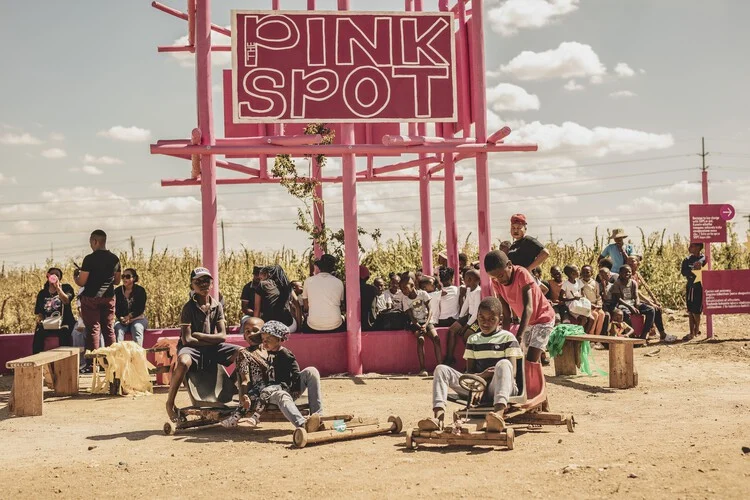
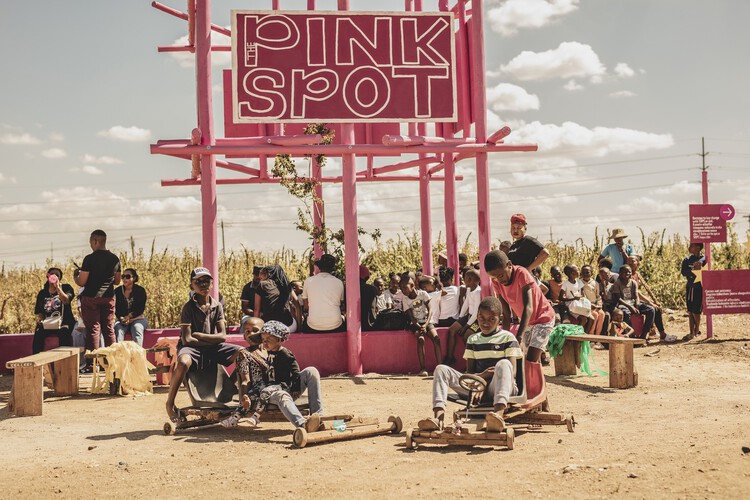
1. House of the Pink Spot (South Africa)
Designed by Frankie Pappas International, this project demonstrates how architectural interventions can inject vibrancy and communal ownership into neglected urban fabrics. By prioritizing visual permeability, active community interfaces, and engaging spatial programming, the project transforms potential danger zones into welcoming civic anchors.
2. Suba Nuestro Jardín Cultural (Colombia)
Helmed by local initiatives like Bicistema, this project highlights the integration of mobility, cultural programming, and green space in Bogotá. By designing cycling and pedestrian infrastructure that connects historically underserved neighborhoods with well-lit, active community spaces, the design minimizes isolated transition zones where women are most vulnerable to street harassment.
3. Charaani Public Stairs (Lebanon)
Developed by Emergent Vernacular Architecture (EVA Studio), this project addresses the complex topography of dense urban settlements. In many hillside or informal settlements, steep, unlit staircases act as intimidating bottlenecks. By re-imagining these pedestrian links with improved lighting, handrails, seating areas, and community-driven art, the design turns precarious pathways into safe, dignified public thoroughfares.
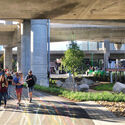
4. Infra-Space 1 (United States)
Created by Landing Studio, this project reclaims the forgotten, often menacing spaces underneath highway infrastructures and bridges. Traditionally avoided due to poor lighting, lack of visibility, and spatial isolation, Infra-Space 1 transforms industrial leftovers into active public parks, demonstrating that infrastructural gray spaces can be successfully converted into safe, lit, and heavily utilized community amenities.
Implications for the Future of Urban Planning
The lessons drawn from these diverse global projects carry profound implications for the future of architecture and city-making:
1. Moving Beyond Reactive Policing
Municipalities must recognize that adding more police officers or security cameras does not fix bad design. True safety is proactive. When a space is naturally active, well-lit, visually connected, and regularly maintained, it reduces the opportunity for harassment without infringing on civil liberties or creating an oppressive atmosphere.

2. Participatory Design as a Standard
Architects and urban planners can no longer design in a vacuum. Incorporating the lived experiences of women, children, the elderly, and marginalized communities into the initial briefing and participatory design phases is essential. Those who navigate the city daily hold the most accurate data regarding its spatial failures.
3. Holistic Urban Governance
Designing safer cities requires breaking down silos between departments of transportation, parks, urban planning, and municipal finance. Lighting must be maintained, public transit schedules must align with pedestrian safety, and sidewalks must be kept clear of obstructions. Safety is an ongoing operational commitment, not just a one-time construction milestone.
Ultimately, designing public spaces for women’s safety creates better cities for everyone. When a city is safe and navigable for a woman walking alone at night with a stroller or groceries, it is a city that works for all of its inhabitants.