By Motor1 Automotive Desk
Published following the Salone Auto Torino
Introduction: The Micro-EV Design Revolution
In the modern automotive landscape, horsepower figures, 0-to-60 acceleration times, and battery range capacities dominate industry discourse. Vehicles are increasingly judged by brute metrics rather than emotional resonance. However, at the recent Salone Auto Torino, legendary automotive designer Fabrizio Giugiaro and entrepreneur Lapo Elkann disrupted this paradigm. They proved an undeniable truth: even a sub-$15,000, low-speed electric city car can carry the profound weight of a definitive design statement.
Unveiled at Giugiaro’s renowned GFG Style studio, the duo debuted two radically distinct, one-off interpretations of the humble Fiat Topolino: the Top.L and the Top.J. Neither vehicle alters the fundamental mechanical architecture or low-speed urban runabout purpose of the production Topolino. Instead, they completely rewrite its visual and emotional language. Together, they transform Fiat’s most affordable electric vehicle (EV) into a rolling argument that true automotive passion requires neither massive horsepower nor an astronomical price tag.
1. Main Facts: The Anatomy of the Top.L and Top.J
At first glance, the production Fiat Topolino is a charming, utilitarian quadricycle designed for tight European alleys and dense metropolitan cores. The GFG Style interpretations strip away this basic utilitarian facade, injecting high-fashion tailoring and historical motorsport reverence into the chassis.
The Top.L: Speedster Attitude
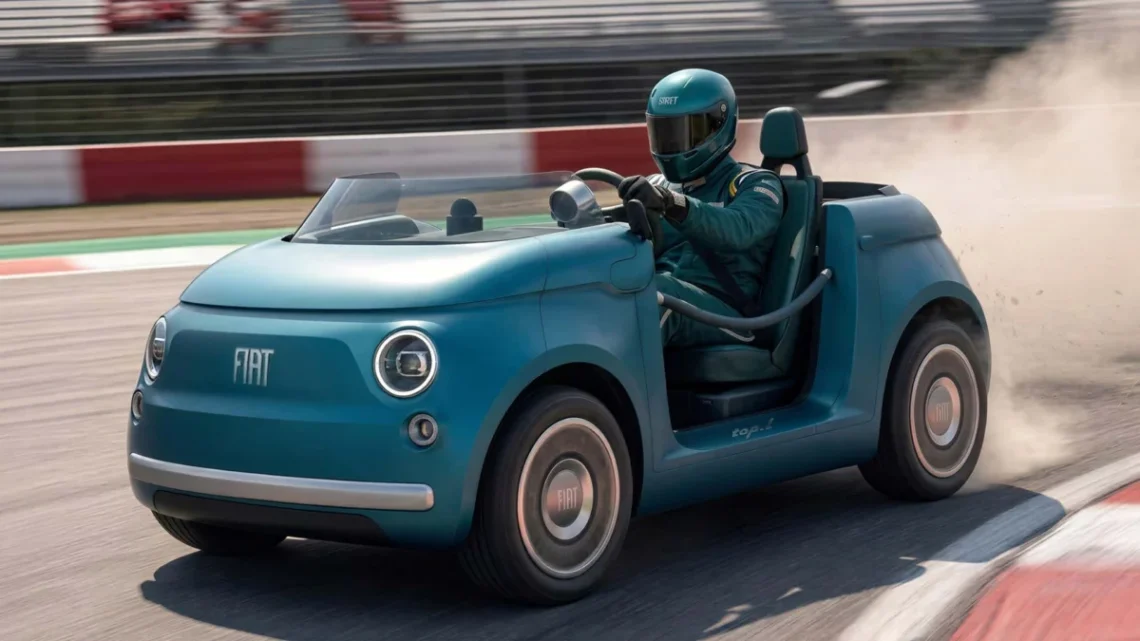
The Top.L reinterprets the Topolino as an uncompromising, roofless two-seat speedster. Key features include:
- Minimalist Design: A drastically chopped, minimal windshield replaces the standard glasshouse, exposing the occupants directly to the elements.
- Color and Materials: Finished in a striking matte aquamarine paint scheme, the exterior flows seamlessly into a bespoke cabin upholstered in matching aquamarine leather and Alcantara.
- Design Philosophy: Fabrizio Giugiaro stated that the explicit goal was to push a small, accessible vehicle as far along the spectrum of emotion and creativity as physical engineering would allow. The styling acts as a direct nod to rebellious historical sports cars—most notably the Porsche 550 Spyder famously dubbed "Little Bastard" by James Dean. It is not a literal copy, but rather an emulation of attitude: a diminutive car engineered to command attention without needing velocity to back it up.
The Top.J: Joy, Heritage, and Micro-Luxury
In stark contrast, the Top.J flips the script on interior packaging and historical tribute:
- Four-Seat Layout: Despite measuring a mere 8.3 feet in length, the Top.J manages to seat four passengers. In a clever spatial trick, the rear pair of seats face rearward.
- Open-Air Architecture: A traditional fixed roof is discarded in favor of a taut fabric cover, maximizing the open-air micro-tourer experience.
- The Agnelli Family Livery: The cabin and exterior mix marine-grade foam and supple leathers in bespoke shades of blue and green. This color palette directly references the historic Ferrari 166 MM Barchetta once owned by Gianni Agnelli (Lapo Elkann’s grandfather), while also recalling Umberto Agnelli’s tradition of commissioning personal runabouts in identical hues.
- Nomenclature: According to Lapo Elkann, the names were chosen to split the overarching concept neatly in two: Top.J for "Joy" and Top.L for "Love"—both envisioned as free, irreverent, and utterly authentic expressions of Italian design culture.
2. Chronology: From Factory Micromobility to Showroom Icons
Understanding how these two concepts came to life requires examining the timeline of the Fiat Topolino platform and its expanding global footprint.
- The Genesis of the Modern Topolino: Rooted in the revival of micro-mobility, the production Fiat Topolino was introduced to Europe as a corporate cousin to the Citroën Ami and Opel Rocks Electric. Built strictly for short, urban environments, it captured imaginations with its retro-chic styling cues and ultra-low operating costs.
- Global Expansion and U.S. Adaptation: While initially targeted strictly at European markets under L6e quadricycle regulations, Fiat began targeting North American niches, positioning the Topolino for closed communities, dense urban neighborhoods, and golf cart-adjacent use. Current U.S.-spec configurations are limited to a top speed of approximately 19 miles per hour and are not street-legal right off the showroom floor.
- The Salone Auto Torino Debut: Fabrizio Giugiaro and Lapo Elkann selected the Salone Auto Torino to showcase their vision. Leveraging GFG Style’s engineering capabilities, they fast-tracked the development of the Top.L and Top.J to demonstrate how coachbuilding heritage can be applied to modern electric micro-cars.
- Future Road-Legal Roadmap (Late 2026): Looking ahead, Fiat has committed to rolling out a free, dealer-installed Street Legal Conversion Kit by late summer 2026. This kit reclassifies the vehicle as a Low Speed Vehicle (LSV), raising the top speed threshold to roughly 25 miles per hour and granting access to most roadways posted at 35 miles per hour or less.
3. Supporting Data & Technical Specifications
To contextualize the design exercises of Giugiaro and Elkann, one must examine the baseline specifications of the vehicle they modified:
| Specification | Production Fiat Topolino (Base) | Top.L / Top.J Concepts (GFG Style) |
|---|---|---|
| Vehicle Class | Light Quadricycle (L6e in Europe / LSV target in US) | Coachbuilt Show Concepts |
| Length | ~8.3 feet (2,535 mm) | ~8.3 feet (2,535 mm) |
| Seating Capacity | 2 occupants | Top.L: 2 occupants / Top.J: 4 occupants |
| Powertrain | Single Electric Motor (Sub-10 hp equivalent) | Standard Topolino Electric Drivetrain |
| Battery / Range | ~5.4 kWh lithium-ion / ~45 miles (75 km) | Standard Platform Specs |
| Top Speed (Current) | 19 mph (U.S.) / 28 mph (28 km/h in Europe) | Unchanged (Low-speed urban dynamics) |
| Target Price (U.S.) | ~$14,985 (Before options and conversion kits) | One-off (Priceless design study) |
4. Official Responses and Industry Perspectives
The partnership between GFG Style and Lapo Elkann’s creative agencies has long been celebrated for pushing aesthetic boundaries, but this project represents a unique foray into the economy EV sector.
Fabrizio Giugiaro’s Design Vision
Fabrizio Giugiaro emphasized that the challenge of working with a micro-car lies in avoiding the trap of looking cheap. "When you remove excess dimensions, weight, and power, design is all you have left," Giugiaro noted during the presentation. "With the Top.L, we wanted to see how far the emotional DNA of a sports car could be compressed into a vehicle that honors simplicity while refusing to look mundane."
Lapo Elkann on Family Heritage and Joy
Lapo Elkann, known for his flamboyant and deeply personal automotive commissions through Garage Italia and other ventures, highlighted the emotional narrative of the Top.J. "My grandfather’s cars were statements of personal taste, not just utility. Bringing the colors of the Ferrari 166 MM into a micro-EV bridges the gap between post-war Italian elegance and modern sustainable mobility. Top.J is pure joy; Top.L is unbridled love. Together, they prove that you do not need a multi-million-dollar supercar to evoke smiles and stir the soul."
Fiat’s Corporate Stance
While Fiat has not announced plans to put the Top.L or Top.J into mass production, company representatives have embraced the cultural halo effect provided by the GFG Style concepts. As rumors regarding potential high-performance variants—such as an anticipated, enthusiast-driven Abarth Topolino—continue to swirl, Fiat management acknowledges that creative customization is key to keeping younger demographics engaged in electric mobility.
5. Implications: What This Means for the Future of Micromobility
The collaboration between Giugiaro and Elkann carries several significant implications for the automotive sector at large:
- The Democratization of Design: For decades, coachbuilding and bespoke styling were reserved exclusively for ultra-luxury marques like Ferrari, Rolls-Royce, and Bugatti. The Top.L and Top.J demonstrate that bespoke craftsmanship can trickle down to the most accessible segments of the market, elevating the cultural status of affordable transportation.
- Combating EV Sterility: As the automotive industry transitions toward electrification, critics frequently decry the "homogenization" of vehicle design, driven by aerodynamic efficiency and strict safety regulations. Micro-cars like the Topolino, when treated as blank canvases by master designers, offer a desperately needed antidote to automotive uniformity.
- Urban Integration and Aesthetic Value: Cities across Europe and North America are increasingly looking toward light quadricycles and LSVs to solve urban congestion and carbon emissions. However, public adoption often stalls if vehicles are viewed purely as uninspired "compliance appliances." By wrapping micromobility in high-fashion, desirable aesthetics, designers can accelerate cultural acceptance.
- A Sign of Things to Come: While the Top.L and Top.J currently stand as one-off showpieces, both creators have hinted that this marks merely the opening chapter of a longer collaborative pipeline. Whether future iterations achieve full road-legality or remain gallery centerpieces, they have irrevocably altered expectations for what an entry-level city car can look like.
Motor1’s Take
The debut of the Fiat Topolino Top.L and Top.J by GFG Style proves an essential truth: styling possesses the unique power to grant low-speed electric vehicles an outsized personality without altering their fundamental utilitarian purpose. For urban planners, manufacturers, and everyday consumers who value affordable, highly visible, and sustainable transport, this matters deeply.
Whether these specific concepts inspire official factory trim packages or remain isolated masterclasses in Italian coachbuilding, Fabrizio Giugiaro and Lapo Elkann have successfully reminded the global automotive community that passion, heritage, and joy are not determined by the size of an engine or the length of a price tag.