By Automotive News Desk
Published: February 2025
For decades, the name Jensen evoked a very specific kind of motoring nostalgia: the grand touring elegance of the 1960s and 70s, defined by long hoods, aggressive fastback rooflines, and muscular American V8 engines wrapped coach-built British style. While the badge faded into automotive history following the brand’s quiet demise, the spirit of Jensen has stubbornly refused to die.
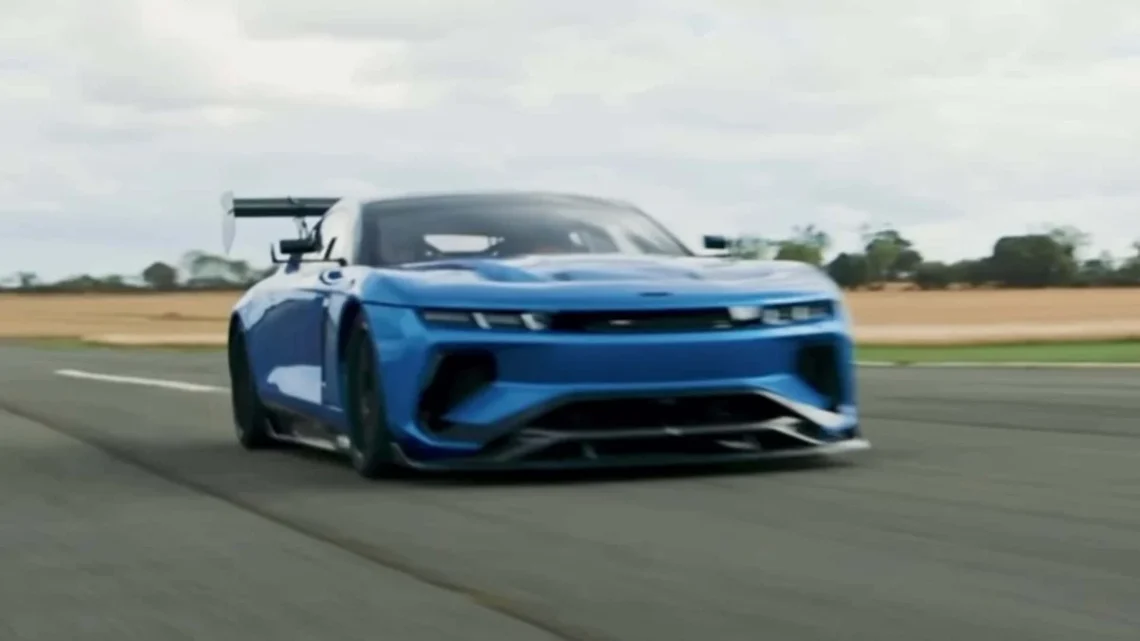
Now, the iconic nameplate is storming back into the consciousness of enthusiasts with a vengeance. The newly unveiled Jensen Interceptor GTX may currently exist strictly as a track-only prototype, but it serves as a thunderous announcement that a legendary British marque is ready to reclaim its place in high-performance history. And judging by the ferocious, unadulterated wail of its supercharged powertrain at full chat, the automotive world is in for a wild ride.
Main Facts: Unleashing the Beast
At its core, the 2026 Jensen Interceptor GTX is a masterclass in cross-continental engineering, fusing traditional British grand tourer ethos with unapologetic American muscle. While current iterations of the car are confined to closed-circuit testing and track days, the specifications alone are enough to command the immediate attention of purists and speed aficionados alike.
- The Powertrain: Beneath the hood lies a massively reworked, supercharged 6.8-liter V8 engine sourced originally from General Motors, transformed into a high-revving powerhouse by Texas-based Late Model Engine (LME).
- Power Output: The engine routinely kicks out an astonishing 973 horsepower in its current specification, with Jensen engineers confirming that a simple ECU tune can unlock up to 1,200 horsepower.
- Transmission: Defying modern industry trends toward lightning-fast dual-clutch automatics, the Interceptor GTX channels its monstrous output through a traditional manual gearbox, putting raw mechanical control squarely in the hands of the driver.
- Future Roadmap: While the GTX starts life as a track-only machine, Jensen’s long-term business plan includes transitioning the platform into street-legal variants, specifically a grand touring GT and a more aggressive sporting GTR.
Chronology: The Resurrection of a Brand
The journey from a forgotten historical footnote to a 1,000-horsepower track weapon has been methodical, driven by passionate investors and engineers determined to restore the Jensen name to its former glory.
Phase 1: The Blueprint (Early 2024)
Rumors began circulating within British automotive circles that the Jensen name was being evaluated for a modern revival. Unlike many resurrected brands attempting to pivot immediately to electrification, insiders leaked that the new leadership wanted to lean into traditional, analog thrills—specifically, a high-displacement internal combustion engine capable of rivaling modern supercars.
Phase 2: Naming and Teasers (Mid-2024)
Jensen officially confirmed the revival by releasing shadowy teasers of an ultra-high-performance luxury performance car. Shortly after, the company announced the official nomenclature: the Jensen Interceptor GTX. This immediately signaled to enthusiasts that the new car would pay direct homage to the classic Interceptor of 1966–1976, which famously utilized Chrysler big-block V8 engines inside a hand-formed Italian-designed body shell.
Phase 3: The Track-Only Reality (Late 2024)
As development progressed, Jensen made the strategic decision to debut the car as a track-only special. This move allowed the engineering team to bypass rigorous, time-consuming global homologation regulations for street vehicles, focusing instead purely on track dynamics, downforce, structural rigidity, and extracting maximum performance from the drivetrain.
Phase 4: The Prototype Debut and Acoustic Reveal (Early 2025)
The wraps finally came off the Interceptor GTX prototype, stunning observers with its aggressive aerodynamic package, race-prepped interior, and the star of the show: its supercharged 6.8-liter V8. Releasing high-definition audio and video of the car running at full chat across a circuit, Jensen gave the world its first real taste of the mechanical fury waiting inside the carbon-fiber bodywork.
Supporting Data: Under the Skin of the Interceptor GTX
To understand how the Interceptor GTX achieves its staggering performance figures, one must look at the meticulous engineering applied to its mechanical components.
+-------------------------------------------------------------------+
|                   JENSEN INTERCEPTOR GTX SPECS                    |
+----------------------+--------------------------------------------+
| Engine Configuration | Supercharged 6.8-Liter V8                  |
| Engine Origin        | GM Block, Upgraded by Late Model Engine    |
| Horsepower           | 973 hp (Base) / Up to 1,200 hp (Tuned)     |
| Cylinder Heads       | CNC Machined with Titanium Valves          |
| Engine Management    | MoTeC Advanced ECU System                  |
| Transmission         | Manual Gearbox                             |
| Vehicle Application  | Track-Only Prototype (Road Variants TBD)   |
+----------------------+--------------------------------------------+
The Transatlantic Engine Partnership
Jensen utilizes a robust General Motors engine block as the foundation. However, leaving a stock GM block untouched was never an option for a bespoke British builder. The block is shipped across the Atlantic to Late Model Engine (LME) in Texas, renowned for building world-class, high-horsepower domestic performance motors.
At LME, the engine undergoes a total structural overhaul. The cylinder heads are completely CNC-machined to optimize airflow and combustion efficiency. Lightweight, ultra-durable titanium valves are swapped in to handle the punishing RPMs and thermal loads associated with forced induction. Furthermore, the internal rotating assembly is heavily reinforced to withstand the pressures delivered by the massive supercharger.
Electronic Mastery and Fueling
Managing nearly 1,000 horsepower requires surgical precision. Jensen relies on a sophisticated MoTeC engine management system to control the engine’s fury. This motorsport-grade ECU governs everything from boost pressure and ignition timing to traction control and telemetry, ensuring that the driver can effectively harness the staggering output without immediately tearing the rear tires to shreds.
Official Responses and Industry Perspectives
The reception from the automotive community has been overwhelmingly positive, particularly among purists who mourn the gradual disappearance of high-displacement manual sports cars.
Jensen’s executive team has emphasized that the track-only Interceptor GTX is not merely a styling exercise, but a functional testbed. Company spokespersons have repeatedly noted that the grueling conditions of the race track are the ultimate proving ground for sorting out the chassis dynamics, cooling packages, and powertrain reliability before a single customer-facing road car is ever signed off.
Motor1’s Take: A Step in the Right Direction
Automotive analysts and testing editors have echoed a mixture of cautious optimism and sheer excitement:
"The race car definitely has us buzzing with anticipation for a road-ready version of the Interceptor. Jensen could have quite a ways to go to get there, but clearly the company is on the right path. When it does arrive, it likely won’t be cheap. But it should stand out, especially if it can sound anything close to the race car."
Industry experts point out that transitioning a bespoke track car into a street-legal vehicle is fraught with regulatory hurdles—ranging from crash-test homologation and pedestrian safety standards to emissions compliance. Yet, the fact that Jensen is laying its foundation with a pure, unfiltered track weapon proves they are prioritizing authentic driving dynamics over rushed commercialization.
Implications: What the Interceptor GTX Means for the Future of Motoring
The arrival of the Jensen Interceptor GTX carries significant symbolic and industrial weight in today’s rapidly changing automotive landscape.
1. The Resistance of Analog Thrills
At a time when the performance car market is dominated by heavy, complex electric vehicles and automated dual-clutch transmissions, the Interceptor GTX stands as a proud bastion of old-school mechanical engagement. Mating a supercharged V8 to a manual gearbox in a lightweight, driver-focused chassis proves that there is still a massive, vocal demographic that values visceral, tactile driving experiences over pure digital lap times.
2. The Blueprint for Boutique Manufacturers
Jensen’s strategy—developing a halo track car first, building brand equity through sound and fury, and subsequently promising grand touring (GT) and sporting (GTR) road variants—serves as a masterclass in modern boutique manufacturing. By using proven American V8 architecture paired with elite domestic tuning houses like LME, Jensen avoids the astronomical research and development costs associated with designing an entirely proprietary engine from scratch, passing those savings (and reliability benefits) down to the engineering of the chassis and aerodynamics.
3. The Rebirth of the British GT Rivalry
When the road-going iterations of the GT and GTR finally materialize, they are expected to enter a fierce competitive arena dominated by ultra-luxury performance brands like Aston Martin, Bentley, and high-end bespoke coachbuilders. If the road cars retain even a fraction of the raw acoustic drama, manual transmission engagement, and menacing aesthetics of the Interceptor GTX prototype, established luxury marques will have serious competition on their hands.
Conclusion
For now, the Jensen Interceptor GTX remains a hyper-exclusive, track-only experiment—a smoke-billowing, tire-shredding punctuation mark signaling the return of a storied British name. There is no official release date for the road-legal variants, and when they finally arrive, they will undoubtedly command a stratospheric price tag.
Yet, as the supercharged 6.8-liter V8 screams at full chat down a straightaway, echoing off pit walls and rattling the nerves of anyone fortunate enough to be standing nearby, one thing is abundantly clear: Jensen is back. And motoring is all the better for it.