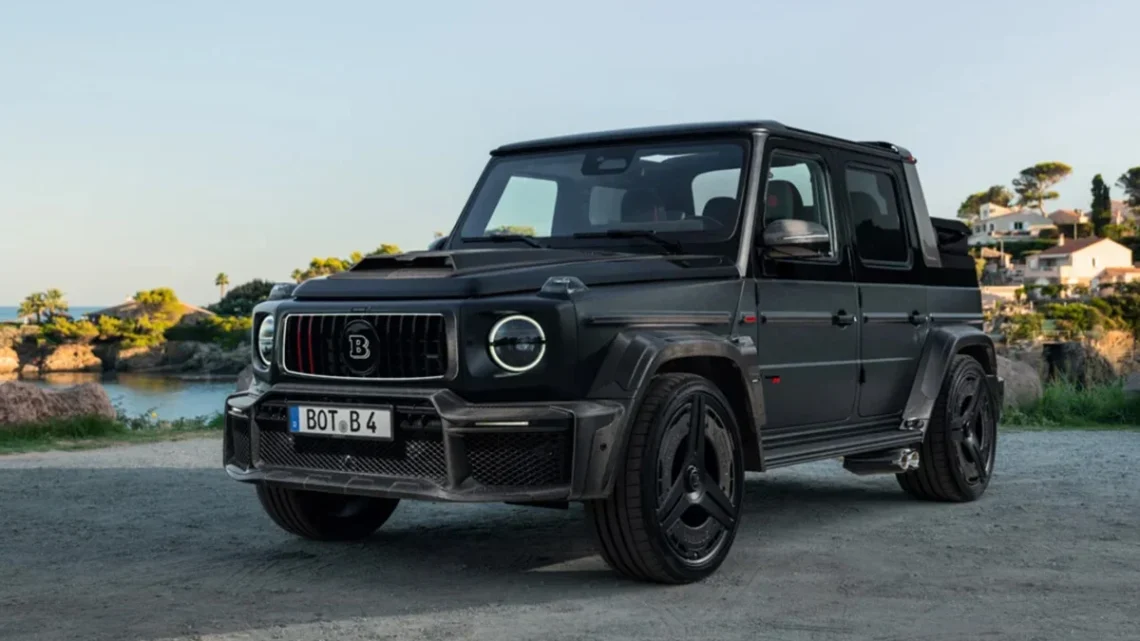
September 25, 2026 — Bottrop, Germany — Renowned luxury high-performance tuning house Brabus has once again pushed the boundaries of automotive excess with its latest creation. Unveiled today, the Brabus 900 Rocket Edition Cabrio takes the iconic Mercedes-Benz AMG G 63 and transforms it into an ultra-exclusive, open-air hyper-SUV. While it is not the German workshop’s first foray into topless G-Wagens, it stands as the most powerful, technologically advanced, and aggressively styled version to date.
Limited to a strictly allocated production run of just 10 examples worldwide, this million-dollar convertible marries brutal supercar performance with uncompromising bespoke luxury.
Main Facts
The Brabus 900 Rocket Edition Cabrio is a masterclass in bespoke automotive engineering, built upon the foundation of the legendary Mercedes-AMG G 63.
The Powertrain: Beneath the vented carbon-fiber hood lies a heavily modified 4.5-liter twin-turbocharged V-8 engine featuring forged pistons, custom connecting rods, and a specialized billet crankshaft.
Performance Figures: The engine pumps out a staggering 888 horsepower and 922 ft-lbs of torque. Power is routed to all four wheels through a nine-speed automatic transmission, allowing the heavy SUV to sprint from 0 to 62 mph (100 km/h) in a blistering 3.2 seconds. Its top speed is electronically limited to 149 mph.
Open-Top Architecture: The factory fixed roof has been excised from the beltline upwards past the C-pillar, replaced by a bespoke motorized soft top composed of 500 newly engineered components. A carbon-fiber aerodynamic bow ensures the fabric top maintains structural integrity at high velocities.
Exclusivity & Pricing: Production is strictly limited to 10 units globally. Pricing starts at €890,740, translating to just over $1,000,000 USD before bespoke personalizations and local import duties.
Chronology of Evolution: From Factory Icon to Brabus Rocket
To understand the magnitude of the 900 Rocket Edition Cabrio, one must examine the timeline of how Brabus evolved the utilitarian military-grade G-Wagen into a playground for the ultra-wealthy.
1. The Genesis of the G-Wagen Tuner Culture
For decades, Brabus has treated the Mercedes-Benz G-Class as a blank canvas. While AMG elevated the vehicle with factory V-8 and V-12 powerplants, Bottrop’s engineers consistently sought to rewrite the rules of physics. Over the years, conversions grew from simple wheel-and-exhaust packages to full engine rebuilds and extravagant widebody aesthetics.
2. The Open-Top Predecessors (The XL 800 Cabrio Era)
Mercedes-Benz famously experimented with limited factory convertibles like the Mercedes-Maybach G 650 Landaulet, but demand far outstripped supply. Seizing an opportunity, Brabus introduced previous open-top iterations, most notably the XL 800 Cabrio. These conversions required profound structural modifications, as removing the roof of a body-on-frame SUV inherently compromises torsional rigidity. Brabus mastered this art, reinforcing the chassis to handle massive power outputs without flexing.
3. The Development of the 900 Rocket Platform
The introduction of the Rocket badge signified Brabus stepping into hyper-performance territory. Following the success of sedan and coupe Rocket editions, the designation was applied to the G-Class to denote extreme aerodynamic styling, signature Rocket Red accents, and bored-out, highly tuned powerplants.
4. September 2026: The Worldwide Debut of the 900 Rocket Edition Cabrio
Unveiled to the public on September 25, 2026, the 900 Rocket Edition Cabrio represents the pinnacle of this evolutionary timeline. By merging the 4.5-liter displacement-bored V-8 engine with the newly re-engineered convertible soft-top architecture, Brabus has synthesized its most extreme mechanical capabilities into a single, breathtaking vehicle.
Supporting Data and Technical Specifications
A closer examination of the Brabus 900 Rocket Edition Cabrio reveals an exhaustive catalog of bespoke engineering upgrades across its chassis, engine bay, aerodynamics, and interior architecture.
Powertrain and Performance Metrics
Engine Type: Brabus V8 Biturbo 4.5-liter (enlarged from the stock AMG 4.0-liter displacement).
Internal Components: Billet steel crankshaft with custom stroke, forged pistons, and high-performance connecting rods.
Max Power: 888 hp (653 kW) at 6,200 RPM.
Max Torque: 922 lb-ft (1,250 Nm) electronically limited to protect the drivetrain.
Top Speed: 149 mph (240 km/h) electronically governed.
Exterior Aerodynamics and Styling
Body Kit: Complete widebody "Widestar" styling package featuring aggressive front and rear fascias, larger carbon-fiber fender flares, and integrated cooling ducts.
Hood: Custom carbon-fiber hood scoop with integrated power domes.
Grille: Bespoke front grille incorporating dual red slats, illuminated badging, and the iconic Brabus "B" logo in place of the three-pointed star.
Wheels: "Platinum Edition" forged Monoblock wheels, utilizing a retro-futuristic three-spoke design heavily inspired by Brabus builds from the 1980s.
Suspension: Brabus RideControl adjustable coilover suspension system, allowing drivers to drop the ride height by up to 1.8 inches for enhanced on-road handling dynamics.
Interior Craftsmanship
Seating Layout: A luxurious four-seat configuration separated by a custom full-length center console running between both rows.
Materials: Premium black leather and Alcantara enveloping the cabin from floorboards to the soft-top ceiling.
Accents: High-gloss carbon-fiber trim panels on the dash and consoles, contrasted by vibrant "Rocket Red" switchgear, piping, and illumination.
While Brabus has long maintained a reputation for appealing to a niche clientele of collectors, sports stars, and royalty, the reception to the 900 Rocket Edition Cabrio has been overwhelmingly enthusiastic within high-end automotive circles.
Industry analysts note that while utility-focused purists often scoff at chopping the roof off an off-road icon, the market dynamics for ultra-exclusive, coachbuilt vehicles tell a completely different story.
"Brabus doesn’t build cars for people looking for sensible transportation; they build rolling statements of absolute individuality," notes luxury automotive commentator Marcus Vance. "When you combine the theater of an open-top G-Wagen with nearly 900 horsepower and a seven-figure price tag, you aren’t just selling an SUV—you are selling membership into an extremely exclusive club of ten people worldwide."
Brabus representatives have emphasized that the engineering behind the soft-top mechanism required thousands of hours of computer-aided design (CAD) and wind-tunnel testing. Ensuring that a convertible SUV can handle a 149 mph top speed without wind buffeting or structural degradation required completely rethinking the C-pillar bracing and roof-tension systems.
Implications for the Luxury Automotive Market
The debut of the Brabus 900 Rocket Edition Cabrio carries several broader implications for the ultra-luxury and custom tuning sectors:
1. The Resurgence of Coachbuilding and Ultra-Exclusivity
Mass production no longer appeals to the upper echelon of wealth. As global wealth concentrates, collectors increasingly demand hyper-personalized, ultra-low-volume vehicles. By capping production at 10 units, Brabus ensures immediate collector status and long-term asset appreciation.
2. The V-8 Engine’s Swan Song in Extreme Tuning
As global emissions regulations increasingly mandate electrification, tuners like Brabus are squeezing every drop of thermal efficiency and mechanical fury out of internal combustion engines. The 4.5-liter twin-turbo V-8 stands as a monument to the golden age of high-displacement, fuel-burning performance engineering before hybrid and electric architectures take total precedence.
3. The Reimagining of the G-Wagen Market
Mercedes-Benz’s upcoming electric G-Class (the G 580 with EQ Technology) points toward a silent, battery-powered future for the off-roader. However, creations like the 900 Rocket Edition Cabrio prove that the appetite for old-school, petrol-guzzling, high-decibel internal combustion performance remains ferociously strong among elite buyers.
Buying In
With production capped at just 10 units globally and a sticker price starting at €890,740 ($1+ million USD), prospective buyers are advised to contact Brabus directly. Given the intense demand for previous open-top variants from the Bottrop workshop, these 10 chassis are expected to find homes among elite collectors before the year is out.