Main Facts: The Ultimate Rotary Franken-Build
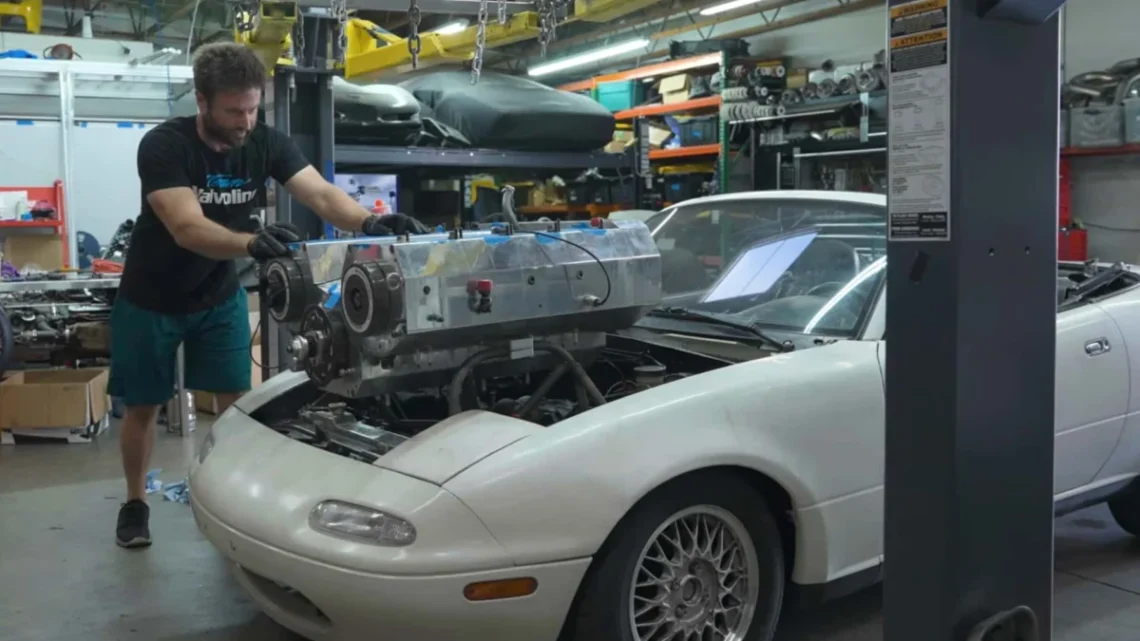
In the hyper-competitive world of custom automotive fabrication, few builders operate on the same plane of theatrical absurdity as Rob Dahm. Known globally for his YouTube channel dedicated to pushing Mazda’s legendary rotary engines to unprecedented mechanical extremes, Dahm has outdone himself. For the 2026 SEMA Show in Las Vegas, Dahm unveiled his latest creation: a first-generation Mazda MX-5 Miata stuffed with an unbelievable 13-rotor configuration backed by four turbochargers—and astonishingly, the car actually runs.
The engineering reality behind the internet-breaking headline, however, involves a clever sleight of hand. The vehicle pairs a massive, non-functional 12-rotor engine sitting proudly up front with a separate, fully operational single-rotor engine equipped with a Garrett GBC22 turbocharger. The single-rotor motor does the heavy lifting of actually moving the car under its own power, while the 12-rotor block acts as an elaborate, fully plumbed display piece.
Commissioned by engine management giant Haltech for its primary exhibition booth in the Central Hall, the project bridges the gap between internet shock value and genuine, high-level fabrication problem-solving. Dahm’s team managed to package an impossibly long engine layout into a subcompact roadster chassis designed originally for a modest, inline-four cylinder motor. The finished machine stands as a testament to what happens when mechanical ambition completely overrides packaging limitations.
Chronology: From Concept to the Las Vegas Convention Center Floor
Bringing a 13-rotor Miata to life for one of the automotive industry’s most prestigious stages was anything but a straightforward process. The build followed a grueling timeline, moving from wild YouTube concept art to frantic, last-minute garage engineering.
Phase 1: The Brief and Packaging Realities
The genesis of the project began when Haltech approached Dahm with a simple request: bring something unforgettable to their 2026 SEMA booth. For a builder whose name is synonymous with multi-rotor conversions, standard builds were out of the question. Dahm decided that even a twelve-rotor engine wouldn’t be enough to satisfy the crowd; he needed to push the envelope further, combining his past engineering experiments into a single platform.
Because a true 13-rotor inline layout would stretch the length of a small school bus—let alone fit inside an MX-5 engine bay—the team had to strategize. They decided on the optical illusion layout: a colossal 12-rotor mock-up positioned in the engine bay to steal the spotlight, paired with a hidden or secondary single-rotor setup responsible for propulsion.
Phase 2: Fabrication and Engine Bay Gymnastics
Cramming the massive hardware components into a first-generation (NA) Miata chassis required intense structural modification. The team fabricated custom engine mounts from scratch. These mounts had to be intricately triangulated into the chassis frame rails to resist both side-to-side torsional wobble and severe teeter-totter pitching caused by the overwhelming front-end weight distribution.
Every component installation became a high-stakes puzzle. Turbochargers, intake manifolds, and custom fuel rails had to be reinstalled in an exact, non-negotiable sequence. Certain secondary parts were engineered to double as structural braces, holding the assembly rigid against the car’s inner fenders. To save critical time under the tight deadline, Dahm’s crew relied on labeled wiring harnesses and peripheral components salvaged from previous rotary projects, bypassing the months-long process of building a harness completely from zero.
Phase 3: The Trailer Crisis and SEMA Debut
Before the vehicle could be praised for its engineering, it had to survive the journey to the exhibition floor. Moving the heavily nose-heavy Miata into a transport trailer proved to be a nail-biting logistical crisis. The team engaged in an intense debate regarding ground clearance versus the steep angle of the loading ramp.
Compounding the problem, the car’s rear end began to slide sideways mid-load as the extreme weight shifted across the chassis. Success ultimately came down to millimeter-precise measurements, sheer nerve, and an acceptance that the undercarriage would likely scrape on the way up.
The vehicle successfully made the journey and took its place in Haltech’s Central Hall booth for the 2026 SEMA Show, running from November 3 through November 6. Throughout the four-day event, fans and automotive journalists crowded around to witness the machine fire up and move under its own power.
Supporting Data: Specifications and Technical Breakdown
To truly understand the scale of Rob Dahm’s SEMA build, one must look at the technical parameters and sheer physical weight penalties inflicted on the diminutive Mazda chassis.
- Total Rotor Count: 13 rotors combined (12-rotor display engine + 1-rotor running engine).
- Turbocharger Count: 4 turbochargers total across the integrated ecosystem, including a Garrett GBC22 turbocharger dedicated to the functional propulsion unit.
- Claimed Output: The massive 12-rotor engine carries a theoretical output rating of 4,500 horsepower (though it functions purely as an aesthetic masterpiece in this application).
- Weight Penalties: Each of the primary turbochargers adds approximately 70 pounds directly to the front end, severely overloading a platform engineered for a lightweight, balanced four-cylinder motor.
- Chassis Modifications: Custom-fabricated, triangulated engine mounts designed to manage extreme front-heavy weight distribution and rotational torque forces.
- Event Window: Exhibited November 3–6, 2026, at the Haltech Booth, Central Hall, Las Vegas Convention Center.
Official Responses and Industry Reception
The automotive community’s reaction to Dahm’s 13-rotor Miata has been a mix of amusement, awe, and deep respect for the sheer audacity of the fabrication work. Haltech, as the primary sponsor and host of the vehicle, championed the build as an embodiment of the uninhibited spirit of aftermarket tuning.
"When you give builders like Rob Dahm a platform and a blank canvas, you don’t get conventional engineering—you get rolling art that challenges every convention of what an engine bay is supposed to hold," noted a Haltech representative during the setup days in Las Vegas.
Rob Dahm himself has consistently addressed the skepticism surrounding the build with transparency. Rather than attempting to hide the fact that the 12-rotor engine is non-functional in the drivetrain sense, Dahm leaned into the mechanical theater. He and his team intentionally kept the wiring harnesses, fuel lines, and peripheral accessories completely intact and routed across the massive block. Their goal was to force onlookers into a state of cognitive dissonance—questioning the laws of physics and internal combustion packaging rather than instantly spotting a missing driveshaft or blocked transmission tunnel.
Industry peers at SEMA praised the execution under pressure. Building a custom multi-rotor engine is widely considered a dark art within engine tuning circles due to apex seal stability, eccentric shaft flex, and complex oil delivery requirements. By successfully merging old project remnants into a cohesive, rolling showpiece within a compressed schedule, Dahm’s team earned the admiration of veteran fabricators attending the convention.
Implications: What This Means for Custom Car Culture
Rob Dahm’s 13-rotor Miata represents much more than a viral YouTube stunt or a clever SEMA booth attraction. It highlights several key trends and shifts within modern automotive enthusiast culture.
1. The Blurring Line Between Content Creation and Master Fabrication
In the modern era, high-end custom builds are intrinsically tied to digital media consumption. The pressure to deliver sensational visual content for platforms like YouTube often drives builders to attempt feats that would otherwise be economically or logistically unviable. However, as Dahm proves, internet-driven projects are no longer just "all show and no go." Behind the viral headline of a 13-rotor Miata lies legitimate, high-level CAD design, custom metal fabrication, and complex engine management integration.
2. The Evolution of Automotive "Packaging Art"
Packaging constraints have always dictated automotive design. Dahm’s approach turns traditional packaging wisdom on its head. By utilizing a non-functional primary engine block simply to achieve a specific aesthetic and conceptual goal, the build opens up a conversation about automotive sculpture. It challenges purist notions of functionality, suggesting that in the realm of custom show cars, visual and mechanical storytelling can sometimes supersede pure utility.
3. Keeping the Rotary Flame Alive
Mazda enthusiasts have long lamented the apparent death of the rotary engine in mass-market production vehicles, despite brief flickers of hope like the rotary-range-extended Mazda MX-30. Independent builders like Rob Dahm keep the rotary spirit alive by dragging the rotary engine—kicking, screaming, and turbocharged—into the 21st century. By pushing rotor counts into the double digits, Dahm ensures that the unique, high-pitched scream of rotary combustion remains a dominant cultural touchstone for a new generation of gearheads.
Ultimately, whether viewed as an engineering marvel or an exercise in sheer automotive madness, the 13-rotor Miata secures its place in SEMA history as a build that dared to ask: "What if we just kept adding rotors until it stopped fitting?"—and then made it fit anyway.