Deep in the heart of the Algerian Sahara, under a canopy of stars so dense they appear as a luminous, textured quilt, the modern world feels not just distant, but entirely non-existent. Lying on a thin roll-up mattress, zipped into a canvas sleeping bag, one can hear the nervous system finally settling into a rhythm of absolute stillness. There is no cell reception, no ambient hum of traffic, and no digital tether to the pressures of urban life. For a traveler, this profound "stress-shrinking" silence is the ultimate luxury, a rare commodity in an increasingly connected world.
Algeria, Africa’s largest nation by land area, is currently embarking on a transformation that aims to put this desert tranquility on the global map. Long dominated by the oil and gas sector, the country is now cautiously pivoting toward tourism, seeking to diversify its economy and share its vast, untapped landscapes with the world.
The Strategy: A Four-Fold Vision for 2030
Historically, Algeria has remained an outlier in the North African tourism landscape, attracting only a fraction of the visitor numbers seen by its neighbors, Morocco and Tunisia. For decades, the government showed little interest in the sector, leaving infrastructure underdeveloped and the country largely off the typical traveler’s itinerary.

However, a new "master plan" has emerged from the Ministry of Tourism, aiming for an ambitious four-fold increase in international arrivals by 2030. The primary focus of this initiative is the Sahara—a vast, otherworldly expanse that promises the kind of rugged, authentic adventure that seasoned travelers are increasingly seeking.
To facilitate this growth, the government has introduced a "visa on arrival" scheme specifically for those visiting the desert. Since its inception in 2023, nearly 39,000 visitors have utilized this streamlined process. For many, the experience is a stark contrast to the red tape often associated with regional travel. While the process involves careful monitoring and, at times, patient waiting at the airport, the end result—a stamp that grants access to one of the planet’s last great frontiers—is considered a fair trade.
Chronology of a Desert Expedition
The journey into the Sahara is a study in contrasts, beginning in the chaotic, historic energy of Algiers and ending in the absolute void of the Tassili n’Ajjer plateau.

The Northern Gateway: Algiers
The trip begins in the capital, Algiers. Here, the experience is a cultural immersion. Travelers are greeted by the lush, sprawling Hamma Botanical Garden and the winding, UNESCO-listed alleys of the Casbah. The city serves as a living museum, offering a poignant look at the country’s history, particularly through the National Museum of the Mujahid, which chronicles the harrowing war for independence from France. It is a city that demands repeat visits, with experts like local guide Wassim Messgo suggesting that the historic beauty of cities like Constantine offers a Roman-era grandeur that is rarely matched elsewhere in North Africa.
The Deep Desert: Djanet
A two-hour flight, often scheduled in the quiet of the night to avoid the harsh daytime desert winds, transports travelers from the coast to Djanet. This oasis town, situated near the borders of Libya and Niger, serves as the operational hub for desert expeditions.
Upon arrival, the reality of Algeria’s security landscape becomes clear. Due to regional geopolitical sensitivities, travel in the deep desert is strictly managed. Guides must coordinate closely with the military, submitting detailed itineraries, vehicle registration numbers, and the identity of every guest. This is not merely a bureaucratic hurdle; it is a fundamental part of the regional tourism infrastructure.

The Five-Day Plateau Journey
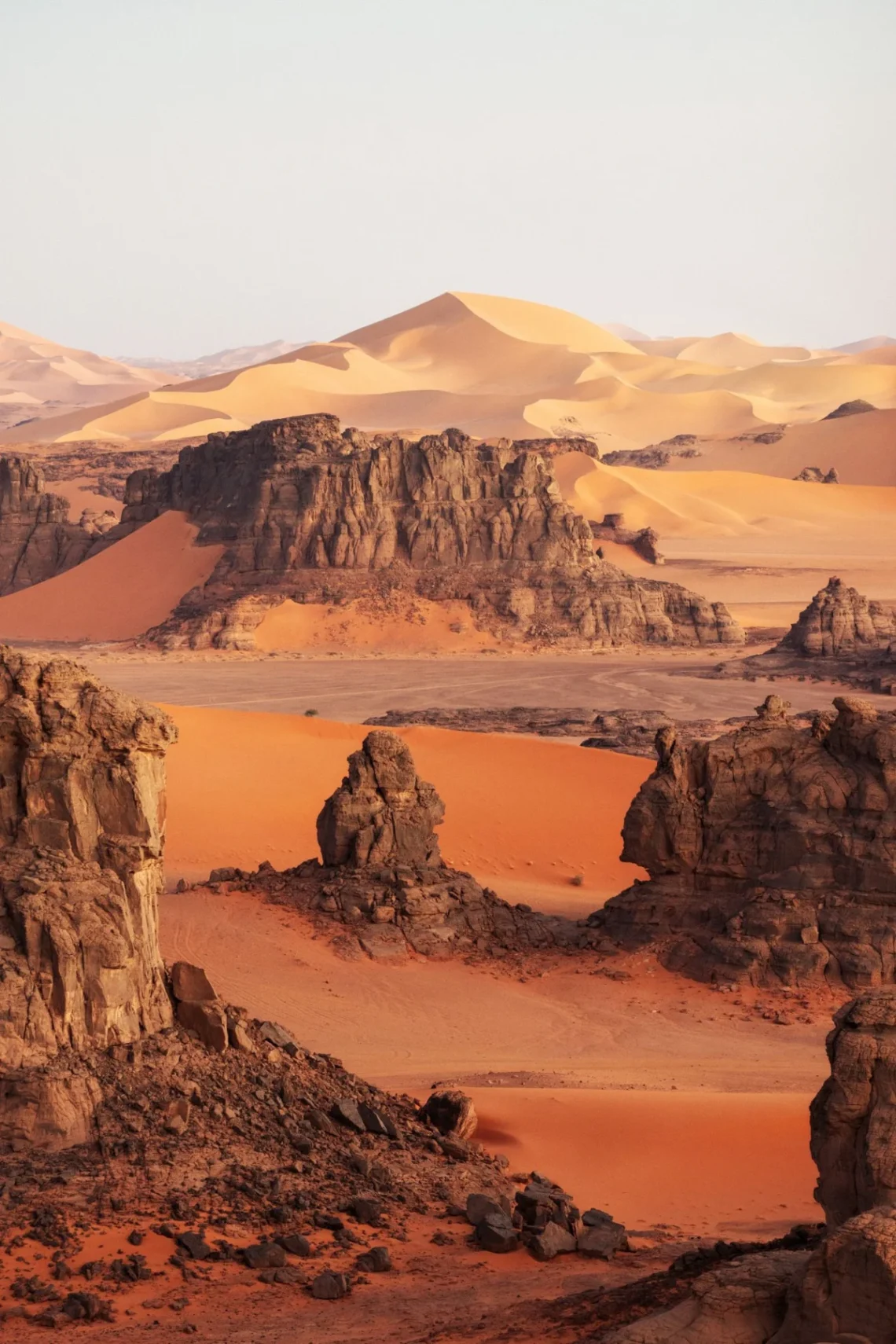
Traveling through the Tassili n’Ajjer plateau feels like traversing another planet. The geography shifts with dizzying speed: from jagged, Mars-like rocky flats to towering canyons and vast, sweeping seas of peach-colored dunes.
The region is also an archaeological treasure trove. The desert’s caves and overhangs protect over 15,000 examples of rock art, some dating back 10,000 years. These etchings depict a time when the Sahara was a lush, thriving ecosystem, showing giraffes, cattle, and hunters—a humbling reminder of the region’s cyclical history.
The daily rhythm of the expedition is dictated by the environment. Days begin with a simple breakfast of baguettes and coffee, followed by explorations on foot or in 4×4 vehicles. Midday is reserved for siestas in the shade of rock formations to escape the peak sun. Evenings are spent around a campfire, watching local guides like Moussa Hemaya perform the traditional, hour-long ritual of brewing Maghrebi mint tea, pouring it from a height to create the signature frothy top.

Supporting Data: The Economic Shift
The shift toward tourism is not merely anecdotal; it is a calculated economic strategy. Data from the World Bank and other global observers suggest that Algeria’s reliance on the energy sector has left it vulnerable to commodity price fluctuations. By targeting 12 million tourists by 2030, the government hopes to create a resilient service economy.
While many projects, such as the construction of high-end hotels, are still in the early stages, the current model leans heavily on small-group operators like Explore Worldwide. This approach allows for a "low-volume, high-value" style of tourism, which helps protect the delicate desert environment while providing a sustainable income for local Touareg communities.
The lack of mass-market commercialization is currently a selling point. In five days of desert transit, it is possible to encounter fewer than six other vehicles, ensuring that the experience remains deeply personal and isolated.

Official Perspectives and Local Sentiment
There is a palpable tension between the desire for economic growth and the need to preserve the "soul" of the desert. Local guides, who have spent decades navigating these sands, are vocal about their hopes for the future.
"I don’t want Algeria to be like Morocco or Tunisia," says Aissa Khirani, a Djanet native and seasoned guide. His sentiment is shared by many in the industry. The goal, he argues, is to develop tourism "in a smart way." For Khirani and his peers, the desert is not just a commodity; it is a sanctuary. They express a genuine concern that an influx of mass tourism could degrade the sense of "peace of mind" that currently defines the Saharan experience.
The government’s cautious approach—limiting visa-on-arrival to those venturing into the desert—suggests that they are listening to these concerns. By focusing on the Sahara, they are effectively pushing tourists toward areas that require local expertise, thereby ensuring that the economic benefits stay within the desert communities.

Implications: The Challenges Ahead
Despite the optimism, significant challenges remain. The infrastructure for international tourism is still nascent. While the desert experience is unparalleled, the amenities in major cities, such as the historic El Aurassi hotel in Algiers, often fall short of the standards expected by luxury international travelers. Service levels, though warm and welcoming, are still adapting to the requirements of a global market.
Furthermore, the legal landscape remains rigid. The prohibition on importing drones and binoculars for recreational use, while grounded in security concerns, can be a point of friction for photographers and birdwatchers. Travelers must also be prepared for a cash-heavy economy, as credit card acceptance is limited, and ATMs are famously unreliable.
The political climate in North Africa also remains a backdrop to all tourism planning. Tensions with neighboring countries mean that security protocols will likely remain a fixture of any Algerian itinerary for the foreseeable future. However, for the type of traveler who finds joy in the absence of Wi-Fi and the presence of 10,000-year-old art, these hurdles are often viewed as part of the authenticity of the adventure.

Conclusion: The Persistence of the Sahara
As one returns to Djanet, the transition back to civilization is jarring. The first shower after five days in the desert is a revelation, though it rarely succeeds in removing the fine, orange dust that settles into every fiber of one’s clothing and hair.
This, perhaps, is the true souvenir of Algeria. The sand stays with you—a lingering reminder of a landscape that is both harsh and incredibly welcoming. Whether the country can successfully balance its ambitious goal of 12 million visitors with the preservation of its rugged, silent, and ancient heart remains to be seen. But for now, Algeria remains one of the world’s last true frontiers, offering a rare glimpse into a world that has not yet been polished for the masses.
For the intrepid traveler, the time to visit is now—before the rest of the world catches on to the secret of the Sahara’s silence.