WARSAW — In an unprecedented escalation of institutional warfare that has sent shockwaves through European capitals and drawn immediate praise from the Kremlin, Poland has plunged deeper into a constitutional abyss.
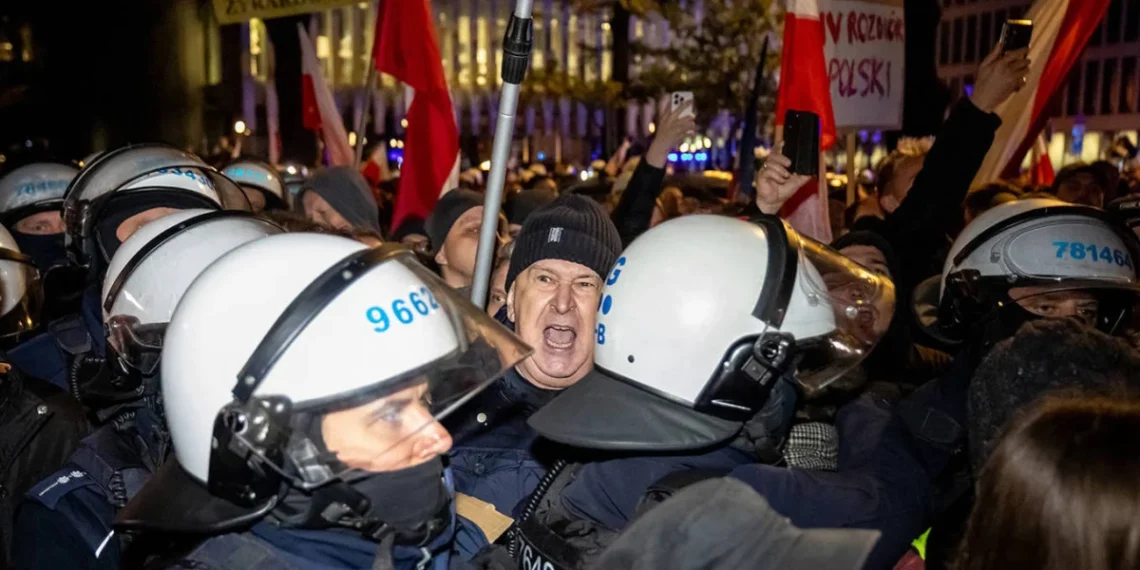
In the dead of night, Polish President Karol Nawrocki—accompanied by a cadre of right-wing populist political allies and security personnel—stormed the country’s Constitutional Tribunal. Captured on video in a sequence that has since gone viral across global media platforms, the raiding party forced their way into the high-security judicial chambers, physically confronting and brutally shoving aside the magistrates they encountered, including an elderly female judge.
The brazen operation was not merely a physical trespass; it was a violent assault on the architecture of Polish democracy. By seizing control of the institution designed to act as the ultimate check on executive overreach, Nawrocki and his faction have signaled a dangerous new phase in the global playbook of democratic erosion. As international observers, legal scholars, and European Union officials scramble to respond, the fundamental question echoing through Warsaw is both simple and terrifying: What, or who, were they really coming for?
1. Main Facts
The extraordinary events at the Constitutional Tribunal represent the culmination of years of escalating tension between Poland’s executive branch and its judicial branch. The core facts of the incident reveal a calculated effort to bypass normal legal channels and seize physical and administrative control of the country’s highest constitutional authority.
- The Midnight Incursion: Late in the evening, Polish President Karol Nawrocki, alongside key right-wing political figures and unverified security personnel, breached the facilities of the Constitutional Tribunal in Warsaw.
- Physical Confrontation: Video footage—which quickly circulated internationally—depicts the raiding party pushing past judicial staff and sitting judges. Notably, reports and visual evidence confirmed that an elderly female judge was shoved aside during the melee.
- The Target: The raid was executed to secure physical control over the tribunal’s offices, docket rooms, and digital infrastructure. Observers note that the intruders sought immediate access to pending rulings, administrative credentials, and cases involving the legitimacy of recent political appointments and electoral challenges.
- Geopolitical Echoes: The takeover was swiftly celebrated by state media in the Russian Federation, while far-right political movements across Europe viewed the maneuver as a masterclass in capturing state apparatuses.
- Democratic Fallout: Legal experts universally characterize the tribunal as a vital firewall distinguishing a liberal democracy from an autocracy, making its compromise a textbook maneuver for authoritarian consolidation.
2. Chronology of Events
To understand how Poland arrived at this midnight breach, it is necessary to examine the timeline of institutional capture, political polarization, and the rapid sequence of events that culminated in the raid.
Phase One: The Long War on the Judiciary (2015–2023)
- The Initial Crackdown: Following the rise to power of the Law and Justice (PiS) party in 2015, Poland experienced its first major wave of judicial restructuring. The government systematically undermined the independence of the Supreme Court and the National Council of the Judiciary, setting a precedent for political interference in the courts.
- Packing the Tribunal: Over several years, the composition of the Constitutional Tribunal was altered through controversial appointments, transforming it from an independent arbiter into a body frequently accused of acting as a rubber stamp for the ruling right-wing agenda.
Phase Two: The Democratic Transition and Resistance (2023–2026)
- A Fractured Government: Following subsequent democratic elections, a coalition of pro-EU, centrist, and leftist parties assumed executive power, attempting to restore the rule of law and unseat partisan loyalists embedded within state institutions.
- The Presidential Roadblock: With Karol Nawrocki—a prominent right-wing populist—holding the presidency, the executive branch remained deeply divided. Nawrocki used his veto power and institutional influence to shield partisan judges and block the new government’s judicial reforms.
Phase Three: The Midnight Raid (November 2026)
- The Setup: In the days leading up to November 3, 2026, rumors circulated of impending legal rulings from the Constitutional Tribunal that could threaten the legal standing and political future of Nawrocki’s faction.
- Nightfall (11:30 PM, November 2): President Nawrocki’s motorcade arrives outside the Constitutional Tribunal complex in central Warsaw. Accompanied by loyalist parliamentarians and auxiliary personnel, the group bypasses standard security protocols.
- The Breach (12:45 AM, November 3): Security guards inside the building attempt to block the unauthorized entry. A scuffle ensues. Footage captures high-ranking political figures physically clearing a path through the corridors. Judges attempting to record the event on mobile devices are blocked or brushed aside.
- Morning Aftermath (8:00 AM, November 3): By dawn, presidential loyalists have occupied key administrative offices. Statements begin flooding the media as the Polish government plunges into an unprecedented constitutional crisis.
3. Supporting Data & Institutional Context
The assault on the Constitutional Tribunal does not happen in a vacuum. It is part of a broader, well-documented global phenomenon often referred to as "democratic backsliding" or "autocratization." Comparative political data highlights the unique danger of targeting supreme constitutional courts.
The Role of Constitutional Courts in Democratic Resilience
According to data compiled by international democracy watchdogs such as Freedom House and the V-Dem (Varieties of Democracy) Institute:
- The Judicial Firewall: In consolidated democracies, the constitutional court acts as the ultimate referee, possessing the power to strike down unconstitutional legislation passed by transient parliamentary majorities.
- The Authoritarian Playbook: Empirical studies of democratic breakdowns in Hungary, Turkey, and Latin America reveal that capturing the constitutional court is almost invariably the second step—following the subjugation of public media—in dismantling democratic checks and balances. Once the court is controlled, unconstitutional acts can be retroactively legalized.
Public and Political Polarization in Poland
- Polling Data: Recent surveys indicate a deeply polarized Polish electorate. While urban centers and younger demographics strongly favor European integration and judicial independence, older and rural demographics display higher levels of support for populist figures who promise traditional values and a strong hand against perceived domestic and foreign enemies.
- Media Ecosystem: The infiltration of the tribunal was framed sharply in domestic media. State-aligned and independent outlets offered radically divergent narratives: independent media characterized it as a "coup against the constitution," while populist-aligned commentators framed it as a "necessary patriotic intervention" to save the state from judicial subversion.
4. Official Responses
The international and domestic fallout from the midnight raid was immediate, sharp, and deeply polarized. Governments, international bodies, and local leaders rushed to issue statements condemning or condoning the action.
Domestic Reactions
- The Polish Government: Prime Minister and members of the ruling democratic coalition held an emergency cabinet meeting early on November 3. In a televised address, government leaders labeled the raid an "act of domestic terrorism and high treason" against the Polish constitutional order. Prosecutors announced immediate criminal investigations into the individuals involved in the physical breach.
- President Karol Nawrocki’s Office: Defending the operation, representatives for President Nawrocki claimed the action was a "lawful intervention" to protect national sovereignty and prevent "politically motivated rogue judges" from issuing illegal decrees designed to destabilize the state. Nawrocki asserted that he was safeguarding the highest law of the land from usurpation.
International and European Union Responses
- European Commission: Brussels issued a stern warning, reminding Warsaw that the core values of the European Union—chief among them the rule of law and the separation of powers—are non-negotiable. European officials hinted at the acceleration of disciplinary mechanisms, which could include the freezing of vital EU funds.
- Foreign Capitals:
- Berlin and Paris expressed deep alarm, calling for immediate restraint and respect for judicial independence.
- Moscow, conversely, used state-controlled outlets to mock the fragility of Western liberal democracies, portraying the chaos in Warsaw as proof of the inherent instability of Euro-Atlantic governance structures.
- Human Rights Organizations: Amnesty International and Human Rights Watch released joint statements condemning the physical intimidation of magistrates and demanding independent, transparent investigations into the conduct of the president and his entourage.
5. Implications for Poland and Europe
The storming of the Constitutional Tribunal marks a dark watershed moment for contemporary European politics. Its long-term implications stretch far beyond the borders of Poland, threatening regional stability and the future of the European integration project.
The Death of Institutional Norms
When political actors resort to physical force and midnight raids to resolve constitutional disputes, the social contract underpinning democracy fractures. The normalization of physical intimidation against judges creates a chilling effect across the entire public sector. Future magistrates, civil servants, and law enforcement officers will face an impossible choice: uphold the impersonal rule of law or bend to the immediate, coercive will of armed or politically protected executives.
The Future of Poland’s EU Membership
Poland has long been a frontline state in the geopolitical struggle between Western democratic liberalism and Eastern authoritarian populism. This latest stunt severely tests the patience of the European Union. While previous crises involving judicial reforms could be debated in courtrooms and negotiated through bureaucratic channels, a physical assault on a tribunal building crosses a red line. It revives the specter of a definitive "Polexit-by-exclusion," where Poland’s democratic backsliding forces the EU to take unprecedented punitive actions, isolating Warsaw on the European stage.
A Warning for Global Democracies
The events in Warsaw serve as a sobering case study for democracies worldwide. They demonstrate that constitutional checks and balances are fragile constructs, dependent entirely on the good faith and restraint of the political actors entrusted with power. When populism discards institutional norms in favor of raw power politics, the defense of democracy ceases to be an abstract legal debate—it becomes a high-stakes struggle for the soul of the nation.
As investigations unfold and international pressure mounts, Poland stands at a dangerous crossroads. Whether the nation can pull back from the brink of authoritarianism—or whether the midnight raid in Warsaw becomes the new normal for a fractured continent—remains the defining question of our time.