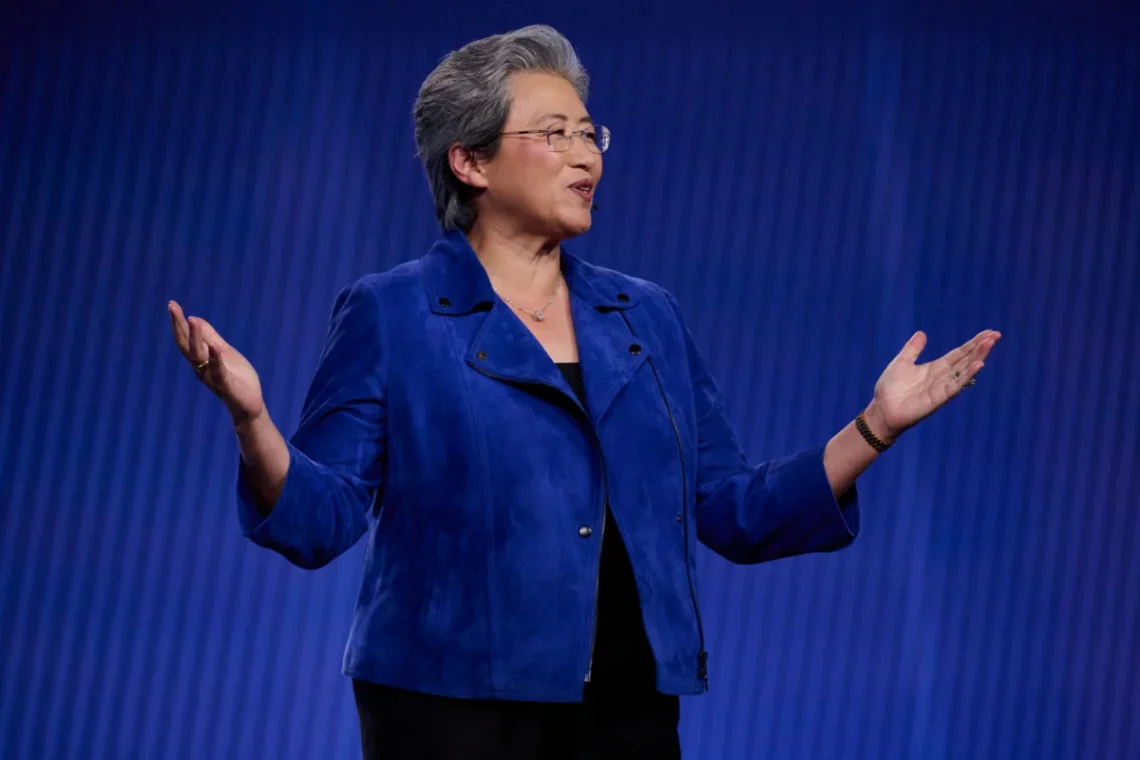
In a high-stakes power play that signals a shifting tectonic plate within the semiconductor industry, AMD has officially fired a massive shot across the bow of Nvidia. At the company’s sold-out "Advancing AI" conference in San Francisco, AMD Chair and CEO Dr. Lisa Su unveiled the company’s strategic response to the insatiable hunger of modern data centers: the Helios rack-scale system. Designed specifically to meet the grueling demands of the world’s most sophisticated AI labs, Helios represents more than just a new product—it is AMD’s aggressive attempt to seize the throne in the era of "agentic AI."
The Main Facts: Defining the Helios Era
At its core, Helios is an architectural marvel. It is a rack-scale system that consolidates a vast array of high-performance processors into a single, cohesive, high-powered unit. In the modern data center landscape, these racks are the primary engines of innovation, serving as the "brains" that train and execute large language models (LLMs) and other compute-intensive workloads.
Dr. Su did not mince words during the keynote, labeling Helios the "highest-performance AI rack in the tech industry." Built to scale, the system is engineered to handle the world’s most demanding "frontier" models—the cutting-edge AI architectures that currently define the state of the art. With the capability for gigawatt-scale deployment, AMD is positioning Helios as the foundational hardware for the next decade of AI development.
A Chronology of the AMD Offensive
The arrival of Helios is the culmination of a long-term roadmap that began surfacing in 2025.
- Initial Revelation (2025): AMD first teased the concept of its rack-scale AI strategy, signaling to investors and competitors alike that the company was moving beyond individual chip sales toward full-stack system solutions.
- The CES Reveal (January 2026): Helios made its public debut on stage at CES 2026. The sheer physical presence of the unit—which weighs as much as two compact cars—underscored the engineering challenge AMD overcame to pack that much compute density into a single rack.
- Strategic Partnerships (July 2026): The momentum hit a fever pitch this week. Microsoft CEO Satya Nadella confirmed that the tech giant would significantly expand its Azure infrastructure using Helios racks. Simultaneously, a landmark partnership was announced between AMD and Anthropic, aiming to deploy up to two gigawatts of AMD Instinct MI450 series GPUs via the new Helios architecture.
- The Future Roadmap (2027): Looking toward the horizon, AMD confirmed the upcoming launch of the Venice-X CPU. Designed specifically to complement the Helios environment, this chip will feature 96 cores and 1,152 MB of 3D V-Cache, signaling that AMD is not just iterating, but aggressively accelerating its compute capabilities.
Supporting Data: Why AMD Believes It Can Win
For years, Nvidia has held an iron grip on the AI hardware market, largely through its Grace Blackwell and the newer Vera Rubin architectures. However, the industry is entering a phase of "compute fatigue," where clients are desperate for alternatives that offer both high performance and supply chain diversity.
According to reports from The Register, preliminary performance metrics suggest that Helios does more than just compete; in several key benchmarks, it reportedly outperforms Nvidia’s flagship Vera Rubin systems. This delta in performance is critical. As AI labs reach the limits of what current hardware can process, even a marginal gain in efficiency or speed translates to millions of dollars in saved training time and energy costs.
Dr. Su’s vision is anchored in a massive forecast: by 2030, the AI accelerator market is projected to reach $1.4 trillion. To put that into perspective, the entire global semiconductor market today is roughly equivalent to that figure. By the end of the decade, Su argues, AI-specific silicon will move from being a specialized niche to the single largest pillar of the entire tech economy.
Official Responses and Industry Sentiment
The reception from the "hyperscalers"—the massive cloud providers that drive global AI demand—has been overwhelmingly positive. The strategic alignment with Microsoft and Anthropic is a clear indicator that these entities are actively seeking a "Plan B" to avoid total reliance on Nvidia.
"We are seeing a step change in compute demand," Dr. Su noted during her keynote. She emphasized that the shift is driven by the rise of "agentic AI." Unlike traditional AI, which might generate a simple response to a prompt, agentic AI systems reason, call upon external tools, access data, and iterate through dozens of steps to solve complex, multi-layered problems.
"When you ask an agent to do something, it requires significant compute overhead," Su explained. "It has to reason, it has to call tools, it has to access data, and it has to keep doing it over and over until it solves the problem. You need a massive amount of GPUs to do all that."
This demand for continuous, high-intensity reasoning is why AMD is betting on GPUs to make up the vast majority of the future accelerator market. Because the underlying algorithms for AI are still in their infancy, the industry needs silicon that is programmable and adaptable. AMD’s ecosystem, according to Su, is built specifically to offer that flexibility, allowing developers to pivot as AI models evolve.
The Implications: What This Means for the Market
The emergence of the Helios system marks a pivot point for the entire tech sector. Here are the primary implications:
1. The End of a Monopoly
While Nvidia remains the dominant incumbent, the presence of a viable, high-performance alternative in Helios means that the market is finally moving toward a multi-vendor future. This is a "win" for hyperscalers like Microsoft, Oracle, and Meta, who now have more leverage in price negotiations and supply chain logistics.
2. The Gigawatt-Scale Standard
The move to "gigawatt-scale" deployments is a paradigm shift. We are no longer talking about ordering racks by the dozen; we are talking about powering entire data centers with specialized hardware. This requires a level of integration—power management, cooling, and networking—that AMD has successfully mastered with the Helios design.
3. The "Agentic" Bottleneck
Su’s focus on agentic AI provides a window into what the next generation of software will look like. If her prediction holds true, the bottleneck for the next five years will not be the software itself, but the sheer amount of silicon required to keep an agent "thinking." AMD is betting that by providing the infrastructure to support these agents, they will become the "picks and shovels" provider for the next digital gold rush.
4. The 2030 Outlook
If the AI accelerator market truly hits $1.4 trillion by 2030, the company that wins the rack-scale battle today will define the infrastructure of the global economy tomorrow. AMD’s commitment to the Venice-X CPU and its aggressive expansion of the Instinct series suggest that they are playing a long game. They are not merely trying to catch Nvidia; they are trying to redefine the standards by which all AI hardware is measured.
Conclusion
As the industry watches the rollout of Helios, the message from Santa Clara is clear: AMD is no longer content with being a secondary player in the data center. By marrying high-performance silicon with a scalable, rack-ready architecture and securing commitments from the biggest names in the AI space, AMD has set the stage for a dramatic conflict.
Whether Helios can consistently erode Nvidia’s market share remains to be seen, but one thing is certain: the competition for the silicon that will power the future of human intelligence has never been more intense. For the tech world, the race to 2030 has officially begun, and with the launch of Helios, AMD has proven that it intends to lead the pack.