Main Facts
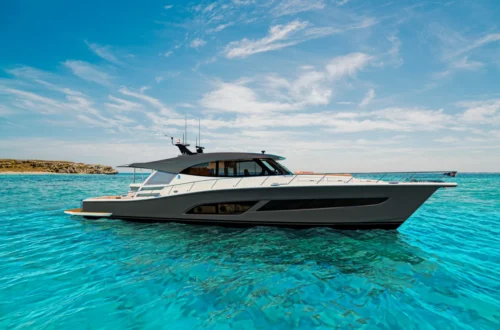
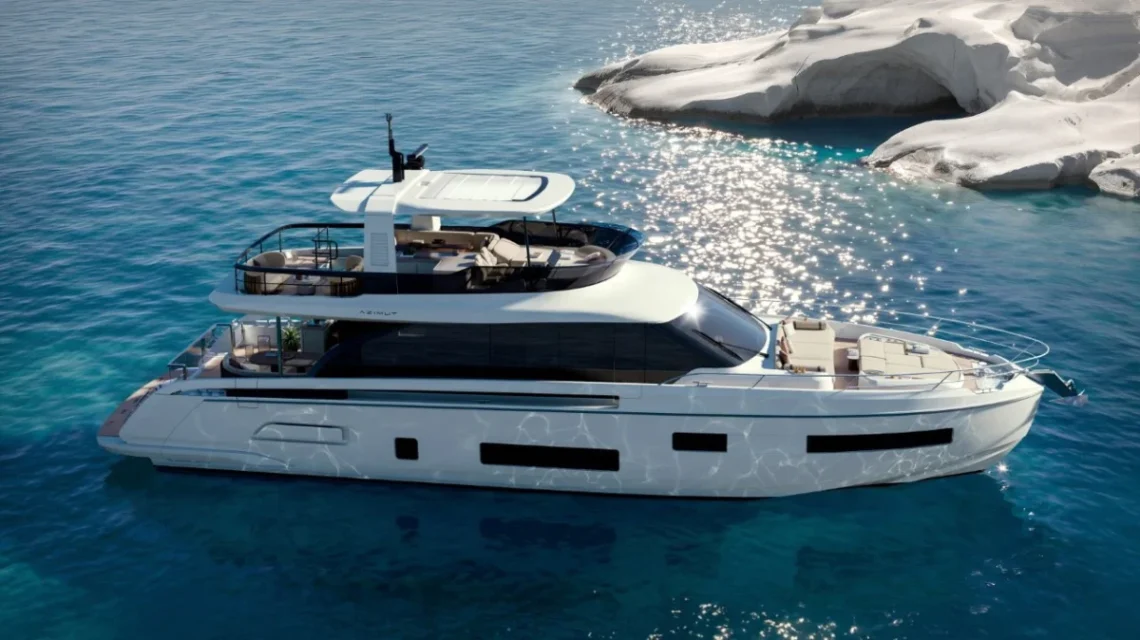
Azimut is set to capture the international maritime spotlight with the world premiere of its highly anticipated Fly 70 at the 2026 Cannes Yachting Festival. Representing a radical reimagining of the traditional flybridge motor yacht, the 70-footer is the result of a powerhouse collaboration between two celebrated Italian design talents: exterior designer Alberto Mancini and interior architect Fabio Fantolino. Together, they have crafted a vessel that marries architectural sophistication with an uncompromising focus on outdoor living and a seamless connection to the marine environment.
The Fly 70 arrives as part of an aggressive, innovation-driven lineup from the shipyard, standing proudly alongside three other major world premieres for the brand at Cannes: the Seadeck 9, the Magellano 27M, and the Grande 44M. Measuring 70 feet in length, the new flybridge incorporates Azimut’s advanced Carbon Tech Generation construction methodology, ensuring an optimized strength-to-weight ratio that enhances both performance and efficiency. Propelled by twin Volvo IPS 1350 pod drives, the yacht achieves an impressive top speed of 31 knots while offering remarkably smooth, responsive handling.
Beyond its performance metrics, the Fly 70 introduces a groundbreaking ecological advancement to the sector: Azimut Silent Technology – Pure. This proprietary emissions-reduction system combines a particulate filter and advanced exhaust-control technology to slash particulate emissions by an astounding 95 percent, all while drastically dampening acoustic signatures to reduce ambient noise by more than 5 decibels (dBA).
Accommodating up to eight guests across four exquisitely appointed lower-deck cabins, and offering flexible, highly customizable layout options on both the main deck and cockpit, the Fly 70 is positioned to redefine luxury, comfort, and environmental responsibility in the mid-size luxury yacht market.
Chronology of the Project: From Concept to Cannes
The genesis of the Azimut Fly 70 is a story of meticulous planning, cross-disciplinary design iteration, and engineering foresight that spans several years of development within the Italian shipyard’s advanced research and development facilities.
Phase 1: Conceptualization and Design Brief (2024)
The project began with a distinct brief: to challenge the conventions of the traditional flybridge layout, which had historically prioritized enclosed volume at the expense of open-air connectivity. Azimut enlisted Alberto Mancini to spearhead the exterior lines, charging him with the task of preserving the sleek, dynamic profile characteristic of the brand while dramatically expanding usable outdoor spaces. Simultaneously, Fabio Fantolino was brought on board to curate the interior architecture, bridging the gap between contemporary residential design and nautical functionality. The pairing of Mancini’s exterior fluidity with Fantolino’s warm, materials-focused interior language formed the bedrock of the Fly 70’s identity.
Phase 2: Engineering and Structural Innovation (2025)
As the design renderings matured into engineering blueprints, Azimut’s technical teams focused heavily on weight reduction and propulsion integration. Utilizing the brand’s signature Carbon Tech Generation—which strategically incorporates carbon fiber laminates into the superstructure and upper decks—engineers managed to lower the yacht’s center of gravity while increasing overall structural rigidity. During this phase, the integration of the Volvo IPS 1350 system was optimized for hydrodynamic efficiency, and the research division finalized the development of the "Silent Technology – Pure" emissions package, moving from laboratory testing to sea trials on prototype platforms.
Phase 3: Sea Trials and Refinement (Early–Mid 2026)
By the spring of 2026, the first hull of the Fly 70 hit the water for rigorous sea trials off the coast of Italy. Testing focused on evaluating the hull’s behavior across various sea states, verifying the 31-knot top-speed targets, and fine-tuning the acoustic insulation. The newly developed particulate filters and noise-reduction systems underwent extensive endurance testing to ensure they met stringent environmental benchmarks without compromising engine performance or backpressure limits.
Phase 4: The 2026 Cannes Yachting Festival Debut (September 2026)
The culmination of the Fly 70’s journey takes place at the Vieux Port during the 2026 Cannes Yachting Festival. Positioned as one of the crown jewels of Azimut’s four-vessel premiere sweep, the yacht welcomes international media, prospective owners, and industry experts to experience its innovative cockpit configurations and eco-conscious engineering firsthand.
Supporting Data & Technical Specifications
To fully appreciate the engineering and design achievements embedded within the Azimut Fly 70, it is helpful to examine the quantifiable data that defines its architecture, performance, and operational capabilities.
General Specifications
- Model: Azimut Fly 70
- Builder: Azimut Yachts (Italy)
- Exterior Design: Alberto Mancini
- Interior Design: Fabio Fantolino
- Hull Construction Material: Carbon Tech Generation (Composite fiberglass with strategic carbon fiber reinforcement)
- Guest Accommodation: 8 guests across 4 lower-deck cabins
- Maximum Speed: 31 knots (powered by twin Volvo IPS 1350)
- Debut Venue: 2026 Cannes Yachting Festival
Deck-by-Deck Layout Analysis
1. The Cockpit Options (Terrace vs. Beach)
The Fly 70 introduces modular versatility to the aft main deck, offering two distinct configurations tailored to different ownership styles:
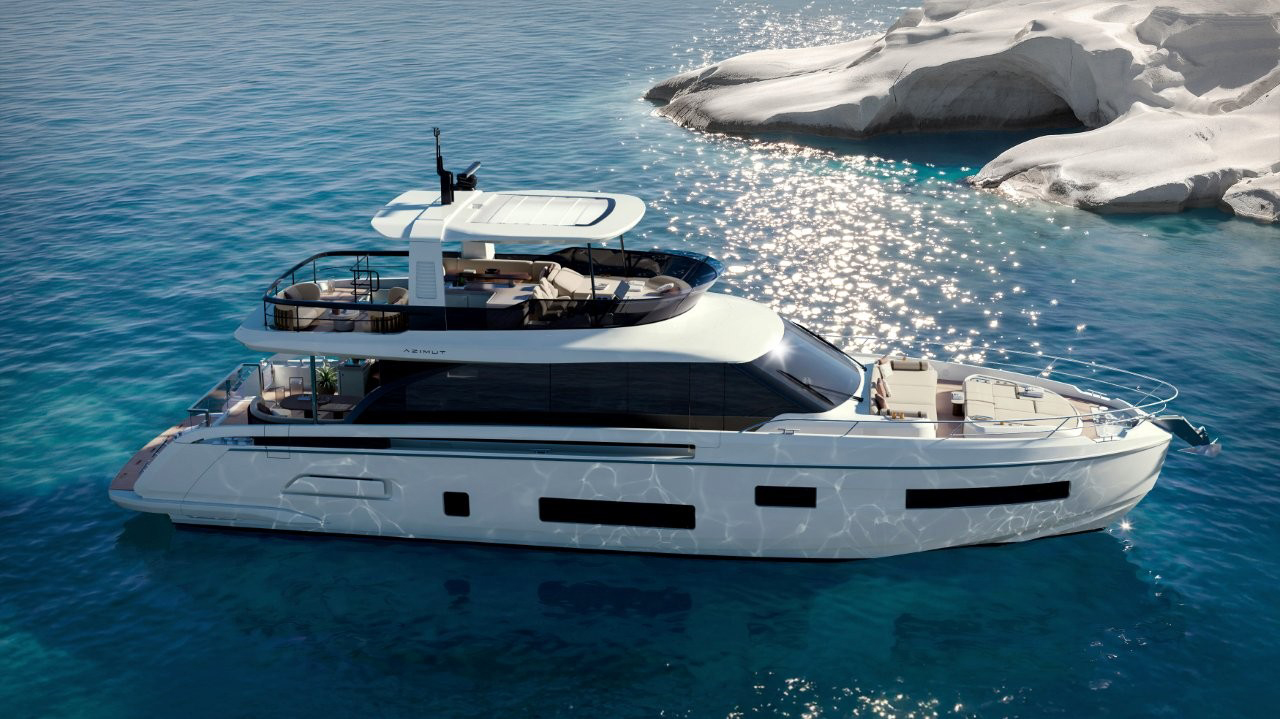
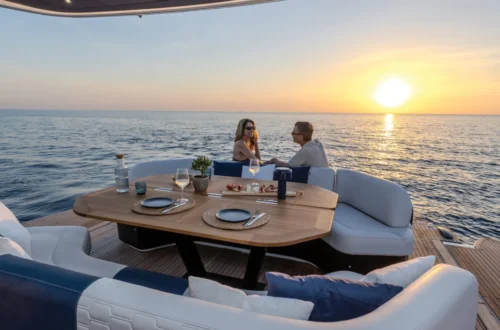
- The Terrace Cockpit (Featured at Cannes): Utilizes a transparent aft parapet that dissolves the visual boundary between the vessel and the sea. It features a stern-facing dining arrangement comfortably seating eight guests, creating an amphitheater-like connection to the wake.
- The Beach Cockpit: An alternative setup designed for pure relaxation, transforming the transom by lowering the aft bench to form a sprawling, water-level sunpad that extends the swim platform experience directly into the cockpit.
2. The Flybridge Architecture
The upper deck is meticulously segregated into three distinct, multi-functional zones:
- Forward: A dedicated sunpad lounging area optimized for sun-worshipping while underway or at anchor.
- Center: A protected C-shaped dinette paired with a fully equipped wet bar, serving as the social hub of the upper deck for casual lunches and evening cocktails.
- Aft Terrace: A flexible open-air space that can be customized with freestanding furniture, allowing owners to adapt the area for lounging, entertaining, or yoga sessions with a panoramic view.
3. Main Deck and Interior Living
The main deck serves as a harmonious transition between the exterior aft spaces and the interior salon. It features:
- A pair of facing sofas creating an intimate conversation pit.
- A dedicated indoor dining area positioned for optimal views.
- A forward-facing galley that balances service convenience for both indoor and outdoor dining.
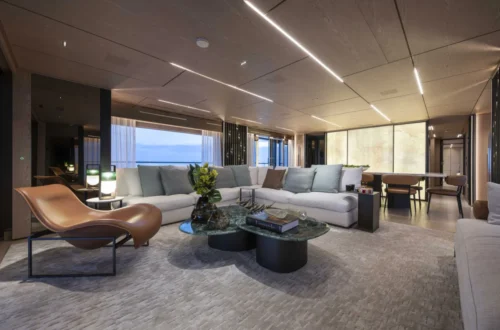
- Four lower-deck cabins accommodating eight guests in total, characterized by Fabio Fantolino’s signature use of warm textures, refined woodwork, and contemporary Italian soft furnishings.
Sustainability and Propulsion Metrics
- Propulsion: Twin Volvo IPS 1350 pod drives, delivering precise maneuverability via joystick control alongside high-speed efficiency.
- Azimut Silent Technology – Pure:
- Particulate Reduction: Cuts particulate matter emissions by up to 95%.
- Acoustic Dampening: Reduces ambient noise levels by more than 5 dBA, significantly improving onboard comfort at anchor and while cruising.
Official Responses and Industry Perspectives
The announcement of the Fly 70 has generated substantial commentary from the yachting community, highlighting Azimut’s ongoing evolution toward sustainable luxury and human-centric design.
Azimut’s executive leadership has emphasized that the Fly 70 is not merely an incremental update to an existing product line, but a philosophical shift in how medium-to-large flybridge yachts should function in the modern era. In statements released ahead of the Cannes debut, brand representatives noted that today’s luxury yacht owners demand a deeper, more tactile connection to the natural environment without sacrificing the creature comforts, speed, and volumetric space traditionally associated with larger mega-yachts.
Designers Alberto Mancini and Fabio Fantolino have also shared insights into their collaborative process. Mancini remarked that the exterior styling was driven by the desire to eliminate visual bulk, creating a silhouette that feels agile, low-slung, and inherently dynamic, despite the immense interior volume enclosed within. Fantolino emphasized his approach to the interior spaces, noting that the goal was to craft an ambiance that feels less like a conventional boat interior and more like a high-end, contemporary seaside villa—utilizing tactile materials, organic curves, and bespoke lighting to foster a deep sense of psychological well-being.
Industry analysts at the Cannes Yachting Festival have praised Azimut’s dual-pronged strategy: pairing aesthetic and functional luxury with measurable ecological advancements. The introduction of the "Silent Technology – Pure" system has been singled out as a watershed moment for the semi-custom production yacht market, signaling to competitors that emissions and noise reduction can no longer be treated as secondary considerations. As environmental regulations tighten globally and consumer consciousness evolves, Azimut’s proactive integration of particulate filtration positions the Fly 70 as a pioneer in responsible yachting.
Implications for the Luxury Yacht Market
The unveiling of the Azimut Fly 70 at the 2026 Cannes Yachting Festival carries profound implications for the global luxury yacht industry, particularly within the competitive 65-to-80-foot flybridge segment.
1. Raising the Bar for Environmental Accountability
For decades, high-performance motor yachts have faced scrutiny regarding their environmental footprint, particularly concerning exhaust emissions and acoustic pollution in protected anchorages. By introducing Azimut Silent Technology – Pure across the Fly 70 platform—achieving a 95 percent reduction in particulate emissions and a 5+ dBA drop in noise—Azimut has established a new benchmark for corporate responsibility. This move is expected to exert pressure on competing shipyards to accelerate their own research and development into green technologies, transforming emissions-control systems from optional novelties into standard industry expectations.
2. Redefining the Flybridge Paradigm
The traditional flybridge yacht has historically prioritized enclosed interior saloons and raised helm stations, occasionally resulting in compartmentalized exterior spaces. The Fly 70’s dual cockpit configurations (Terrace vs. Beach) and its tripartite flybridge layout demonstrate that owners no longer have to choose between sheltered volume and open-air connectivity. By blurring the lines between interior and exterior zones, Azimut is dictating a new design language that other builders will inevitably seek to emulate in future generations of yachts.
3. The Power of Collaborative Design
The seamless fusion of Alberto Mancini’s exterior exterior vision with Fabio Fantolino’s interior architecture underscores the commercial and artistic power of cross-disciplinary collaboration in yacht design. As buyers become increasingly sophisticated and design-literate, the days of in-house styling departments working in isolation are drawing to a close. The market now demands cohesive, holistic narratives where the exterior lines and interior living spaces speak the exact same aesthetic language.
4. Market Positioning and Competitiveness
As one of four world premieres showcased by Azimut at Cannes 2026—alongside heavyweights like the Seadeck 9, Magellano 27M, and Grande 44M—the Fly 70 anchors the lower-to-mid end of the builder’s expansive portfolio update. It proves that innovation and technological trickle-down are not reserved exclusively for flagship superyachts. For prospective buyers looking for a 70-footer that delivers 31-knot thrills, modular outdoor living, and state-of-the-art ecological stewardship, the Fly 70 establishes an extraordinarily high standard that will shape the trajectory of luxury cruising for years to come.