On August 12, 2026, the Iberian Peninsula will serve as the world’s grandest stage for a celestial event of historic proportions. For the first time in over a century, a total solar eclipse will sweep across Northern Spain, carving a path of darkness from the rugged coastlines of Galicia to the azure waters of the Mediterranean and the Balearic Islands. This rare occurrence, which will cast its shadow over approximately 40% of the Spanish territory, is already being hailed as the premier astronomical event of the decade.
For stargazers, scientists, and casual travelers alike, the "sunset eclipse" of 2026 offers more than just a momentary darkening of the sky. It represents a confluence of geography, timing, and atmospheric conditions that promises to be nothing short of breathtaking.
The Main Facts: A Once-in-a-Century Phenomenon
A total solar eclipse occurs when the Moon perfectly aligns between the Earth and the Sun, completely obscuring the solar disc and plunging the landscape into an eerie, mid-evening twilight. While solar eclipses happen periodically across the globe, the 2026 event is distinct for its specific path and timing.
The Path of Totality
The path of totality—the narrow corridor where the Sun is completely hidden—will enter Spain at the northwestern tip of Galicia. From there, it will traverse the wide, rolling plains of central Spain before heading east toward the Mediterranean coast and the Balearic archipelago.
Key cities positioned directly within the path of totality include:
- A Coruña: Where the eclipse will make its dramatic landfall.
- Bilbao: Providing a backdrop of northern industrial elegance against the darkened sky.
- Zaragoza: Offering expansive, flat horizons perfect for tracking the Sun’s low-angle descent.
- Valencia: A major coastal hub where observers can witness the eclipse meeting the sea.
Meanwhile, major urban centers like Madrid and Barcelona will experience a near-total eclipse, with approximately 99% of the Sun obscured. While this remains a spectacular sight, those seeking the true "moment of totality"—where the corona becomes visible and the temperature drops—must position themselves within the central track.
Chronology: The "Sunset Eclipse" Explained
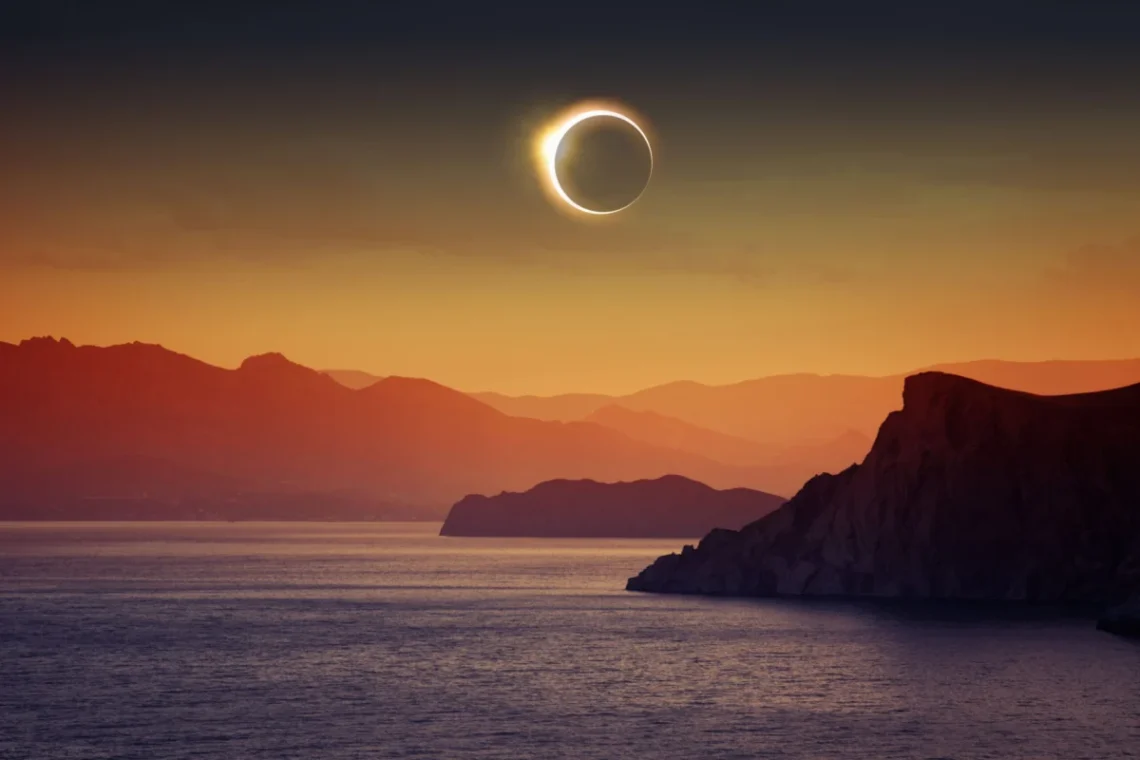
Unlike the 2024 North American eclipse, which reached its peak at the zenith of the sky during midday, the 2026 event will occur during the golden hour. As the Sun nears the horizon, the timing of totality is scheduled between approximately 8:26 p.m. and 8:32 p.m. local time.
This timing introduces a phenomenon known as the "sunset eclipse." Because the event occurs so low in the sky, observers will be treated to the famed "diamond ring" effect—a brilliant flash of light that appears as the final sliver of the Sun is obscured, creating the visual illusion of a shimmering ring.
.jpg)
Why Timing Matters
The low-slung position of the Sun requires a radical shift in viewing strategy. In a traditional midday eclipse, observers look straight up. In 2026, the horizon becomes the primary focus. This means that terrain—whether mountains, city skylines, or even rows of trees—could potentially obstruct the view. Astronomers are advising travelers to scout locations with clear, unobstructed views to the west-northwest.
Supporting Data: The Case for Spain’s Astrotourism
Spain has long been a favorite destination for sun-seekers, but in 2026, it is set to become the global capital of "astrotourism."
The "Iberian Trio"
The 2026 event is only the beginning of a remarkable run for the region. Astronomers have identified a series of events dubbed the "Iberian Trio":
- August 12, 2026: Total Solar Eclipse.
- August 2, 2027: Another Total Solar Eclipse.
- January 26, 2028: An Annular Solar Eclipse.
This three-year streak has prompted the Spanish government and regional tourism boards to invest heavily in infrastructure and public safety. With August being Spain’s second-sunniest month, the statistical probability of clear, cloudless skies is exceptionally high, making it perhaps the most reliable location on Earth to witness the 2026 event.
The Perseids Coincidence
Adding to the magic, the eclipse coincides with the annual Perseids meteor shower. As the sky turns dark during the sunset eclipse, the atmospheric conditions will be primed for viewing meteor activity, effectively extending the spectacle long after the Sun has officially set.
Official Responses and Safety Protocols
Local authorities across Spain are preparing for a massive influx of international visitors. From the municipal councils of A Coruña to the tourism bureaus of the Balearic Islands, the focus is on two fronts: crowd management and safety.
The Essential Safety Standard
The most critical message from the scientific community is the necessity of ISO 12312-2 certified eclipse glasses. Because the Sun will be low on the horizon, the temptation to look at it during the partial phases will be high. Experts emphasize that standard sunglasses, regardless of the brand or price, offer zero protection against the retinal damage caused by direct solar viewing.
Environmental Stewardship
In line with the global "Leave No Trace" movement, local governments are implementing strict guidelines for rural and coastal viewing sites. As thousands of eclipse chasers descend upon beaches and mountain lookouts, the preservation of these fragile ecosystems is paramount. Officials are urging visitors to utilize public transport where possible and to avoid camping in unauthorized areas.

Implications: Where to Watch and Why
For those planning their journey, the geography of the viewing site is the most significant decision one can make.
Coastal Vantage Points: The Atlantic and the Mediterranean
Coastal regions offer the cleanest horizons, but they require careful selection.
- Galicia (Cape Ortegal): Likely to host one of the longest windows of totality in the country. The rocky, dramatic cliffs provide a rugged, cinematic setting.
- Cantabria (El Puntal and Playa de Langre): These beaches provide expansive, westward-facing views over the Atlantic, making them ideal for capturing the sunset alignment.
- The Balearics (Mallorca, Menorca, Ibiza): These islands fall directly in the path of totality. However, because many beaches face east or south, travelers are increasingly booking private boating charters. Being on the water provides a 360-degree horizon, removing the risk of landscape obstruction.
Urban vs. Rural Strategy
While cities like Valencia offer excellent infrastructure, their official viewing spots—often on beaches—may face inland. Those remaining in urban areas are encouraged to seek out high-altitude terraces or to consult with local guides who understand the specific orientation of the city’s skyline relative to the west-northwest.
The Cultural Element of the Experience
Beyond the science, the eclipse will be a cultural celebration. Spain’s hospitality sector is already curating "Eclipse Packages" that combine astronomical viewing with local culinary traditions. As the sky darkens, the rhythm of Spanish life—usually geared toward late dinners and evening social gatherings—will reach a crescendo.
Visitors are encouraged to engage with local communities. Learning basic Spanish phrases—“Buenas tardes” (Good afternoon) for your arrival, or “Gracias” (Thank you) for the local hospitality—will undoubtedly enhance the experience. The event is not just a scientific observation; it is a moment of collective wonder that will be shared by millions across the country.
Conclusion: A Moment to Remember
The 2026 total solar eclipse is a rare alignment of celestial mechanics and human experience. Whether you find yourself on a boat off the coast of Ibiza, a lighthouse in A Coruña, or a quiet field in the heart of the Spanish interior, the event promises to be a life-changing spectacle. As the Sun dips toward the horizon, the day turns to night, and the corona flares into view, Spain will undoubtedly cement its reputation as the premier destination for the world’s most awe-inspiring astronomical theater.
Prepare your gear, secure your glasses, and look to the west-northwest. The shadow is coming.