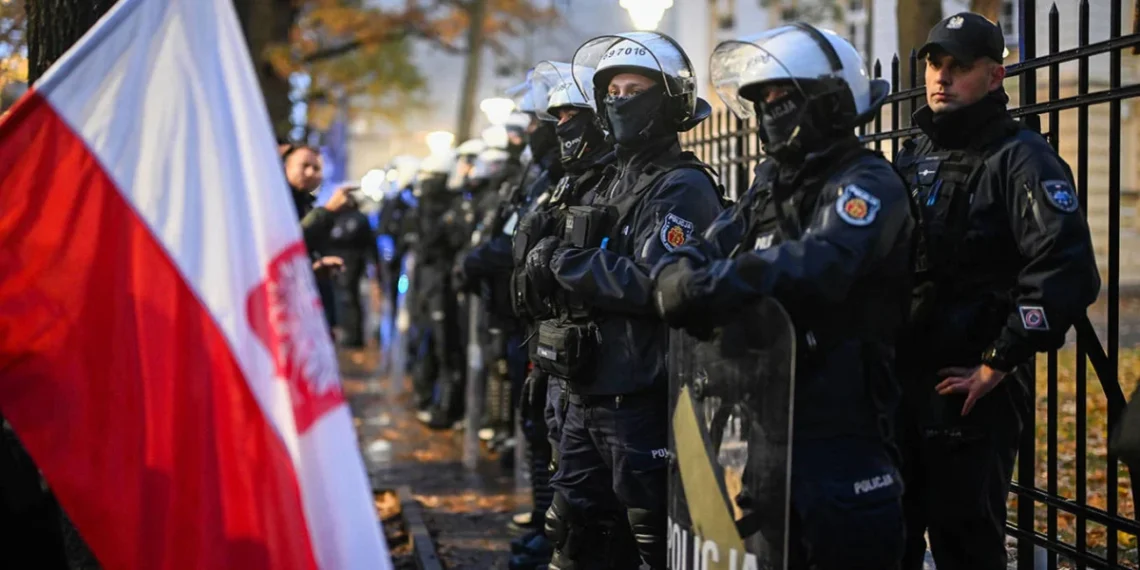
WARSAW — Dramatic scenes played out inside Poland’s Constitutional Tribunal as the ouster of Bogdan Święczkowski—a holdover and loyalist of the former populist regime—triggered a physical confrontation at the court and escalated an ongoing political standoff between Prime Minister Donald Tusk’s coalition government and the far-right Law and Justice (PiS) party.
The removal of Święczkowski has sparked intense domestic and international speculation. Critics of the current government ask whether Prime Minister Tusk’s liberal parliamentary majority is overstepping constitutional bounds, prompting a broader philosophical debate: Can democrats legitimately bend or break established legal procedures to restore democratic institutions that were systematically undermined by populist authoritarians?
According to legal experts and defenders of the current administration, however, that is fundamentally the wrong question. In the Polish case, the debate is not about breaking the law to fix the system; it is about enforcing existing constitutional order against an illegally installed usurper.
Main Facts
The immediate flashpoint centers on the legitimacy of the Constitutional Tribunal’s leadership and the broader institutional warfare that has paralyzed Polish governance since the democratic transition of power in late 2023.
- The Incident: Bogdan Święczkowski, a close political ally of PiS and a former national prosecutor, was physically barred from entering the premises of the Constitutional Tribunal following a determination that his tenure as tribunal president was legally void ab initio (invalid from the start).
- The Core Dispute: The Tusk administration contends that Święczkowski was never legitimately appointed to the presidency of the court, pointing to systemic irregularities in how the previous PiS administration packed the judicial branch.
- The Political Divide: Prime Minister Tusk’s coalition argues that restoring constitutional integrity requires purging politicized actors who were unconstitutionally placed in high offices. Conversely, PiS and its supporters characterize the actions of the current government as an authoritarian purge, judicial overreach, and a direct violation of the separation of powers.
- The Broader Context: The clash at the Constitutional Tribunal represents the culmination of a decade-long constitutional crisis that began when PiS first came to power in 2015 and systematically dismantled the checks and balances inherent in Poland’s post-communist democracy.
Chronology of a Crisis: How Poland Reached the Breaking Point
To understand the physical confrontations and legal gridlock currently unfolding in Warsaw, one must trace the timeline of institutional capture and counter-reformation that has defined Polish politics over the last ten years.
2015–2016: The Original Sin of the Tribunal Capture
Immediately following its electoral victory in late 2015, the Law and Justice (PiS) party, led by Jarosław Kaczyński, engineered a hostile takeover of the Constitutional Tribunal. The outgoing parliament had controversially appointed five judges; the incoming PiS majority nullified those appointments, refused to swear them in, and subsequently appointed its own loyalists—referred to by critics as "dupe judges" (sędziowie-dublerzy). Julia Przyłębska, a PiS loyalist, was later installed as the president of the tribunal through a process that legal scholars deemed procedurally flawed. This move effectively neutralized the court’s ability to act as an independent check on the legislative and executive branches.
2017–2023: European Condemnation and Judicial Subordination
Over the next eight years, the European Commission launched numerous infringement procedures against Poland under Article 7 of the Treaty on European Union. The European Court of Justice (ECJ) and the European Court of Human Rights (ECtHR) repeatedly ruled that Poland’s overhauled judicial bodies—including the Disciplinary Chamber of the Supreme Court and the politically compromised Constitutional Tribunal—failed to meet the standards of an "independent and impartial tribunal previously established by law." Despite these rulings, the PiS government dug in its heels, deepening Poland’s isolation within the European Union and freezing billions of euros in post-pandemic recovery funds.
December 2023: The Return of Donald Tusk
Following the October 15, 2023 general election, a pro-European coalition led by Donald Tusk secured a parliamentary majority and formed a government. Tusk campaigned on a platform of przywracanie praworządności (the restoration of the rule of law). The new government faced an immense constitutional dilemma: how to dismantle an entrenched network of partisan appointees embedded throughout the judiciary, prosecution service, and state media without utilizing extraordinary—and potentially legally ambiguous—measures.
2024–2025: The Institutional Standoff
Throughout 2024 and 2025, the Tusk government systematically audited appointments made during the PiS era. State media were restructured through commercial law procedures after traditional legislative paths were vetoed by PiS-allied President Andrzej Duda. Meanwhile, the Constitutional Tribunal—still dominated by PiS appointees—attempted to shield the former regime by issuing rulings declaring the current government’s reform efforts unconstitutional. This created a parallel legal reality where the government ignored tribunal rulings it deemed illegitimate, while PiS accused the government of staging a constitutional coup.
November 2026: The Flashpoint at the Tribunal
The crisis reached a physical boiling point with the challenge to Bogdan Święczkowski. Having assumed a leadership role within the tribunal, Święczkowski’s tenure was challenged by reform-minded judges and Ministry of Justice officials who argued that his appointment suffered from the same original procedural defects as those of his predecessors. When security and administrative personnel blocked his entry to the tribunal building, it transformed a theoretical legal debate into a visceral, televised spectacle of democratic decay and renewal.
Supporting Data and Legal Context
The conflict at the Constitutional Tribunal is underpinned by starkly contrasting legal philosophies and empirical data regarding public trust in Polish institutions.
European Court Rulings
- The Xero Flor w Polsce v. Poland (2021) Ruling: The ECtHR ruled that the presence of an improperly appointed judge on the Constitutional Tribunal breached the right to a tribunal established by law.
- The Advance Pharma v. Poland (2022) Ruling: The ECJS reinforced that systemic deficiencies in judicial appointments render subsequent judicial decisions legally defective.
- EU Recovery Funds: The freezing and eventual unfreezing of over €130 billion in EU cohesion and recovery funds were directly tied to benchmarks demanding the restoration of judicial independence in Poland.
Public Opinion and Institutional Trust
According to polling conducted by independent sociological research centers in Warsaw:
- Trust in the Constitutional Tribunal plummeted from over 50% prior to 2015 to below 20% by 2024, as the court became widely perceived as a partisan arm of the PiS party.
- A slim majority of the Polish electorate (approximately 52–55% in various 2025–2026 surveys) supports decisive government action to remove PiS appointees, even if those actions push the boundaries of conventional legal procedures—reflecting a public sentiment that "imperfect restoration" is preferable to permanent institutional capture.
Official Responses and Political Reactions
The dramatic events at the Tribunal have elicited swift and polarized reactions from across the Polish and European political spectrum.
The Government Perspective: Restoring Constitutional Order
Prime Minister Donald Tusk’s administration has defended its actions as a necessary, defensive use of state power to safeguard democracy. Speaking in Warsaw following the incident, government spokespersons emphasized that an institution operating outside the constitution cannot claim constitutional protections for its occupants.
"We are not breaking the law; we are clearing away the wreckage left behind by those who broke the state," a senior Ministry of Justice official stated on condition of anonymity. "You cannot use the rules of a democratic constitutional state to protect individuals whose entire purpose was the systematic destruction of that very state."
Legal scholars aligned with the government argue the doctrine of competing constitutional necessities applies: when the constitutional guardians themselves become the captors of the constitution, the democratic sovereign (acting through its elected parliamentary majority) retains the inherent right of self-defense to reconstitute legitimate organs of state.
The Opposition Perspective: Authoritarian Overreach
Law and Justice (PiS) leaders have condemned the physical barring of Bogdan Święczkowski as a totalitarian assault on the separation of powers and an act of political thuggery. Jarosław Kaczyński, speaking at an emergency press conference, accused Donald Tusk of establishing a dictatorship under the guise of defending European values.
"What we are witnessing today is the total collapse of the constitutional order orchestrated by a government that respects neither courts, laws, nor the Polish constitution," Kaczyński declared. "They are physically locking out judges because they cannot win an intellectual or legal argument. This is Belarusization, not Europeanization."
PiS has called for international intervention and has appealed to President Andrzej Duda—whose second and final term has been a key institutional bulwark for the opposition—to condemn the government’s actions unequivocally.
International Reactions
European Union institutions have walked a diplomatic tightrope. While Brussels has consistently championed the Tusk government’s broader mission to restore the rule of law and satisfy EU judicial benchmarks, European Commission officials have privately expressed concern over the optics of physical confrontations at judicial institutions.
A spokesperson for the European Commission reiterated Brussels’ stance: "All member states must ensure that reforms to the judiciary are carried out strictly in accordance with national constitutions and European standards, while fully respecting the independence of the judiciary."
Implications for Poland’s Democratic Future
The clash at the Constitutional Tribunal is far more than a localized dispute over office space or administrative titles; it is a stress test for how liberal democracies can recover after surviving populist-authoritarian assaults.
- The Precedent of "Fighting Democracy": The events in Warsaw raise profound theoretical questions for constitutional law globally. If a populist party captures supreme courts and rewrites institutional rules to make removal through normal constitutional channels impossible, do democrats have a legitimate right to bypass those rules? Poland is currently writing the textbook on the risks and necessities of this approach.
- The Danger of Tit-for-Tat Governance: Critics warn that by bending legal norms to purge political enemies, the current liberal coalition risks establishing a dangerous precedent. If future governments feel justified in ignoring court rulings and physically removing rival appointees, the rule of law is reduced to a tool of whoever holds transient political power.
- The Upcoming Presidential Election: The conflict underscores the high stakes of Poland’s upcoming political cycles. With the presidency remaining under the influence of the PiS-aligned camp until the conclusion of Andrzej Duda’s mandate, institutional friction between the executive, legislative, and judicial branches will remain white-hot.
As crowds continue to gather outside Warsaw’s administrative courts and legal scholars fiercely debate the nuances of constitutional self-defense, Poland remains suspended in a tense transitional phase—proving that while dismantling a populist autocracy is difficult, rebuilding the rule of law on its ruins may prove even more perilous.