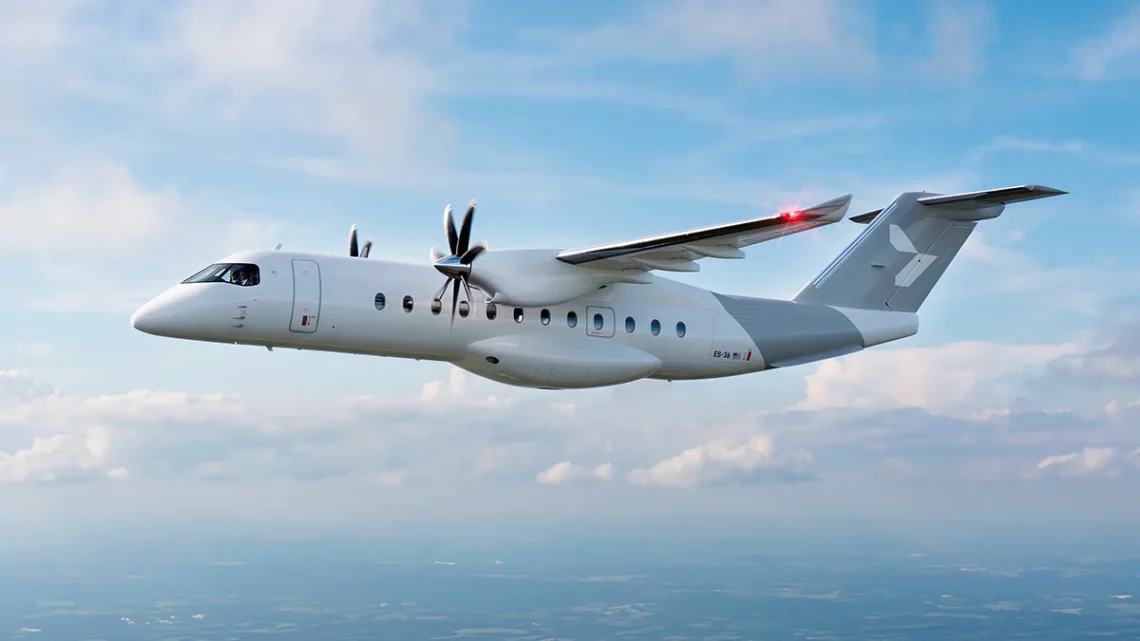
LOS ANGELES — In a milestone announcement for sustainable aviation, California-based aircraft manufacturer Heart Aerospace has pulled the curtain back on its latest innovation: the ES-36. Designed specifically to service community airports with significantly reduced emissions and operational overhead, the 36-seat hybrid-electric regional airliner represents a massive leap forward in green aviation technology.
Built on the foundational engineering of the company’s earlier ES-30 model—unveiled in 2022—and the rigorous flight-testing data gathered from the X1 demonstrator earlier this year, the ES-36 is engineered to maximize commercial viability. Despite offering six additional seats and a 1,415-pound boost in payload capacity compared to its predecessor, the new aircraft maintains the identical maximum takeoff weight and battery capacity footprint.
For an industry grappling with the dual pressures of economic viability and aggressive net-zero carbon targets, Heart Aerospace’s new flagship production aircraft offers a compelling blueprint for the future of short-haul regional transit.
Main Facts: The Engineering and Capabilities of the ES-36
The ES-36 is not merely an incremental update; it is a ground-up rethinking of how regional aviation can operate more efficiently. Featuring an aerodynamically optimized airframe, the aircraft creates interior and exterior volumes that prioritize both passenger comfort and operator profitability.
One of the most notable design shifts from the previous ES-30 concept is the reduction in propulsion infrastructure. While the earlier iteration utilized four engines, the ES-36 streamlines its propulsion system into two nacelles and propellers. According to company engineers, slashing the number of propulsion components by half directly correlates to dramatically lower maintenance overhead—a critical selling point for regional airlines operating on tight profit margins.
At the heart of the aircraft’s propulsion system are two advanced hybrid powertrains. Each powertrain integrates a formidable 1.65 MW electric motor driving a dedicated propeller. Onboard battery arrays provide an all-electric range of 125 miles, allowing the aircraft to handle short-haul, city-to-city commuter hops with zero direct carbon emissions and minimal noise pollution.
For longer routes, the powertrain is equipped with an integrated turbogenerator driven by a gas turbine. This generator supplements the battery packs in flight, extending the ES-36’s total hybrid range to an impressive 745 miles. This dual-mode flexibility bridges the gap between purely electric urban air mobility and traditional regional jet operations.
Chronology: From Concept to Production Reality
The journey toward the ES-36 spans several years of calculated research, development, and iterative testing:
2022: Heart Aerospace debuts the ES-30 concept, introducing the aviation market to its vision of a scalable, hybrid-electric regional commuter plane.
Early 2026: The company achieves a major engineering milestone by successfully flying its X1 demonstrator aircraft, gathering invaluable real-world performance metrics.
Late 2026: Heart Aerospace officially unveils the production-ready ES-36 design, incorporating the hard-won aerodynamic and electrical lessons learned during the X1 flight-test campaign.
2028 (Projected): The first pre-production ES-36 is slated for its maiden flight, departing from Heart’s pilot manufacturing facility in Los Angeles.
2031 (Projected): Commercial entry into service, marking the operational debut of the aircraft with early launch customers.
Supporting Data: Specifications and Market Commitment
To truly understand the disruptive potential of the ES-36, industry analysts look closely at the quantitative metrics provided by Heart Aerospace:
Seating Capacity: 36 passengers (a 6-seat increase over the ES-30).
Payload Capacity: Increased by 1,415 pounds over previous iterations.
All-Electric Range: 125 miles (zero-emission operations for local feeder routes).
Hybrid Range: 745 miles (utilizing the onboard turbogenerator).
Motor Output: Dual 1.65 MW electric motors.
Propulsion Layout: Twin-engine/nacelle configuration to minimize maintenance drag.
Launch Order Book: Prominent public charter carrier JSX has already signed a firm agreement for 50 aircraft, with purchase rights for an additional 50 units.
Official Responses: Industry Leaders Weigh In
The unveiling of the ES-36 has already garnered significant praise from both engineering leadership and early adopting commercial operators.
Ben Stabler, Chief Technology Officer at Heart Aerospace, emphasized that the new design is a direct byproduct of empirical data rather than theoretical modeling.
“The ES-36 design is a direct result of what Heart learned designing, building, testing, and flying our X1 demonstrator aircraft,” Stabler said in a statement. “Those learnings have helped us make the production aircraft more capable in the air and more productive for operators.”
The commercial enthusiasm is equally pronounced. JSX, an innovative public charter operator known for disrupting traditional regional travel models, has locked in a substantial commitment for the aircraft, placing an order for 50 units with options for 50 more.
Alex Wilcox, Chief Executive Officer of JSX, highlighted how the aircraft aligns with his company’s brand ethos and operational strategy:
“The hybrid-electric ES-36 will enable more nonstop routes from more convenient airports while further elevating the award-winning, no-middle-seat onboard experience that JSX customers love,” Wilcox noted.
Implications: Transforming Regional Mobility and the Future of Flight
The introduction of the ES-36 carries profound implications for the global aviation sector, particularly in the realm of regional connectivity.
Revitalizing Community Airports
For decades, major hub-and-spoke airline models have bypassed smaller community airports due to the prohibitive economics of flying large, fuel-hungry regional jets on low-density routes. The ES-36—with its quiet electric takeoff capabilities, low maintenance requirements, and optimized 36-seat capacity—makes these smaller municipal airports economically viable again. Passengers could soon see a renaissance of direct, point-to-point regional flights that eliminate the need to drive hours to a major international hub.
Environmental Impact and Sustainability
While long-haul international aviation presents immense decarbonization challenges due to current battery weight and energy-density limitations, the short-to-medium-haul regional market is uniquely suited for hybrid-electric propulsion. By executing flights under 125 miles entirely on battery power, operators can slash local emissions to absolute zero. Even on longer missions up to 745 miles, the hybrid turbogenerator system vastly outperforms legacy fossil-fuel turboprops in fuel efficiency.
Economic Pressure on Legacy Manufacturers
As startups like Heart Aerospace transition from concept rendering to tangible pre-production assembly—with the first unit currently under construction at the Los Angeles pilot manufacturing plant—legacy aerospace giants are forced to pay attention. The demand for lower operating costs and sustainable compliance means that regional fleet renewal over the next decade will likely tilt heavily toward electrified architectures.
The Road Ahead to 2031
Despite the high optimism surrounding the ES-36, the path to commercialization remains complex. Heart Aerospace must successfully navigate stringent certification pathways with aviation authorities like the Federal Aviation Administration (FAA) and the European Union Aviation Safety Agency (EASA). Furthermore, scaling supply chains for multi-megawatt electric motors, advanced battery chemistries, and lightweight composite airframes will test the startup’s manufacturing mettle.
Nevertheless, with a clear timeline targeting a maiden flight in the second half of 2028 and commercial entry into service by 2031, Heart Aerospace has firmly established itself as a frontrunner in the race to electrify the skies. If the ES-36 delivers on its ambitious performance and economic promises, it may very well redefine how the world experiences regional travel for generations to come.