
By Sean O’Kane
TechCrunch | Special Report
Main Facts: The Industrial Revolution Hitting the Pipeline
At last year’s 13th annual Bolting Symposium, the highlight for Lindsey Elliott was not a groundbreaking keynote or a macroeconomic panel. It was playing a fiercely contested game of “Bolting Bingo” against a roomful of self-proclaimed “torque dorks.”
Elliott, a former engineer and planner at energy giant ExxonMobil, is herself deeply immersed in the world of industrial fasteners. But her obsession with bolts goes far beyond a niche conference hobby. She has spent years meticulously analyzing the structural and logistical vulnerabilities of the critical infrastructure that transports oil, natural gas, and petrochemicals across North America. Her conclusion? The multi-trillion-dollar energy and industrial sectors are overly reliant on archaic, physically punishing manual labor to perform one of the most repetitive tasks in existence: tightening and loosening the bolts that secure flanged pipe joints.
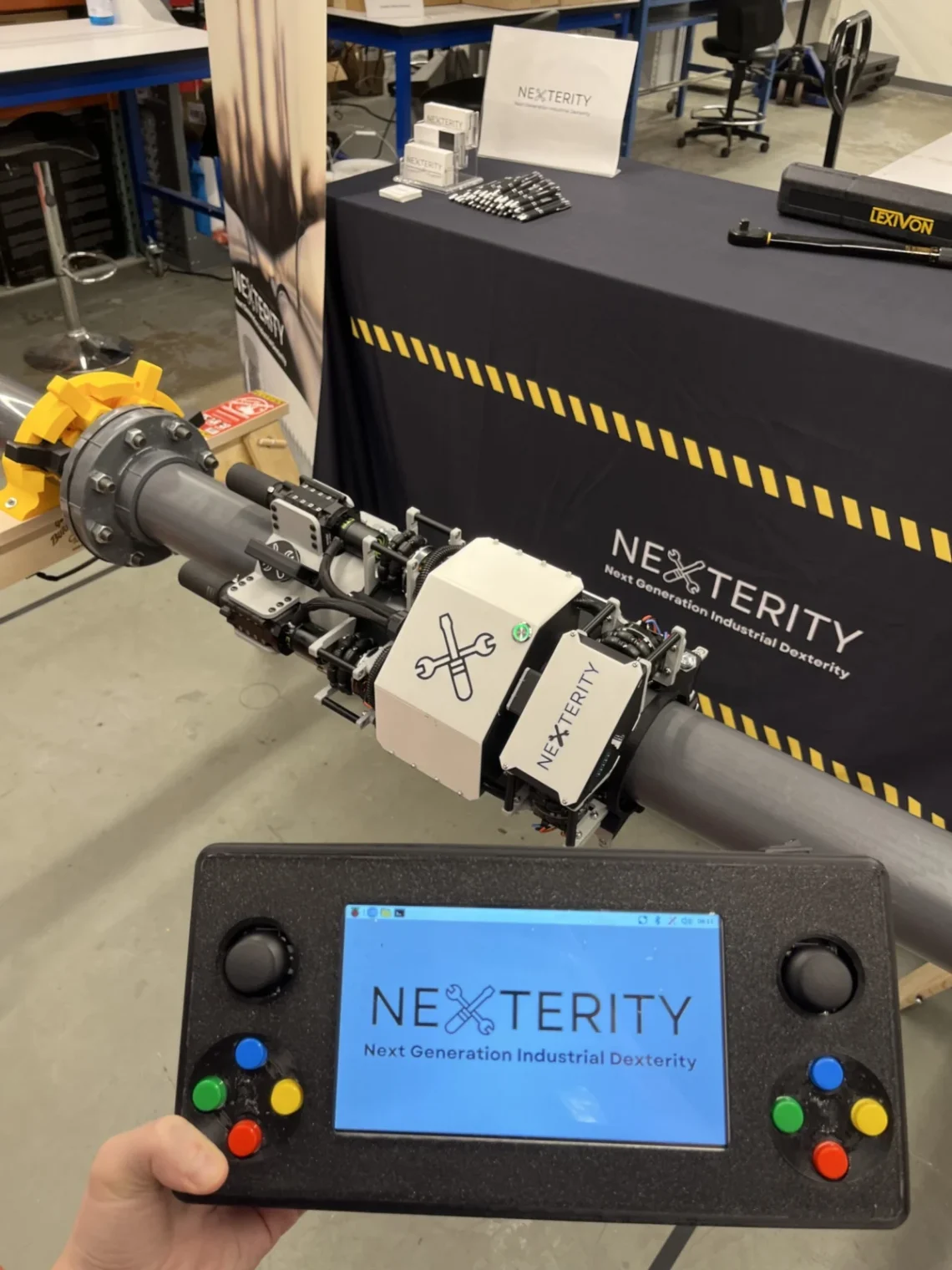
To solve this, Elliott founded Nexterity, a robotics startup selected as one of the elite Startup Battlefield 200 companies participating in TechCrunch Disrupt. Nexterity’s flagship innovation is a compact, battery-powered, remote-controlled robotic device designed to shoulder the grueling physical burden of pipefitting.
If widely adopted, the technology promises to fundamentally reshape a foundational blue-collar profession. By delegating the repetitive, high-strain work of torquing bolts to machines, Nexterity aims to drastically improve worker safety, mitigate the effects of the ongoing skilled trades labor shortage, and inject a much-needed dose of productivity into a notoriously sluggish sector.
Chronology: From ExxonMobil Planning to the Startup Battlefield
The Genesis of an Idea
Before founding Nexterity, Lindsey Elliott spent years working in the trenches of major industrial operations as an engineer and planner for ExxonMobil. Day in and day out, she observed firsthand the bottlenecks that plagued large-scale facilities. While technological advancements transformed fields like software, supply chain logistics, and even heavy machinery, one fundamental element of industrial construction and maintenance remained stubbornly frozen in time: the pipefitter wielding a heavy wrench.
Throughout her tenure, Elliott made a point of talking directly with the people doing the heavy lifting—pipefitters and maintenance crews operating across the United States and Canada. The feedback was overwhelmingly consistent: North American pipefitting productivity was notoriously low, not due to a lack of skill or work ethic among laborers, but because of extreme physical exhaustion.
“Those people get really tired when they’re asked to work 12 hours a day for three months in a row,” Elliott explained in an interview with TechCrunch.
Immersing in the Industry Subculture
Recognizing that systemic change required deep domain expertise, Elliott embedded herself within the engineering community. She began attending specialized industry gatherings, most notably the annual Bolting Symposium and events hosted by the Pressure Vessels & Piping Division of the American Society of Mechanical Engineers (ASME).
It was during these conventions, networking with the engineers affectionately dubbed “torque dorks,” that Elliott uncovered a critical data point that would define her startup’s product-market fit. Through exhaustive conversations with industry veterans, she learned a staggering statistic: roughly 80% of all industrial piping falls strictly between two and eight inches in diameter—known technically as Nominal Pipe Sizes NPS2 to NPS8.
This revelation was a lightbulb moment. Such a high degree of dimensional standardization meant that the problem wasn’t hopelessly fragmented; rather, it was a prime candidate for targeted automation. Armed with this insight, Elliott stepped away from traditional corporate engineering to launch Nexterity, translating years of observations into a tangible, mechanical solution.
Supporting Data: The Anatomy of the Nexterity Robot and the Trillion-Dollar Market
To understand the potential impact of Nexterity’s technology, one must examine the physical realities of industrial piping and the mechanics of the startup’s solution.
Engineering for the Field
The Nexterity robot is built around modularity and field readiness. The system comprises two main structural pieces that snap together around a targeted pipe section. Once secured, the battery-powered device utilizes an integrated drive mechanism to slide smoothly across the exterior of the pipe.
Operating under remote control, the robot targets the bolted flange joint and can rapidly loosen and tighten four bolts simultaneously. This multi-bolt simultaneous operation dramatically cuts down the time required to break or seal a connection compared to manual, one-at-a-time wrenching.
Despite its robust industrial application, the hardware is remarkably portable. Nexterity has engineered multiple configurations to accommodate standard pipe size variations within the NPS2 to NPS8 range. Crucially, every variant of the robot is small enough to fit inside a standard Pelican case, allowing a single worker to transport, deploy, and operate the system without specialized heavy-lifting equipment or cumbersome support vehicles.
The Rental Business Model
This portability directly informs Nexterity’s go-to-market strategy. Rather than selling expensive, fixed-installation automation machinery that facilities must capitalize and maintain, Nexterity intends to treat its robots like rental construction equipment. Contractors and plant operators can order units on-demand, deploy them for specific turnaround or maintenance windows, and ship them back when the job is done. This low-barrier deployment model makes adoption frictionless for industrial service companies operating on tight project margins.
Sizing the Market Opportunity
While oil and gas pipelines initially drew Elliott’s attention, the total addressable market for the technology is vast and largely underappreciated by the general public.
“I think it would shock a lot of people just how big this market is,” Elliott noted. “I mean, day to day, most of us don’t think about piping infrastructure, but even water, wastewater, water treatment, food and beverage, mining, nuclear, any kind of green and sustainable manufacturing facility—they all use the same kind of piping.”
Every industry that relies on fluid transport systems requires thousands of miles of flanged joints, subject to routine maintenance, regulatory inspections, and periodic rebuilds. By focusing on a universal mechanical interface (the bolted flange), Nexterity has positioned its technology to scale horizontally across dozens of multi-billion-dollar industrial sectors.
Official Responses: Industry Reception and Expert Validation
The reception from the mechanical engineering and trade communities has been overwhelmingly positive, validating Elliott’s pivot from corporate planner to startup founder.
Within specialized circles like the ASME Pressure Vessels & Piping Division, the appetite for mechanical assistance has grown in tandem with demographic shifts in the workforce. Older, highly experienced pipefitters are retiring at an accelerated rate, and younger generations are increasingly reluctant to enter demanding trades characterized by repetitive strain injuries, extreme weather conditions, and grueling shift work.
Industry veterans at the Bolting Symposium and ASME panels have praised Nexterity’s approach for striking the right balance between automation and human oversight. Rather than attempting to replace the entire trade—an impossible task given the dynamic, unstructured environments of industrial plants—the robot acts as a force multiplier. It takes over the most physically punishing, high-torque manual labor, leaving skilled technicians free to oversee quality control, system diagnostics, and complex problem-solving.
Furthermore, safety regulators and corporate environmental, health, and safety (EHS) departments have expressed keen interest. Manual torquing of large industrial bolts frequently leads to musculoskeletal disorders, hand and finger trauma, and catastrophic injuries caused by sudden tool slips or fastener failures under residual pressure. By putting distance between the worker and the high-torque point of operation, robotic intervention promises to sharply drive down recordable safety incidents.
Implications: Reshaping the Blue-Collar Industrial Landscape
The rise of startups like Nexterity points toward a broader, much-needed evolution in industrial tech—one that looks beyond flashy consumer gadgets and enterprise software to optimize the physical infrastructure of modern civilization.
1. Alleviating the Skilled Labor Crisis
The North American industrial sector is facing a severe labor deficit. According to numerous trade associations, finding and retaining qualified pipefitters, welders, and millwrights has become one of the single biggest threats to project timelines and operational continuity. By introducing robotic co-workers that can triple or quadruple a single worker’s output during grueling turnaround cycles, companies can maintain high operational capacity with leaner crews. This efficiency helps mitigate burnout and makes the profession more attractive to a tech-savvy younger workforce.
2. Redefining Safety Standards
For decades, the heavy industrial trades have accepted high rates of physical wear-and-tear as an unavoidable cost of doing business. Carpal tunnel syndrome, back strains, and impact injuries have been treated as occupational hazards rather than engineering failures. Technologies that remove workers from the immediate line of fire during high-torque operations establish a new benchmark for corporate responsibility. In the long run, lower injury rates translate to lower insurance premiums, reduced absenteeism, and higher workforce retention.
3. The Democratization of Industrial Robotics
Nexterity’s emphasis on portability and a rental-equipment business model highlights a maturing mindset within hardware startups. Building a brilliant robot is only half the battle; ensuring that field crews can easily unpack, power, and operate it without a degree in advanced mechatronics is what dictates commercial success. By packaging industrial automation into a Pelican case, Nexterity proves that heavy-duty robotics no longer require dedicated factory floors or multimillion-dollar integration budgets.
Conclusion
As Lindsey Elliott prepares to showcase Nexterity on the global stage at TechCrunch Disrupt’s Startup Battlefield 200, the company stands at the intersection of traditional heavy industry and modern robotics. By listening closely to the “torque dorks,” respecting the physical realities of the trades, and applying targeted automation to the humble bolt, Nexterity is proving that the most impactful technological revolutions are sometimes found not in the cloud, but two inches deep in the nuts and bolts of the real world.