Main Facts
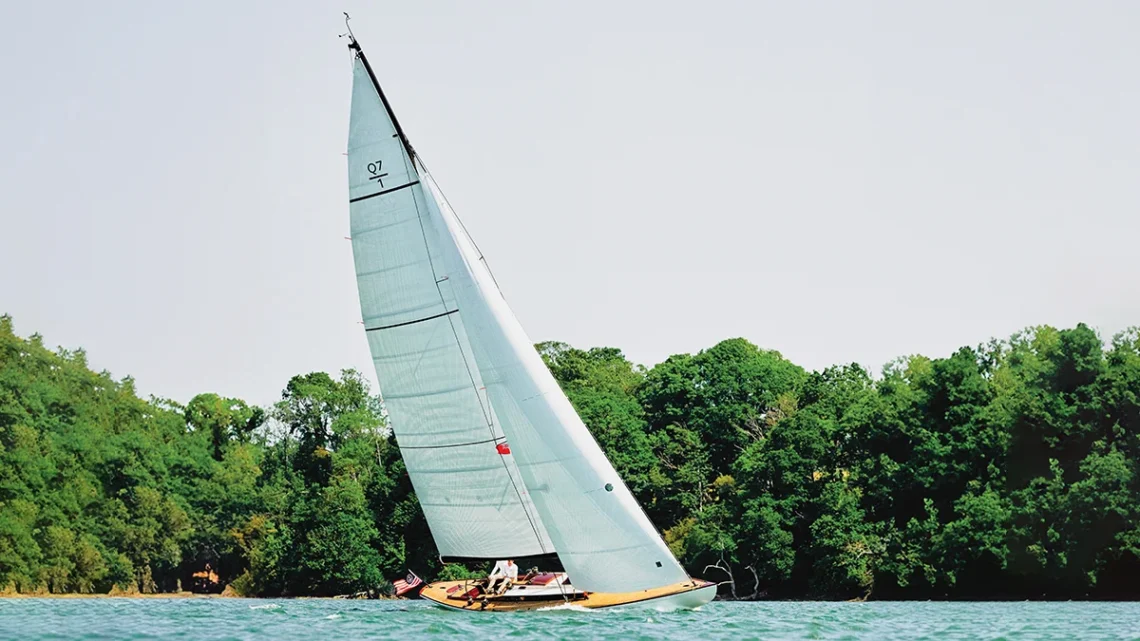
In the rarefied world of classic yachting, few names evoke as much reverence as the Herreshoff-designed Q-Class racers. Built to the Universal Rule formula that governed elite racing throughout the early 20th century, these vessels combined punishing racing performance with breathtaking, timeless aesthetics. Now, a century after the legendary 46-foot sloop Falcon first touched the water, the spirit of the Q-Class has been triumphantly reborn through a modern masterpiece named Victoria.
Commissioned by sailor and entrepreneur Peter Silvester following a painstaking, five-year restoration of Falcon in Maine, Victoria represents the inaugural hull of the "Falcon Study"—a visionary concept developed by Silvester’s San Diego-based start-up, Q7 Yacht Designs. The project bridges a century of nautical evolution by asking a compelling hypothetical question: What would the original designers of Falcon have created if they possessed modern engineering, advanced composites, and a century’s worth of technological breakthroughs?
To bring this ambitious vision to life, Silvester enlisted premier industry titans. World-renowned Dutch naval architecture firm Dykstra—famed for their masterful work on the modern J-Class fleet revivals—engineered the hull lines and performance profile. Meanwhile, renowned U.K. custom boatbuilder Spirit Yachts translated the design into reality, investing more than 30,000 labor hours into the vessel’s construction.
The resulting yacht is a striking paradox: outwardly indistinguishable from a 1920s racing thoroughbred, yet internally and structurally optimized for the 21st century. Equipped with modern rigging, advanced carbon-fiber reinforcements, state-of-the-art deck hardware, and an integrated autopilot system, Victoria allows for effortless single-handed sailing in wind and sea conditions that would historically relegate her vintage counterparts to the safety of the dock.

Chronology: From Maine Restorations to Modern Masterpieces
The genesis of Victoria traces back years before the first line of the new design was ever drawn, deeply rooted in the preservation of maritime history.
- The Falcon Era (1926): Originally crafted by the legendary Herreshoff Manufacturing Company in Bristol, Rhode Island, the 46-foot Q-Class sloop Falcon is launched. Over the decades, she establishes an enviable racing pedigree, collecting numerous prestigious titles, including multiple victories in the Chicago Yacht Club Race to Mackinac, the Silver Jubilee Series, and the coveted Queen’s Cup.
- The Catalyst (Early 2020s): Entrepreneur Peter Silvester acquires Falcon and embarks on an exhaustive, five-year restoration project in Maine. Sailing the vessel extensively sparks a profound realization: while Falcon is an unmitigated triumph of historical craftsmanship, her demanding physical requirements and archaic deck layouts limit her usability in contemporary waters. Silvester resolves to build a spiritual successor.
- Conception and Collaboration (Mid-2020s): Silvester founds Q7 Yacht Designs in San Diego to spearhead the "Falcon Study." He partners with Dutch naval architects Dykstra to refine the underwater geometry and sail dynamics, while commissioning British custom builder Spirit Yachts to handle construction.
- The Sail Plan Evolution: Working alongside loft experts at Quantum Sails, the team develops a bespoke sail inventory. They engineer a mainsail and jib that visually mimic traditional canvas cloth yet are manufactured entirely from cutting-edge technical fibers to maximize aerodynamic efficiency and durability.
- The Debut (August 2026): Following over 30,000 hours of specialized labor, the first hull—named Victoria after Silvester’s wife—is officially completed and delivered, establishing a fresh benchmark for retro-classic yacht design.
Supporting Data and Craftsmanship Specifications
The construction of Victoria represents a masterclass in hybrid manufacturing, seamlessly fusing century-old woodworking traditions with modern aerospace-grade materials.
- Hull Construction: The yacht utilizes a state-of-the-art cold-molded construction process. This technique layers traditional mahogany planking over structural composite cores, reinforced with advanced carbon-fiber matrices to enhance rigidity while dramatically reducing hull weight compared to solid wood builds.
- Deck and Exterior Appointments: Above deck, the vessel features a classic teak deck arrangement paired with custom-machined hardware and meticulously fitted mahogany-framed hatches.
- Interior Styling: Spirit Yachts crafted a warm, cocoon-like interior dominated by organic curves, rich mahogany finishes, and fine wood veneers. Practical cruising amenities include fore-and-aft sleeping berths, an efficient galley, a dedicated shower, and a modern electric head.
- Bespoke Centerpieces: The saloon layout is anchored by a handcrafted whisky table positioned between two custom armchairs—a woodworking feat that required more than 300 hours of dedicated craftsmanship to complete.
- Exclusive Partnerships: To elevate the ownership experience, the yacht comes with curated luxury collaborations. These include custom leather luggage sets crafted by Globe-Trotter and a specialized collection of seven single-malt whiskies curated by The Macallan, perfectly paired with the vessel’s aesthetic and onboard lifestyle.
- Production Limitations: Q7 Yacht Designs has restricted the Falcon Study to a strictly limited run. Aside from the prototype Victoria, exactly six build slots remain globally.
Official Responses and Perspectives
The unveiling of Victoria has generated significant buzz across the global maritime community, drawing commentary from the visionaries who brought the project to fruition.
Reflecting on the legacy of the archetype that inspired the project, Peter Silvester didn’t mince words about Falcon‘s standing in yachting history.

"Falcon really is Q-Class royalty,"
Silvester notes, highlighting the boat’s storied past under the Herreshoff banner. However, he emphasizes that duplicating the past was never the sole objective.
"The boat had to be authentically Q-Class—as real to the essence of the original as we could get."
At the same time, Silvester acknowledges that modern owners demand a level of usability and comfort that vintage racers simply cannot provide without compromise. By integrating high-tech sails, modern winches, and an advanced autopilot system, the team successfully eliminated the steep physical barriers traditionally associated with handling a racing sloop of this scale.
"It’s a bit like sailing Falcon with the training wheels taken off,"
Silvester explains, encapsulating the liberation that modern engineering affords to classic aesthetics.
Implications: Towards a Global Q-Class Renaissance
The completion of Victoria is much more than a successful custom yacht delivery; it signals a potential pivot point for how classic yacht racing is organized and sustained in the 21st century.

For decades, owning a vintage racing yacht meant accepting a punishing maintenance cycle, heavy physical crews, and restricted cruising windows. By proving that a cold-molded classic hull can be married to carbon-fiber performance, push-button sail handling, and modern creature comforts, Q7 Yacht Designs has effectively rewritten the playbook for retro-classic marine architecture.
Furthermore, Silvester harbors ambitions that extend far beyond a single floating masterpiece. While he readily admits that Victoria stands as an objet d’art, his sights are set on community and international competition. With only six additional build slots available for the Falcon Study, Silvester envisions a future where these seven bespoke vessels form an exclusive, global racing circuit.
"One boat is an objet d’art,"
Silvester observes, pointing to the vessel’s exquisite woodworking and bespoke partnerships.
"With seven, you have a chance of meeting fellow Q owners anywhere in the world."
If this vision materializes, Victoria will not only serve as a tribute to a bygone golden age of sail, but as the vanguard of a new, highly connected era for classic yacht enthusiasts worldwide—proving that the elegance of the past can thrive powerfully in the technological present.