

In a move that underscores the widening gap between corporate climate ambition and operational reality, retail giant Target has officially downgraded its long-term emission reduction goals. The company, which operates nearly 2,000 stores across the United States, announced in its latest annual sustainability report that it is pushing its net-zero deadline back by a decade, shifting the target from 2040 to 2050.
This recalibration is not limited to the company’s ultimate climate endgame; Target has also deferred its intermediate milestone for Scope 3 emissions—the indirect greenhouse gas emissions produced throughout the company’s value chain—by five years, moving the deadline for a 32.5 percent reduction from 2030 to 2035.
The decision positions Target among a cohort of major consumer-facing brands that are finding the "last mile" of decarbonization significantly more difficult than initial projections suggested. As the retail sector faces systemic hurdles in logistics, manufacturing, and global energy infrastructure, the once-bullish climate commitments of the early 2020s are increasingly being replaced by more cautious, extended timelines.
The Scope 3 Conundrum: Why Retailers Are Stumbling
To understand the significance of Target’s policy shift, one must look at the math of its carbon footprint. Scope 3 emissions—which encompass the lifecycle of the goods Target sells, from raw material extraction and manufacturing to the transportation of products and their eventual disposal by consumers—account for a staggering 98.5 percent of the company’s total carbon footprint.
Unlike Scope 1 (direct emissions from company-owned facilities) or Scope 2 (emissions from purchased electricity), Scope 3 is notoriously difficult for a retailer to control. It requires deep collaboration with thousands of global suppliers, many of whom operate in jurisdictions with lagging renewable energy infrastructure.
Target’s recent disclosure notes that achieving further decarbonization in this area is no longer a matter of internal efficiency, but rather a "broader transformation in energy systems, technology, and infrastructure." In essence, Target is signaling that it has reached the limits of what a single corporate entity can achieve through voluntary procurement and supplier engagement; further progress is now tethered to the decarbonization of the global economy at large.
A Chronology of Declining Ambition
The timeline of Target’s climate strategy reveals a pattern of early momentum followed by a plateau. In the years following its initial pledges, Target achieved notable success in Scope 3 reduction, particularly throughout 2022 and 2023. During this period, the retailer was operating at a pace that placed it comfortably on track to meet its 2030 goal.
However, the data from 2024 and 2025 tells a different story. The rate of reduction slowed, forcing the company onto a trajectory that rendered the original 2030 deadline mathematically improbable. This "change of pace" has become a familiar narrative in the retail industry.

The Industry-Wide Trend
Target is far from an outlier. The corporate sector has seen a cascade of similar retreats:
- PepsiCo: In May 2025, the beverage giant officially pushed its net-zero goal from 2040 to 2050, citing similar systemic barriers.
- Coca-Cola, McDonald’s, and Starbucks: Each of these industry titans has either publicly downgraded their Scope 3 targets or issued warnings to investors that their existing 2030 goals are no longer viable under current conditions.
- The Packaging Parallel: The trend extends beyond emissions. Walmart, the retail industry’s bellwether, recently confirmed that it missed all of its 2025 sustainability targets related to packaging, highlighting that circular economy goals are proving just as elusive as carbon neutrality.
Supporting Data: The Dual Reality of Renewables vs. Value Chains
While the news on Scope 3 is sobering, Target’s sustainability report does contain a rare, unqualified success story: Scope 2 emissions.
In a notable achievement, Target reached its goal of 100 percent renewable energy use in 2025, five years ahead of its original 2030 schedule. This milestone was achieved through an aggressive, near-doubling of its purchases of renewable energy certificates (RECs). While this move effectively "cleans" the energy used to power its own physical stores, it highlights the disparity between the emissions the company can influence directly and the emissions locked into its global supply chain.
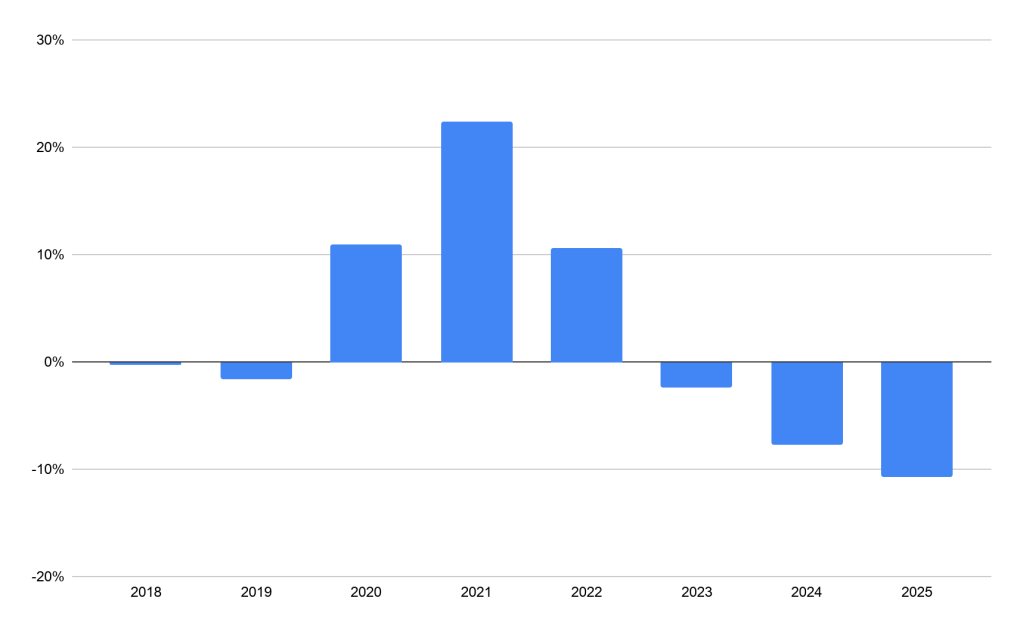
The chart below illustrates the friction in the company’s Scope 3 efforts. While the initial drop from the 2017 baseline was significant, the curve has flattened in recent years, reflecting the difficulty of decarbonizing complex, multi-tiered supplier networks.
(Editor’s Note: The accompanying chart in the sustainability report demonstrates a sharp downward trend from 2020 to 2023, followed by a deceleration in 2024 and 2025, confirming the narrative of diminishing returns on early, low-hanging fruit.)
Official Responses and Corporate Transparency
Despite the gravity of these changes, Target has remained largely silent on the specific tactical failures that necessitated the delay. When reached for comment, the company did not provide additional context beyond the statements included in its annual sustainability report.
This lack of granular detail has drawn criticism from sustainability advocates, who argue that major corporations owe their shareholders and consumers a more transparent account of why these goals are being abandoned. By framing the delay as a result of "broad systemic issues," critics argue that companies like Target are externalizing their inability to drive deep change within their own supply chains.
Implications: The New Era of "Climate Realism"
The implications of these delays are profound, both for the retail sector and for global climate policy.
1. The Death of the "Easy Win"
For the past decade, corporate sustainability was often characterized by "low-hanging fruit"—switching to LED lighting, buying solar credits, and optimizing logistics routes. That era is largely over. The remaining emissions are "hard-to-abate," requiring fundamental changes to manufacturing processes, shipping fuels, and consumer behavior.
2. A Shift in Investor Sentiment
Investors are beginning to view these missed targets as a risk factor. When a company repeatedly shifts the goalposts, it raises questions about the robustness of its long-term strategy and its ability to forecast risks. The market is increasingly demanding that companies decouple their growth from carbon output—a challenge that, as Target’s report confirms, remains a massive hurdle.
3. The Need for Public-Private Synergy
Target’s admission that it requires a "broader transformation" in energy and infrastructure is, in one sense, an admission of defeat—but it is also a call to action. It suggests that retailers cannot act as lone islands of sustainability. Instead, the focus may shift toward lobbying for cleaner grids and standardized global regulations. If a company the size of Target cannot influence its supply chain to hit a 2030 target, it implies that the government’s role in setting environmental standards for industry is more critical than ever.
4. Consumer Trust and Greenwashing
As companies like Target, Walmart, and Starbucks move their dates, they run the risk of alienating a consumer base that is increasingly skeptical of corporate "green" claims. The shift from 2040 to 2050 may seem like a minor administrative adjustment to an executive, but to a consumer, it represents a broken promise. Transparency will be the only currency that retains its value in this new, more difficult environment.
Conclusion: A Long Road Ahead
Target’s decision to downgrade its climate goals is a sobering reminder of the distance remaining between current corporate practices and the requirements of a net-zero world. While the achievement of 100 percent renewable energy in its own stores is a commendable feat, it serves as a stark contrast to the complexities of the broader supply chain.
As we look toward 2035 and 2050, the retail industry stands at a crossroads. The strategy of setting ambitious, decade-long targets and hoping for technological leaps has hit a wall. The next phase of corporate sustainability will require more than just pledges—it will require a fundamental restructuring of global trade, energy, and consumption. For Target, the next few years will be the true test of whether it can maintain its market leadership while navigating a climate landscape that is proving far more resistant to change than initially hoped.