
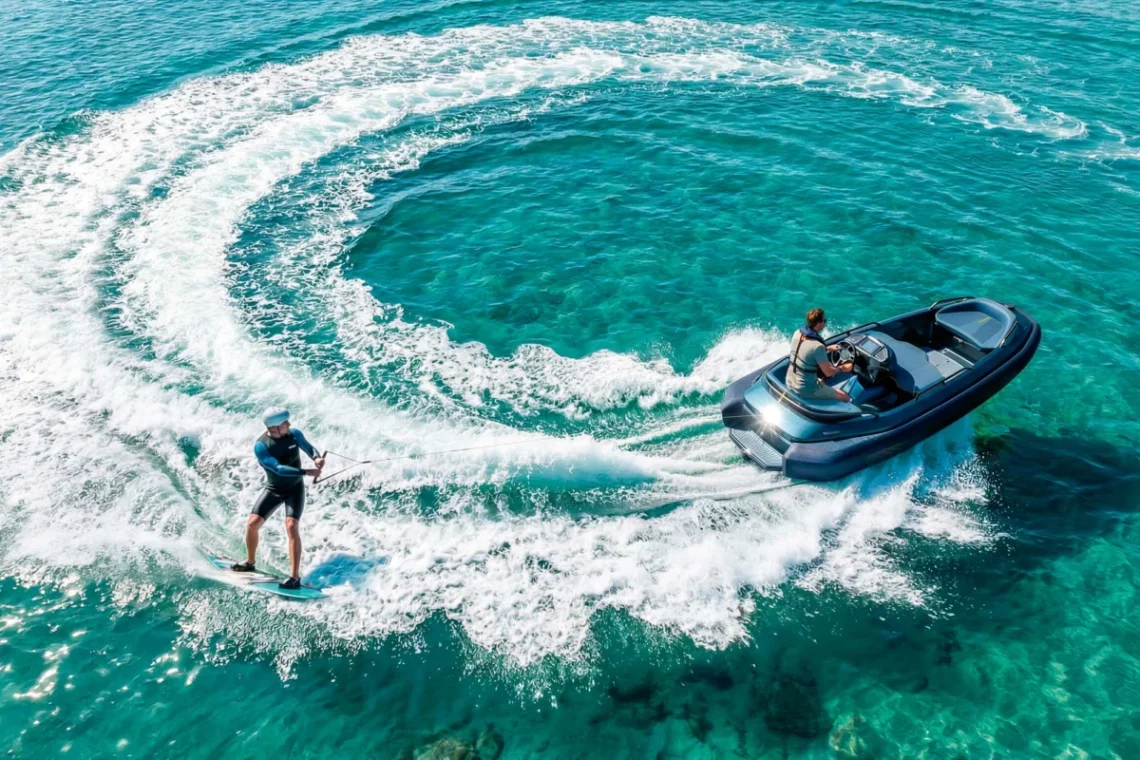
In the rarefied world of superyachting, the tender is often the first and last impression a guest has of the vessel. For years, the market has been bifurcated between purely utilitarian inflatable ribs and bulky, heavy-duty tenders that often feel like an afterthought. However, the unveiling of the Argos Nautic F-330—a high-performance collaboration between the Miami-based manufacturer Argos Nautic and the legendary Italian design house Pininfarina—marks a paradigm shift in how we conceive of the "shore-to-ship" transition.
Measuring just 11 feet in length, the F-330 defies its modest dimensions by blending supercar aesthetics with the punchy agility of a jet-propelled craft. With a 90 hp Rotax jet drive pushing it to speeds in excess of 41 knots, this tender isn’t just a shuttle; it is a statement piece designed to mirror the elegance of the mothership it serves.
Main Facts: Engineering Aesthetics
The F-330 is an exercise in "compressed luxury." By replacing traditional inflatable tubes with high-density closed-cell foam, Argos Nautic has achieved two primary goals: superior aesthetics and enhanced spatial efficiency.
The Shift from Air to Foam
Traditional inflatable tubes are prone to wear, UV degradation, and loss of pressure. By utilizing closed-cell foam, the F-330 maintains a sleek, rigid profile that mimics the sculpted lines of a yacht’s hull rather than a rubber raft. This choice of material offers several distinct advantages:
- Durability: The material is impervious to the common punctures that plague standard tenders.
- Weight Reduction: The absence of heavy air-pumping mechanisms and rubber bulk allows for a lighter displacement, directly contributing to its 41-knot top speed.
- Interior Volume: Without the thick, rounded profile of inflated tubes encroaching on the interior, the F-330 provides a remarkably wide beam, allowing for comfortable seating for four to five passengers.
The Powerplant
At the heart of the F-330 lies a 90 hp Rotax jet drive. The choice of a jet drive is intentional; it eliminates the hazards of an exposed propeller, making the tender significantly safer when operating in shallow waters or maneuvering near swimmers. The Rotax engine is renowned for its power-to-weight ratio, providing the instant torque required to plane quickly even when fully loaded with guests and provisions.
Chronology: A Vision Realized
The development of the F-330 did not happen in a vacuum. It represents the culmination of a multi-year effort to reconcile the rigid requirements of yacht tender storage with the demand for high-end automotive-grade design.
- Phase I: The Conceptual Brief (2023): Argos Nautic approached Pininfarina with a singular goal: to create an 11-foot tender that looked as though it belonged in the same stable as a luxury sports car. The focus was on "flowing lines" and "tactile refinement."
- Phase II: Design Synthesis (2024): Pininfarina’s design team worked to integrate the center console into a collapsible format. This was a critical technical hurdle, as many garages on yachts in the 60-to-100-foot range have strict height limitations.
- Phase III: Prototyping and Sea Trials (2025): The F-330 underwent rigorous testing in the waters off Miami. Engineers tested the stability of the closed-cell foam collar at high speeds, ensuring that the vessel handled choppy water with the grace of a much larger craft.
- Phase IV: Official Market Launch (2026): The vessel was formally introduced to the yachting community, positioning itself as the premier choice for owners who view their tender as an extension of their personal brand.
Supporting Data: Performance and Utility
The specifications of the F-330 reveal a craft that is as functional as it is fashionable.
| Feature | Specification |
|---|---|
| Length Overall | 11 feet (3.35 meters) |
| Engine | 90 hp Rotax Jet Drive |
| Top Speed | 41+ Knots |
| Capacity | 4–5 Passengers |
| Construction | Closed-cell foam collar |
| Special Features | Folding center console |
The decision to incorporate a folding center console is perhaps the most practical element of the design. In many Mediterranean or Caribbean ports, docking fees and garage space are at a premium. By allowing the console to retract, the F-330 can be stowed in smaller tender garages that would otherwise accommodate only personal watercraft. This makes the F-330 a highly viable upgrade for existing yacht owners who are tired of the limitations of their current garage configurations.
Official Perspectives: The Philosophy of Design
Argos Nautic’s leadership has been vocal about the "Pininfarina effect" on the F-330. In recent briefings, the design teams emphasized that the objective was to remove the "utilitarian stigma" of the tender.
"We didn’t want to build another boat that looked like a life raft," says an Argos Nautic representative. "We wanted to build an object of desire. When you pull up to a dock in Nantucket or Porto Cervo, your tender is your business card. Pininfarina helped us translate the language of Italian automotive design into a marine environment."
The collaboration also highlights a trend in the industry: yacht owners are increasingly demanding "cohesive fleets." If the mothership features carbon-fiber accents, high-end upholstery, and a specific color palette, the tender is expected to match. The F-330 is designed to be highly customizable, allowing owners to choose finishes that harmonize with the aesthetic of their primary yacht.
Implications: The Future of the Luxury Tender
The introduction of the F-330 serves as a barometer for the broader yachting industry. We are seeing a move away from the "bigger is better" mentality toward a "smarter and more refined" approach.
Changing Expectations
For the modern yacht owner, the tender is no longer just a shuttle. It is an exploration vehicle. With the F-330, an owner can zip from a moored yacht to a remote beach, or navigate through busy harbor traffic to reach a fine-dining establishment, all while maintaining a level of comfort and style that matches their lifestyle.
The "Nantucket Scenario"
Picture this: It is a balmy July evening in Nantucket. The main yacht is securely moored, swinging gently against the backdrop of the harbor. You have reservations at The Nautilus for a high-end seafood dinner. The wind is picking up slightly, and a traditional inflatable tender might leave you feeling exposed and damp. Instead, you step onto the F-330. Its solid construction and stable design provide a dry, smooth ride to the town pier. The folding console and elegant deck layout mean you arrive at the restaurant looking as composed as you were when you left the yacht. This is the "lifestyle integration" that the F-330 promises.
Impact on Resale and Brand Identity
By partnering with a house as prestigious as Pininfarina, Argos Nautic is effectively elevating the resale value of its tenders. A vessel that bears the mark of a world-class design firm carries a pedigree that generic tenders lack. This is a smart move for owners concerned with the total cost of ownership, as the F-330 is likely to maintain its desirability on the secondary market far better than its competitors.
Conclusion: A New Standard
The Argos Nautic F-330 is more than the sum of its parts. It is a synthesis of cutting-edge materials like closed-cell foam, reliable high-performance engineering from Rotax, and the timeless, fluid design language of Pininfarina.
For the boater who refuses to compromise on quality, the F-330 provides a solution that is as thrilling to drive as it is to look at. It proves that in the world of yachting, the best things often come in small, fast, and meticulously designed packages. As we look toward the 2026 season and beyond, it is clear that the benchmark for the 11-foot tender class has been moved significantly higher.
Whether you are navigating the bustling harbors of the East Coast or exploring the hidden coves of the Mediterranean, the F-330 offers a sophisticated, agile, and remarkably stylish way to traverse the water. It is, quite simply, the ultimate accessory for the modern yachting experience.
For more information on configuring your own F-330, visit argosnautic.com.