For decades, the fixed-mount VHF radio remained an island of stubborn analog antiquity on an otherwise digitized bridge. While chartplotters evolved into high-resolution multi-function displays (MFDs) and radar systems transitioned into complex, predictive imaging tools, the VHF radio often clung to a legacy of clunky knobs, confusing interfaces, and the dreaded, hissing squelch dial.
Now, marine technology giant Garmin is looking to fundamentally rewrite how mariners interact with voice communications. Following its strategic acquisition of New Zealand-based Vesper Marine in 2022, Garmin has spent four grueling years rethinking the ergonomics, software, and audio engineering of the marine VHF. The result of this developmental marathon is the Garmin Signal family—comprising the Signal VHF 400, the Signal VHF 220, and the companion Signal RM 100 remote station.
By marrying the forward-thinking software architecture pioneered by Vesper with Garmin’s manufacturing muscle and advanced audio engineering, the Signal lineup bridges the gap between old-school reliability and modern, smartphone-inspired usability.
Main Facts: The Garmin Signal Ecosystem
The Garmin Signal family introduces a complete reimagining of the traditional marine radio, built from the silicon up rather than patched together from legacy components.
The lineup is anchored by three primary hardware variants:
- Signal VHF 400 ($1,500): A full-featured flagship VHF radio featuring an integrated global navigation satellite system (GNSS) antenna and receiver, built-in Class D Digital Selective Calling (DSC), an integrated Class B-SO Automatic Identification System (AIS) transceiver, and edge-to-edge glass with a sunlight-readable 3.5-inch touchscreen color display.
- Signal VHF 220 ($1,000): Sharing the same core platform and a 3.5-inch touchscreen as the 400, the 220 scales back its AIS capabilities to a listen-only system, making it an ideal choice for cruisers who want advanced VHF functionality without a full Class B-SO transceiver.
- Signal RM 100 ($700): An optional remote station that mirrors the capabilities of the primary units and connects seamlessly via a Garmin BlueNet cable.
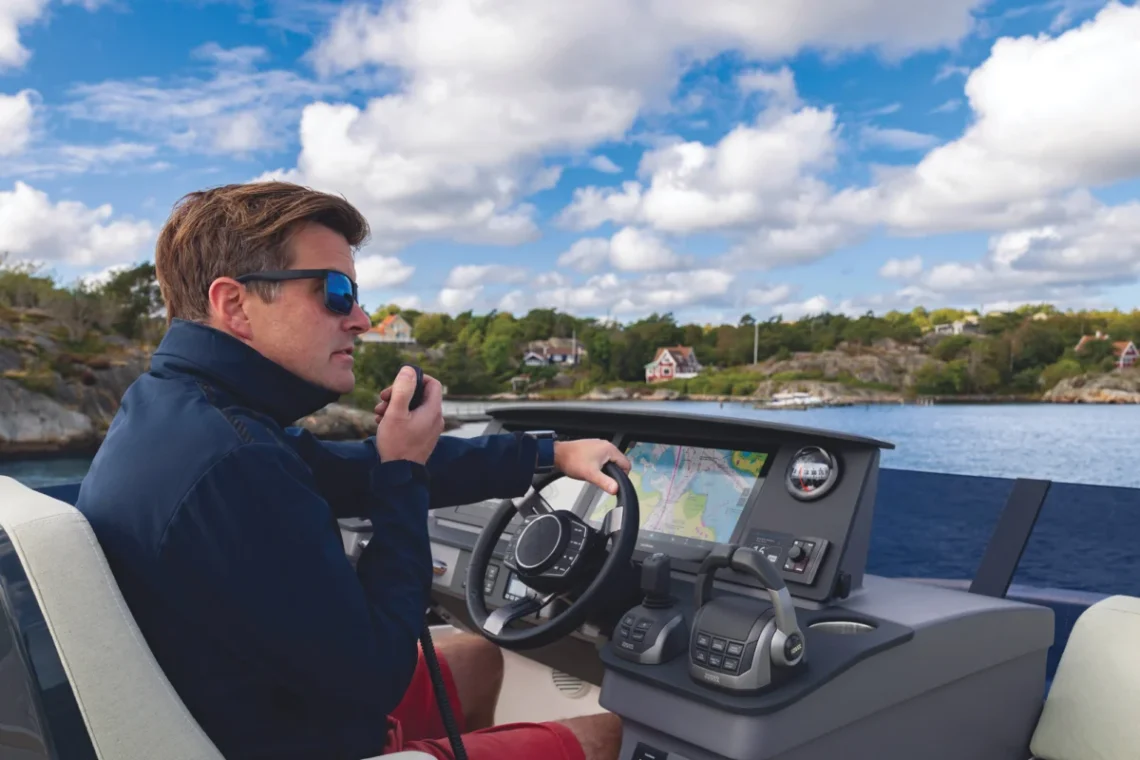
Unlike purely touchscreen systems that abandon physical ergonomics in favor of sleek glass fronts, the Signal family uses a traditional-style, hardwired hand microphone. This fist mic pairs physical handling with a wireless connection to the head unit, striking a balance between one-handed nautical utility and modern touchscreen navigation.
Furthermore, the entire Signal ecosystem relies on Software-Defined Radio (SDR) architecture. This allows Garmin to push over-the-air software updates, implement advanced automated squelch controls, and utilize machine-learning algorithms to strip wind and engine noise out of incoming and outgoing transmissions.
Chronology: From V
esper’s Cortex to Garmin’s Signal
The technological lineage of the Garmin Signal traces back nearly a decade, defined by a deliberate, multi-year evolution in marine electronics design.
2019: The Vesper Cortex Revolution
The foundational seeds for the Signal family were planted in 2019, when Vesper Marine introduced Cortex. Cortex was a watershed moment for recreational marine electronics, recognized as the first VHF radio built on a software-defined radio architecture. It replaced legacy knobs with a smartphone-like touchscreen handset hardwired to a black-box head unit, while incorporating a built-in Class B-SO AIS transceiver for advanced collision avoidance.
January 2022: The Garmin Acquisition
Recognizing the brilliance of Vesper’s software approach, Garmin acquired Vesper Marine in January 2022. This purchase solved a long-standing internal challenge for Garmin. As Dave Dunn, Garmin’s senior director of marine and RV sales, candidly notes, many of the company’s legacy VHFs were historically Garmin-designed, but not Garmin-built. Acquiring Vesper provided Garmin with the foundational engineering talent and software architecture needed to take total control of its marine communication product pipeline.
2022–2026: Four Years of Ground-Up Development
Rather than simply slapping a Garmin badge onto the existing Vesper Cortex hardware, Garmin’s engineering teams embarked on a four-year development cycle. Carl Omundsen, Garmin’s engineering manager of marine communications and a Vesper co-founder, spearheaded the effort. The goal was to take the best attributes of Cortex—such as its SDR flexibility and AIS integration—and wrap them into a high-performance, ergonomically refined solution tailored for modern mariners.
November 2026: The Debut of the Signal Family
Garmin officially pulled back the curtain on the Signal VHF 400, VHF 220, and RM 100 remote station. The launch marked the culmination of a ground-up engineering effort aimed at solving the historical frustrations of marine radio operation, from confusing DSC menus to constant static hiss.
Supporting Data & Technical Specifications
Beneath their sleek, matching exteriors, the technical specifications of the Signal radios reveal a deeply sophisticated marine computer network disguised as a traditional VHF.
Software-Defined Radio (SDR) and Expandability
Because the entire Signal family is built on SDR architecture, its functional capabilities are not permanently locked to its physical silicon at the factory. Garmin engineers can continuously push out new features, diagnostic tools, and user interface refinements via software updates.
This SDR foundation also powers an advanced watch mode, which constantly scans all VHF channels simultaneously for transmissions, ensuring mariners never miss a critical hail. For moments when an announcement or distress call is missed, all three Signal models include internal flash storage and a playback feature capable of recording three minutes of activity across any three active channels.
Intelligent Audio and Noise Cancellation
Perhaps the most universally welcomed technical upgrade in the Signal series is its approach to audio clarity. Garmin integrated an automated squelch control that acts as an intelligent audio gatekeeper, muting the speaker during dead silence and instantly unmuting when a human voice breaks the threshold. Manual squelch override remains available for purists.
To combat the notoriously loud acoustic environment of a boat under way, Garmin integrated an adaptive noise cancellation system powered by machine learning:
- Real-World Training: Garmin engineers trained the machine-learning algorithm using real-world audio data gathered on boats operating in high winds, heavy engine vibration, and crashing waves.
- Dual-Mic Array: Each fist microphone is outfitted with two separate microphones—one positioned on the front and one on the rear. This dual-array layout allows the onboard algorithm to calculate wind direction and automatically select the optimal microphone to isolate the user’s voice.
- Signal Cleanup: When receiving a weak, scratchy transmission from a distant vessel, the radio’s receiver routes the audio through the machine-learning model in real-time, stripping away environmental static and hiss to deliver crystal-clear voice communication.
Network Integration
The Signal radios are fully integrated into the modern marine data grid. They can share AIS and GNSS data with any NMEA 2000-compatible Multi-Function Display (MFD), and users can stream this data directly to their mobile devices using the Garmin Boating app. However, full over-the-air software updates and MFD-based DSC calling are optimized for integration with Garmin-built displays.
Official Responses and Engineering Insights
To understand the philosophy guiding the Signal project, one must look to the engineers and executives who shaped its development.
Dave Dunn emphasizes that the acquisition of Vesper was pivotal in shifting Garmin from a distributor to an end-to-end innovator in marine audio. "A lot of the VHFs that we’ve had in the past were Garmin-designed, but they weren’t Garmin-built," Dunn explains. By bringing Vesper’s engineering ethos in-house, Garmin was able to re-examine the core manufacturing and software loops that govern marine safety equipment.
For Carl Omundsen, the mission was deeply personal and focused heavily on human-machine interaction. "The core focus for us was to make it as easy as possible for people to use and interact with their VHFs," Omundsen states.
Reflecting on the decision to abandon Cortex’s standalone touchscreen handset in favor of a traditional fist mic paired with a head-unit touchscreen, Omundsen points to ergonomics: "There are some ergonomic advantages to having a smaller fist mic designed to be used one-handed."
Regarding the user interface for Digital Selective Calling (DSC)—a feature notoriously underutilized by recreational boaters due to its historic complexity—Omundsen notes that Garmin deliberately mirrored modern smartphone paradigms. "We wanted to make that as familiar as possible," he says.
On the subject of the radio’s AI-driven audio cleanup, Omundsen details the rigorous testing required to perfect the adaptive noise cancellation. "We trained it on actual data, going out on the boat and using it in windy conditions, when engine noise is on and when waves are lapping. If you’re receiving a really weak, scratchy signal, the VHF receiver will run it through that machine learning model and remove a lot of that noise."
Implications for the Marine Electronics Industry
The introduction of the Garmin Signal family signals a broader, inevitable shift across the marine electronics landscape.
For decades, marine VHF radios were treated as regulatory check-box items—necessary safety gear mandated by coast guards, but rarely a focal point for technological innovation. By treating the VHF radio as a networked, software-defined computing node, Garmin is elevating marine communications back to the center of the vessel’s safety architecture.
1. The Death of the Analog Interface
Just as touchscreen chartplotters made paper-chart navigation and knob-heavy radar units obsolete for the average cruiser, the Signal series heralds the twilight of the confusing analog VHF interface. Automated squelch, machine-learning noise suppression, and smartphone-style DSC menus mean that modern boaters no longer need a master’s degree in radio operation to issue a distress call or hail a bridge tender.
As Dave Dunn aptly compares the transition: while some seasoned mariners might initially miss the tactile familiarity of old-school squelch knobs, this nostalgia is fundamentally analogous to smartphone users pining for rotary telephones.
2. Software as a Lifespan Enhancer
In the past, purchasing a marine VHF radio meant buying a static piece of hardware that would slowly become technologically obsolete over a ten-to-fifteen-year lifespan. Because the Signal family operates on an SDR architecture with over-the-air update capabilities, Garmin can continuously deploy new features, security updates, and protocol adjustments. This transforms the VHF from a depreciating asset into an evolving platform that improves with age.
3. Raising the Safety Bar
By democratizing access to AIS data (via the 400’s integrated Class B-SO transceiver or the 220’s listen-only setup) and streamlining Digital Selective Calling, Garmin is effectively lowering the barrier to entry for advanced maritime safety protocols. When emergency communication is intuitive and unhindered by static hiss or complex menu trees, mariners are demonstrably more likely to utilize their equipment proactively.
Conclusion
Garmin’s four-year design odyssey following the Vesper acquisition has resulted in much more than just a new line of marine radios. The Signal family establishes a new benchmark for what a VHF radio should feel, sound, and look like. By blending rugged, one-handed physical ergonomics with artificial intelligence, software-defined adaptability, and crystal-clear audio processing, Garmin has successfully dragged the marine VHF out of the 20th century and firmly into the modern digital age.