The landscape of regional aviation is on the precipice of a seismic shift. For decades, the industry has been bifurcated: traditional fixed-wing aircraft that require sprawling, concrete-heavy infrastructure, and helicopters that offer versatility but struggle with range, payload, and operating costs. Virginia-based aerospace startup Electra.aero is effectively erasing that divide.
In a pivotal move for the future of sustainable, short-haul travel, Electra recently announced that its hybrid-electric ultra-short takeoff and landing (eSTOL) aircraft, the EL9, has achieved a critical certification milestone with the Federal Aviation Administration (FAA). By closing the G-1 Issue Paper, the FAA has effectively set the certification basis for the EL9, providing a clear regulatory roadmap toward commercialization. This is not merely a technical box-ticking exercise; it is the green light for an entirely new category of aviation that promises to bring air travel to the doorstep of communities previously inaccessible by air.
The Core Innovation: Blown-Lift Technology
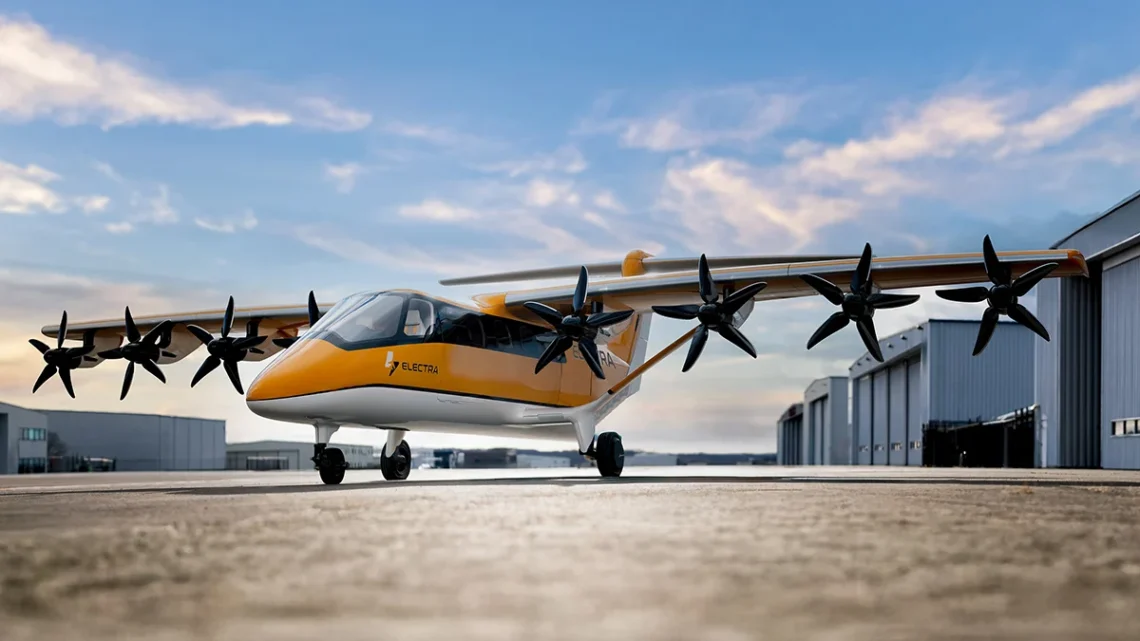
At the heart of the EL9’s capabilities lies a sophisticated aerodynamic concept known as "blown-lift." Unlike traditional aircraft that rely solely on forward velocity to generate lift over the wing, the EL9 utilizes eight electric motors mounted along the leading edge of its 48-foot-long wings.
By blowing air directly over the wings and flaps, the aircraft generates massive amounts of lift at exceptionally low speeds. This allows the EL9 to take off and land at speeds under 30 knots—slower than a professional cyclist’s top speed—enabling it to operate within distances as short as 150 feet. To put this into perspective, the EL9 could potentially operate from a soccer field, a parking lot, or a small clearing, bypassing the need for major airport hubs.
Chronology: From Concept to Regulatory Milestone
The path to this moment has been one of rapid, disciplined engineering. Since its inception, Electra has focused on a hybrid-electric architecture that avoids the "battery trap"—the reliance on massive, heavy battery packs that limit the range and payload of most electric vertical takeoff and landing (eVTOL) craft.
- Initial Concept & Development: Electra moved through rapid prototyping, leveraging its proprietary blown-lift technology to validate performance metrics in sub-scale models.
- The Technology Demonstrator: The successful flight testing of the "Goldfinch" demonstrator aircraft served as the proof-of-concept, proving that the blown-lift mechanics could function safely and reliably in real-world environments.
- The G-1 Milestone: Following extensive data sharing, the FAA closed the G-1 Issue Paper for the EL9. This document is the cornerstone of type certification, defining the airworthiness requirements that the aircraft must meet to fly commercially.
- Future Trajectory: With the regulatory path now set, Electra is targeting full-scale test flights by 2027, with the ultimate goal of achieving type certification and entering commercial service by the end of 2029.
Supporting Data: Why eSTOL Outperforms eVTOL
While the aviation world has been captivated by the promise of eVTOLs (vertical takeoff and landing craft), the EL9 presents a more pragmatic solution for the regional market. By utilizing a runway—even one as small as a soccer field—the aircraft requires significantly less power than a craft forced to fight gravity through vertical lift alone.
Performance Metrics:
- Payload Capacity: 3,000 pounds, enabling it to carry up to eight passengers plus a pilot.
- Range: Up to 1,100 nautical miles, far exceeding the capability of purely battery-powered regional craft.
- Cruise Speed: Up to 175 knots.
- Charging Infrastructure: Because the EL9 is a hybrid-electric aircraft, it carries a turbo-generator that recharges the batteries mid-flight. This eliminates the "range anxiety" and the massive ground-based fast-charging infrastructure required by its purely electric counterparts.
- Acoustic Footprint: At a distance of 300 feet during takeoff, the EL9 produces just 75 decibels—roughly the equivalent of a household vacuum cleaner. This quiet operation is essential for the aircraft to gain the "social license" to operate in urban and residential areas.
Official Responses and Industry Reception
The significance of the G-1 milestone was not lost on the leadership at Electra. CEO Marc Allen, who has been steering the company through the complexities of aerospace regulation, highlighted the partnership between the private sector and the regulator.
"The swift G1 achievement reflects the hard work and productive collaboration between Electra and the FAA, who are working together to make the future of aviation real," Allen stated.

The industry response has been equally bullish. Electra has already secured an impressive backlog of 2,200 pre-orders for the EL9. This order book, valued at nearly $9 billion, includes a diverse range of stakeholders: commercial airlines looking to expand regional connectivity, helicopter operators seeking to upgrade their fleet with more efficient machines, and institutional clients like NASA and the U.S. Armed Forces. These orders underscore a growing consensus that the future of short-haul travel will be defined by aircraft that are cleaner, quieter, and more versatile than the current status quo.
The Implications: A New Era for Regional Connectivity
The implications of the EL9’s success extend far beyond the balance sheet of a single startup.
1. The Democratization of Air Travel
Currently, air travel is largely dictated by hub-and-spoke airport models. Travelers in smaller, remote, or underserved communities are often forced to drive hours to the nearest major airport. The EL9, with its ability to land on improvised, short strips, could revitalize regional air mobility, essentially creating "air bus" routes that connect secondary cities and rural towns with unparalleled efficiency.
2. Economic and Military Utility
The interest from the U.S. Armed Forces and NASA points to the utility of the EL9 in logistics and humanitarian missions. The ability to land a 3,000-pound payload in a tight, austere environment without the need for a traditional runway makes the EL9 an invaluable asset for disaster relief, medical evacuation, and rapid logistics in remote regions where infrastructure has been damaged.
3. Sustainability and the "Green" Transition
The aviation industry is under immense pressure to decarbonize. While long-haul aviation continues to struggle with the weight of current battery technology, regional aviation is the perfect testing ground for hybrid-electric solutions. By slashing the amount of fuel required for takeoff and utilizing electric power for cruise efficiency, the EL9 provides a tangible pathway to reducing the carbon footprint of short-haul regional flights by a significant margin.
4. Urban Air Mobility (UAM)
While the EL9 is not a "flying car" in the sci-fi sense, it acts as a functional bridge for urban air mobility. By utilizing rooftop heliports or small, underutilized municipal lots, the EL9 can move passengers from the suburbs to the city center, bypassing the gridlock of traditional ground transport.
Conclusion: The Road to 2029
The closure of the G-1 Issue Paper is a definitive signal that the EL9 is no longer a paper airplane or a laboratory experiment. It is a maturing aerospace program with a clear path to the skies. As Electra transitions from the certification phase to manufacturing and full-scale flight testing, the aviation industry will be watching closely.
If Electra can successfully navigate the remaining milestones—ensuring safety, proving the durability of their hybrid-electric system under sustained commercial use, and achieving cost-efficiency at scale—the EL9 may well be remembered as the aircraft that moved the world closer together. By turning the "impossible" landing space into a standard runway, Electra is proving that the future of flight isn’t just about going higher or faster; it’s about going everywhere.