The dust has barely settled on the 2026 World Cup, but the global football community is already turning its gaze toward a tournament that promises to be unlike any in the sport’s storied history. The 2030 FIFA World Cup is not merely a competition; it is a sprawling, transcontinental odyssey designed to celebrate the centenary of the beautiful game. Spanning six countries and three continents, the tournament represents a logistical marvel—and a logistical headache—that will redefine what it means to host the world’s most popular sporting event.
Main Facts: A Tournament Across Hemispheres
For the first time in the 100-year history of the FIFA World Cup, the tournament will be held across three different continents. While the primary host nations are Spain, Portugal, and Morocco, the opening act of the tournament will take place an ocean away in South America.
The decision to incorporate Uruguay, Argentina, and Paraguay—the original home of the 1930 tournament—was a strategic move by FIFA to honor the legacy of the inaugural World Cup. On June 8, 2030, the tournament will officially kick off at the iconic Estadio Centenario in Montevideo, Uruguay. This historic venue, which hosted the very first final in 1930, remains the only stadium designated by FIFA as a "Historical Monument of World Football." Following the opener in Montevideo, two additional celebratory matches will be played in Buenos Aires, Argentina, and Asunción, Paraguay.
Following these three symbolic curtain-raisers, the entirety of the 104-match tournament will shift to the primary hosts: Spain, Portugal, and Morocco. The final is scheduled for July 21, 2030, marking the conclusion of a grueling, six-week journey for the participating teams.

A Chronological Look at the 2030 Roadmap
The timeline for the 2030 World Cup is complex, dictated by both the historical significance of the anniversary and the massive infrastructure requirements of the primary host nations.
- June 8, 2030: The symbolic opening matches commence in Montevideo, Buenos Aires, and Asunción.
- June 2030 (Mid-Month): The tournament transitions to the main host countries in Europe and North Africa. This transition will involve significant travel logistics, as players and fans traverse the Atlantic.
- July 21, 2030: The grand finale takes place. While the location remains a subject of intense global debate, the host city will be officially confirmed by FIFA in December 2026.
- Late 2026: FIFA is expected to finalize the stadium selections and the official match schedule, including the host city for the final.
Supporting Data and Infrastructure
The sheer scale of the 2030 World Cup is unprecedented. With 48 teams—and potentially 64 if CONMEBOL’s expansion proposal is accepted by FIFA—the tournament will feature 104 matches. To accommodate this, host nations are investing billions into infrastructure.
Morocco’s Ambition
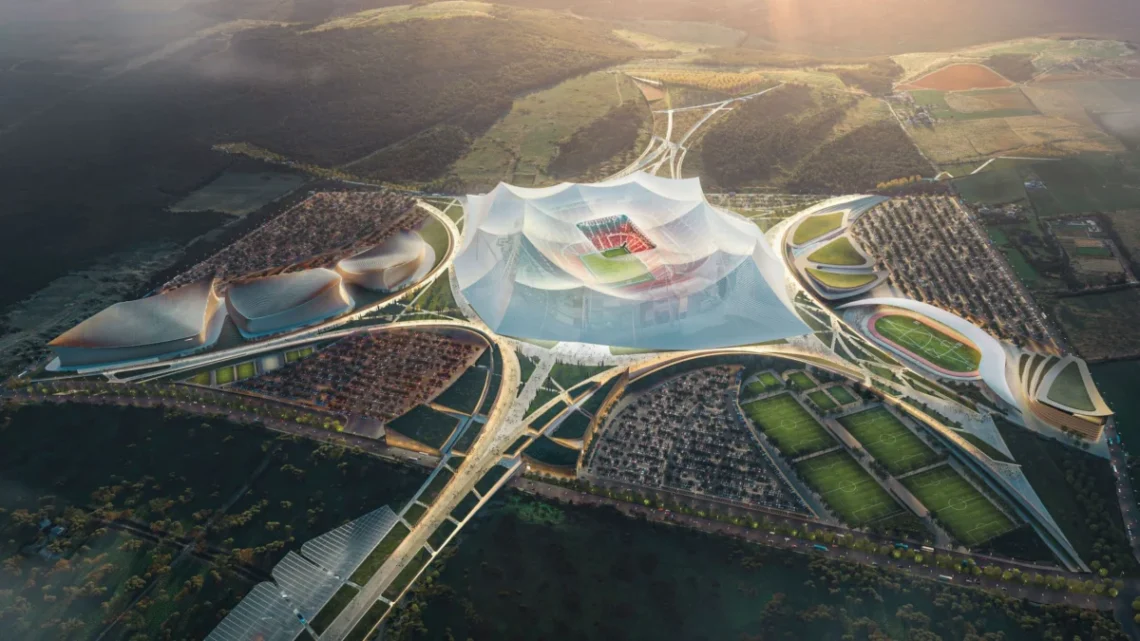
Morocco is positioning itself as a centerpiece of the tournament. In Benslimane, near Casablanca, the country is currently constructing the Grand Stade Hassan II. With a projected capacity of 115,000, it is slated to become the largest football stadium in the world. This architectural marvel, designed to resemble a traditional Moroccan tent, is intended to showcase the nation’s modern capabilities on the global stage.
The Iberian Effort
Spain and Portugal, having last hosted in 1982, are leveraging their existing high-tier stadium network. Spain is currently finalizing its list of host cities, with heavyweights like Madrid’s Santiago Bernabéu and Barcelona’s iconic Camp Nou (currently undergoing a massive renovation) leading the charge. Portugal will utilize the Estádio da Luz in Lisbon and the Estádio do Dragão in Porto, both of which are world-class venues.

South American Upgrades
Despite only hosting one match each, the South American trio is not cutting corners. The Estadio Centenario in Montevideo is set to undergo a 30-month, comprehensive overhaul. The project will add a roof to every stand—save for the historic tower—and expand its seating capacity from 60,235 to 63,000, ensuring it remains a fitting monument for the centennial celebrations.
The Battle for the Final
Perhaps the most contentious aspect of the 2030 tournament is the race to host the final. It is a three-way tug-of-war between the Santiago Bernabéu in Madrid, the rebuilt Camp Nou in Barcelona, and the burgeoning Grand Stade Hassan II in Casablanca.
While Spain has long operated under the assumption that the final would return to their soil, the narrative has shifted significantly over the last year. Reports from the Spanish press suggest that FIFA is seriously considering the Moroccan bid. The proximity between Spain and Morocco, separated only by the Strait of Gibraltar, offers a unique opportunity for cross-border logistics. Fans could technically attend a match in Seville and, within a few hours via ferry or the high-speed Al Boraq train in Morocco, be in Tangier for an evening game. This geographic intimacy may play a role in FIFA’s ultimate decision, which is not expected until December 2026.
Official Responses and FIFA’s Strategy
FIFA President Gianni Infantino has consistently defended the multi-continent format, framing it as a "global bridge." By involving the South American pioneers, FIFA claims to be uniting the past and the future of football.

However, the response from players and coaches has been mixed. While the inclusion of the 1930 host nations is emotionally resonant, the travel requirements are a significant point of concern. FIFA has stated that it has built in "extra rest days" for the teams involved in the South American openers to mitigate the effects of jet lag and climate adaptation. Yet, the fact remains that no previous World Cup has required teams to switch continents in the middle of the group stages.
Furthermore, there is the ongoing discussion regarding the expansion of the tournament. CONMEBOL has been vocal in its desire to see the field grow to 64 teams. While FIFA has been non-committal, Infantino has indicated a willingness to entertain the proposal following the conclusion of the 2026 tournament, suggesting that the structure of 2030 remains fluid.
Implications for Fans and the Future
The 2030 World Cup carries massive implications for the future of international sport. Firstly, it sets a precedent for "distributed hosting." By spreading games across multiple nations, FIFA is effectively lowering the barrier to entry for hosting, allowing countries that might not be able to manage a 104-match tournament alone to participate in the prestige of the event.
For fans, the 2030 experience will be defined by diversity. The tournament will offer a unique blend of South American passion, the tactical brilliance of European football, and the rising prestige of the African game. However, the environmental and logistical impact of moving thousands of fans, staff, and athletes across the Atlantic and between continents will inevitably be scrutinized.

As the world prepares for the 2034 tournament in Saudi Arabia, the 2030 edition stands as a transition point—a celebration of where the game came from, and a bold, sometimes controversial, experiment in how it will be delivered in the future. Whether this "six-country, three-continent" model becomes the new standard or remains a one-time anomaly for the centennial will depend entirely on the success of the 2030 spectacle.
For now, the countdown continues. From the historic streets of Montevideo to the high-speed rail lines of Morocco, the world is preparing for a tournament that, if nothing else, promises to be an unforgettable chapter in the history of human competition.