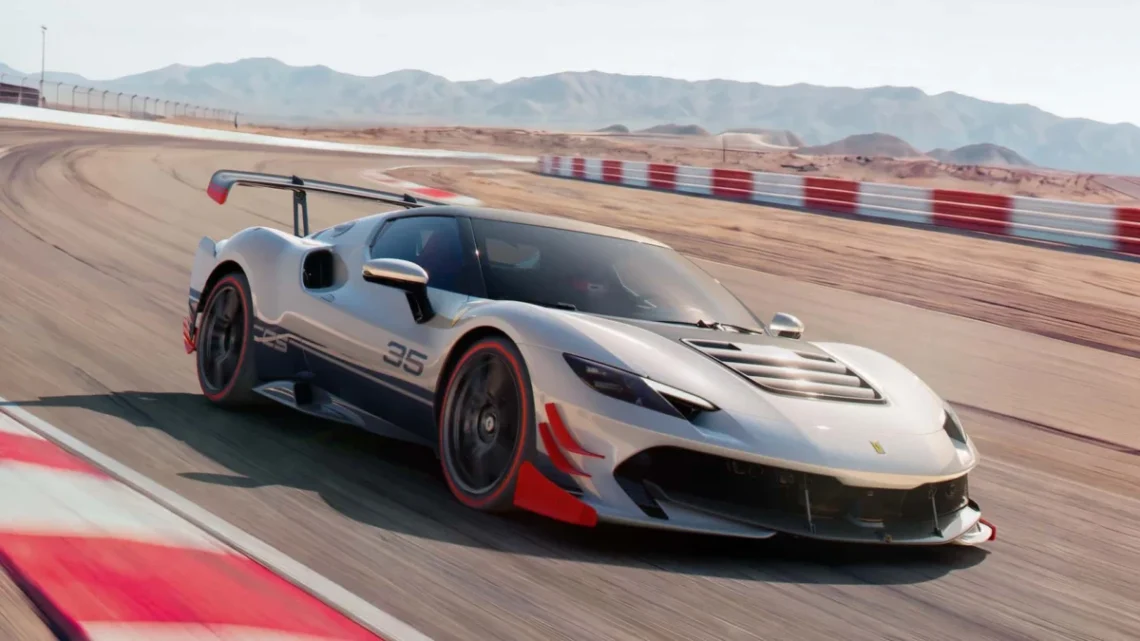
When the curtains lift to reveal Maranello’s latest creation, the immediate reaction is one of absolute fixation. Even standing dead still on a polished presentation floor, the Ferrari 296 Challenge Stradale looks entirely different from anything else wearing the Prancing Horse badge in recent years. It is a striking visual paradox—a genuine, uncompromised racing car that has somehow been granted legal permission to bear license plates for the public highway.
Described by insiders as a deliberate "disruption of balance," this machine represents a significant philosophical departure. Where contemporary supercars lean heavily into electrification, complex torque fill, and assistive technologies to broaden their appeal, the Challenge Stradale strips away the safety nets. It is a razor-sharp track tool built with a singular, unyielding objective: destroying lap times.
Ferrari itself proudly labels it "the production car with the closest connection to a competition vehicle" in the brand’s modern era. Featuring a purely internal combustion heart, a muscular 670 horsepower, a featherlight dry weight of just 2,932 pounds, and a massive 1,360 pounds of aerodynamic downforce at 155 miles per hour, this car redefines what is possible for a road-legal track special. Developed in tandem with the track-only 296 Challenge Evo—which will headline Ferrari’s elite one-make racing series starting in 2027—the Challenge Stradale commands an estimated base price of around $307,000.
Main Facts: Stripping Away the Electric Safety Net
To truly understand the 296 Challenge Stradale, one must look past its stunning silhouette and examine its mechanical architecture. The most defining attribute of this car is its total lack of a hybrid system.
While cars like the 296 GTB and the track-focused 296 Speciale utilize electric motors to supplement low-end throttle response, smooth out power delivery, and assist with corner exits, the Challenge Stradale discards the battery pack and electric motor entirely.
- Engine: Twin-turbocharged 3.0-liter V6 (turbos mounted inside the "V").
- Power Output: 670 horsepower (compared to the 700 hp output of the dedicated 296 Challenge Evo racer).
- Dry Weight: 2,932 pounds with optional lightweight equipment (308 pounds lighter than the standard 296 GTB).
- Power-to-Weight Ratio: 4.37 pounds per horsepower.
- Downforce: 1,360 pounds at 155 mph (a 72% increase over the GTB).
- Fiorano Lap Time: 1 minute and 18.5 seconds.
- Pricing: Approximately $307,000.
"It’s a physical car, fundamentally different to drive," explains a lead development engineer. "It’s not like the 296 Speciale, which is easier and more immediate." Without an electric motor to mask turbo lag or instantly fill torque gaps, the Challenge Stradale demands a higher level of driver engagement. It features a narrower margin for error, relying heavily on its extreme aerodynamic package and mechanical grip to keep the rubber on the tarmac.
Chronology of Competition: Tracing the Challenge Lineage
The symbiotic relationship between Ferrari’s road cars and its legendary racing program dates back to the very foundation of the company. Enzo Ferrari viewed commercial road car production primarily as a financial engine to fuel his burning passion for motorsport competition. That foundational ethos is kept alive today through the Ferrari Challenge, a premier customer racing series that has served as a proving ground for amateur and professional drivers alike since its inception in 1993.
The lineage of track-derived road specials is storied and revered:
- 1993: Ferrari launches the Challenge customer racing series starting with the mid-engined 348.
- Late 1990s to 2000s: The tradition evolves through the F355 Challenge and the iconic 360 Challenge series, establishing a direct pipeline of track technology into showroom models.
- 2000s–2010s: The rollout of lightweight, track-focused road variants—such as the 360 Challenge Stradale, 430 Scuderia, 458 Speciale, and 488 Pista—captivates purists worldwide.
- The Hybrid Era: Ferrari introduces hybrid powertrains to maximize performance, seen in cars like the SF90 Stradale and the standard 296 GTB.
- The Present: The 296 Challenge Stradale arrives, bringing pure racing DNA closer to a road-legal production car than any vehicle in Maranello’s history, bridging the gap directly with the upcoming 296 Challenge Evo race car.
Supporting Data: Engineering Purity and Raw Performance
Under the louvered engine cover sits a heavily revised version of the familiar twin-turbo 3.0-liter V6. The turbochargers themselves and their thermal barriers are carried directly over from the 296 Challenge race car. Ferrari engineers focused their development efforts on optimizing boost pressure calibration, variable valve timing profiles, and thermal insulation.
The resulting dynamic torque output is increased by more than 32 percent compared to the standard 296 GTB. Furthermore, with no electric motor intervention, throttle response is razor-sharp.
Transmission and Exhaust Dynamics
The eight-speed dual-clutch transmission possesses a dual personality. Under aggressive track driving, it adopts the ruthless shifting logic of the 296 Challenge, executing lightning-fast gear changes in roughly 170 milliseconds. At lower speeds or during casual street cruising, it defaults to a smoother, more forgiving calibration borrowed directly from the SF90 XX Stradale. The exhaust soundtrack scales dramatically up to an 8,500 rpm redline, exiting through twin tailpipes pulled straight from the competition car.
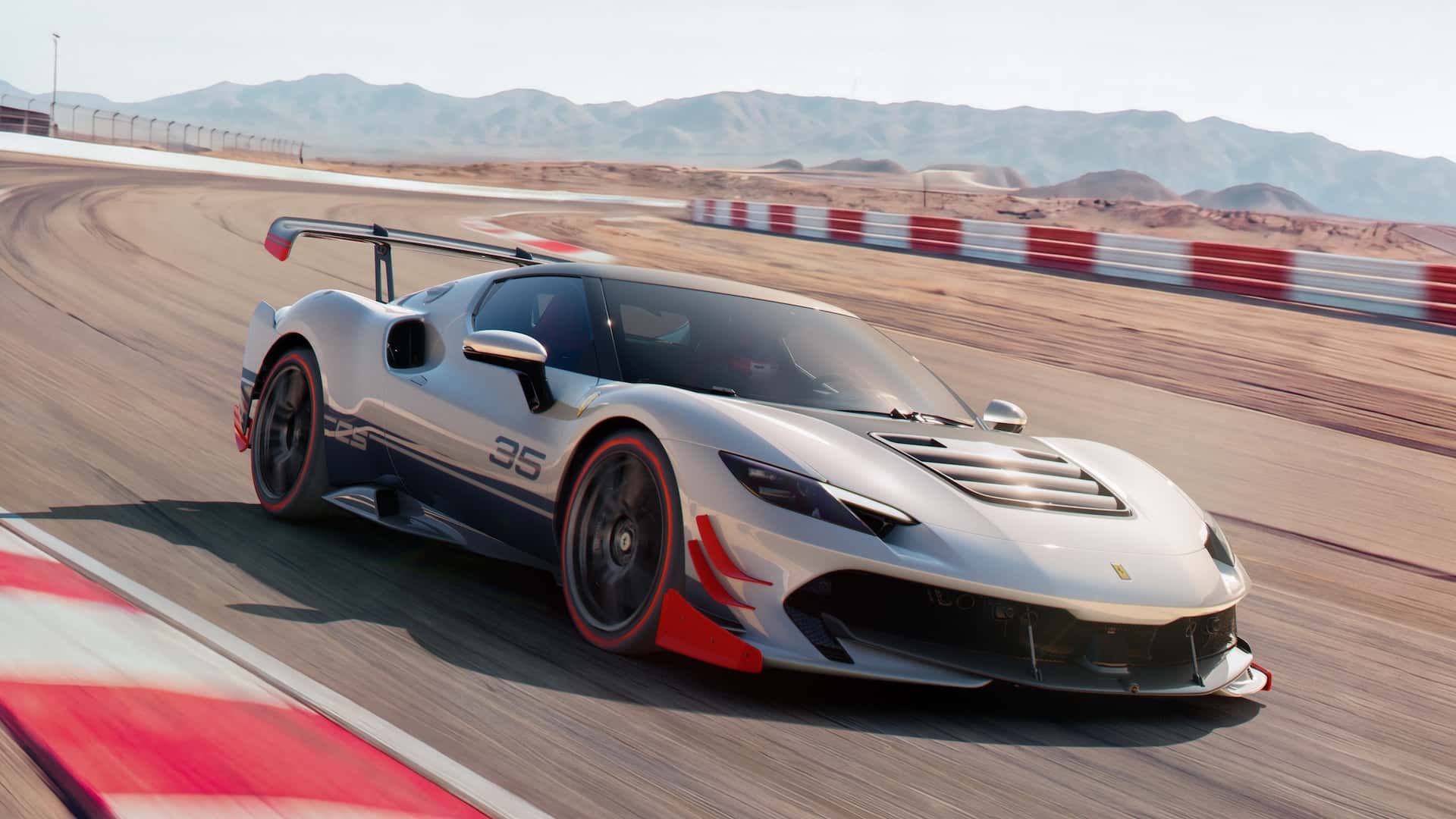
Performance metrics reflect this obsessive focus on weight reduction and power delivery:
- 0 to 60 mph: 2.8 seconds
- 0 to 124 mph (200 km/h): 7.9 seconds
- Top Speed: Exceeds 186 mph (300 km/h)
- Braking Performance (124 mph to 0): 331 feet via carbon-ceramic discs (15.7-inch front, 15-inch rear).
Weight-Saving Measures
Achieving a dry weight of 2,932 pounds required radical surgery. Beyond ditching the heavy hybrid battery and electric drive unit, Ferrari installed a bespoke transmission featuring a lighter casing and shaft. Extensive use of carbon fiber permeates the chassis, body panels, and interior appointments. In a historic first for a production Ferrari, buyers can even specify removable seat coverings that leave parts of the raw carbon-fiber tub structurally exposed to the cabin.
Suspension and Aerodynamics
Body roll has been slashed by 68 percent compared to the GTB. The suspension utilizes springs that are roughly twice as stiff, paired with an auxiliary spring mounted in series—a direct transplant from the 296 Challenge Evo. Semi-active dampers feature two additional rebound settings to maintain a shred of compliance on broken public tarmac.
The aerodynamic profile generates an astounding 1,360 pounds of downforce at 155 mph. A fixed rear wing—derived from the Evo racer—contributes 595 pounds of rear downforce on its own. Notably, to meet strict international road homologation standards (particularly in the United States), the wing mounts from underneath rather than utilizing the race car’s swan-neck design.
Official Responses and Philosophy
Speaking on the design and engineering philosophy of the car, Ferrari’s Centro Stile team—headed by Flavio Manzoni—emphasized that form strictly follows function. Every louver, duct, and carbon-fiber split has a quantifiable aerodynamic purpose.
"This car is a physical disruption," noted a senior project manager during the global unveiling. "We wanted to build something that doesn’t rely on computers to correct mistakes for you. It requires a driver who is fully awake, fully engaged, and ready to dance on the edge of traction."
The vehicle’s traction control and stability management systems are managed by the FIVE system, derived directly from the flagship F80 hypercar. For the first time on a road-going Ferrari, the predictive traction control algorithms have been calibrated explicitly for high-speed track environments, ensuring that aggressive drivers can exploit the car’s limits without electronic interference blunting the experience.
Implications: The Future of Analogue Emotion in an Electric Age
The launch of the Ferrari 296 Challenge Stradale carries profound implications for the ultra-luxury automotive landscape. As global emissions regulations push legacy manufacturers deeper into electrification, solid-state batteries, and software-defined performance, Ferrari has chosen a different path for its most dedicated enthusiasts.
By proving that an intense, race-derived internal combustion engine can still find a home in a road-legal production car—while delivering performance figures that rival dedicated racing machines—Maranello has thrown down the gauntlet. The Challenge Stradale proves that analog driving engagement, raw mechanical noise, and physical feedback are not dead; they are simply being refined into sharper, more focused instruments.
For the fortunate few who secure an allocation at the $307,000 baseline price, the 296 Challenge Stradale is more than just a collector’s item. It is a bridge to a bygone era of pure motorsport emotion, packaged in a street-legal terror that demands absolute respect from whoever sits behind the steering wheel.