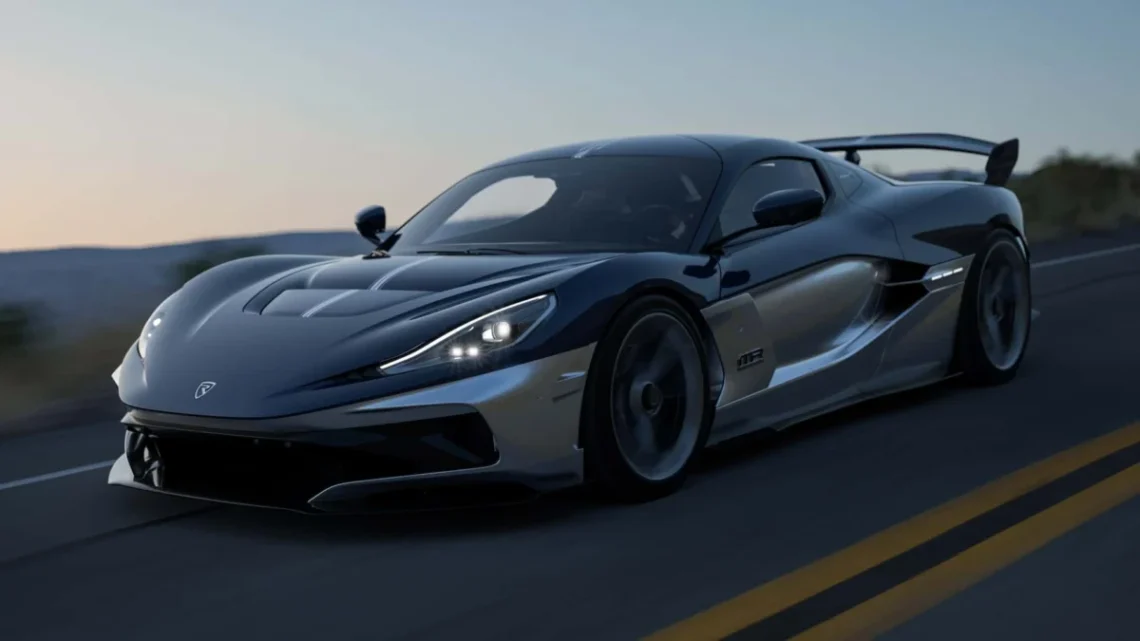
ZAGREB, Croatia — The chapter on one of the most disruptive and boundary-pushing vehicles in automotive history is officially coming to a close. Rimac Automobili, the trailblazing Croatian electric vehicle manufacturer, has announced that production of its flagship hypercar, the Nevera, is wrapping up. With the final batch of 10 heavily track-focused Nevera R models currently rolling down the assembly line—all slated for customer deliveries by the end of this
year—the company is drawing the curtain on a vehicle that redefined what battery-powered performance could achieve.
In a candid announcement shared via social media, Rimac Group CEO and founder Mate Rimac revealed that the company will have built a total of 71 Nevera hypercars since customer deliveries officially commenced in 2022. Of that total, 51 units comprise the standard, record-shattering Nevera, while the remaining 20 units consist of the ultra-exclusive, high-performance Nevera R variant.
While the final production tally falls significantly short of the ambitious 150 units initially projected when the vehicle debuted as the C_Two concept at the 2018 Geneva Motor Show, company leadership remains immensely proud of the car’s legacy. The Nevera not only established Rimac as a titan in the hypercar sphere but also provided the financial and engineering foundation necessary for the brand’s expansive future.
Main Facts: The Numbers Behind the Legend
When Rimac first shocked the automotive world in 2018 with the C_Two concept, it introduced performance metrics that sounded like science fiction. Over the course of its development and subsequent production run, the Nevera consistently shattered expectations, rewriting the rulebook for electric vehicle dynamics.
Powered by a sophisticated quad-motor setup—with independent power delivery to each wheel—the standard Nevera put out a staggering 1,914 horsepower. This immense output allowed the car to sprint from 0 to 60 miles per hour in a jaw-dropping 1.85 seconds, charge through the quarter-mile in 9.1 seconds, and achieve a dizzying top speed of 258 mph.
Not content with resting on its laurels, Rimac pushed the engineering envelope even further with the introduction of the Nevera R. Debuting as an even more hardcore, driver-focused iteration, the Nevera R elevated output to an unbelievable 2,107 horsepower. The performance gains were equally staggering:
- 0–60 mph: 1.74 seconds
- 0–124 mph (200 km/h): 4.38 seconds
- 0–186 mph (300 km/h): 8.66 seconds
- Quarter-mile: 8.23 seconds
Despite commanding multi-million-dollar price tags and catering to an elite clientele—Formula 1 world champion Nico Rosberg notably took delivery of production chassis number one—the Nevera proved that electric powertrains could outclass, outperform, and outmaneuver traditional internal-combustion hypercars.
Chronology: From Geneva Concept to Production Finale
To truly understand the impact of the Nevera, one must trace its evolution from a visionary prototype to a low-volume production reality.
2018: The Genesis at Geneva
At the 2018 Geneva Motor Show, Mate Rimac—then a young entrepreneur operating out of a garage-turned-workshop—unveiled the C_Two concept. Promising radical performance, torque vectoring, and autonomous capabilities, the concept captured the imagination of the global automotive press. At the time, the company mapped out a production run of 150 vehicles, setting high expectations for the fledgling marque.
2021–2022: Transition to Reality and First Deliveries
Following years of rigorous crash testing, aerodynamic refinement, and software optimization, the production-spec Nevera broke cover in 2021. By 2022, customer deliveries officially began, with high-profile enthusiasts like Nico Rosberg securing their keys. The car quickly became a darling of automotive media outlets worldwide, setting numerous production-car speed and acceleration records at testing facilities across the globe.
2024: The Swan Song and the Nevera R
Recognizing the need to inject a final wave of adrenaline into the lineup, Rimac revealed the Nevera R in 2024. Designed to be lighter, sharper, and significantly faster around a racetrack, the Nevera R limited its production to just 20 units.

Late 2025: Production Concludes
As the final 10 Nevera R models near completion, Rimac Automobili is officially closing the book on the vehicle’s manufacturing cycle. All remaining units are scheduled to reach their respective owners by the end of the year.
Official Responses and Reflections
Reflecting on the conclusion of the Nevera era, Mate Rimac offered a pragmatic yet deeply appreciative perspective on the vehicle’s place in automotive history. Addressing the fact that production landed at 71 units rather than the originally planned 150, the CEO emphasized the vehicle’s monumental impact on the company’s trajectory.
"I think it is still a pretty good achievement," Mate Rimac stated in his video address. "It’s the most sold electric hypercar in the world. And without that, there wouldn’t be the Tourbillon today; there wouldn’t be this factory. So, it did its job. I think it’s a quite cool car…that will have its place in history. And thank you to all the owners who are part of this incredible journey."
Rimac’s candid admission highlights the realities of the ultra-exclusive hypercar market. Demand for multi-million-dollar electric vehicles is notoriously niche, yet the Nevera successfully carved out a profitable and defining niche that legitimized EV technology at the absolute apex of performance.
Implications: What the End of the Nevera Means for Rimac Group
The winding down of Nevera production does not signal a slowdown for Rimac Automobili or its parent organization, the Rimac Group. Instead, it marks a calculated transition toward a diversified future that encompasses high-performance hybrids, cutting-edge automotive technology supply, and urban autonomous mobility.
The Bugatti Partnership and the Tourbillon
One of the most significant structural shifts in Rimac’s history occurred in 2021 with the formation of Bugatti Rimac, a joint venture that combined the heritage of the storied French marque with Croatia’s electric wizardry.
The fruits of this partnership are already materializing. The Bugatti Tourbillon—a breathtaking successor to the Chiron—utilizes a radically different powertrain philosophy, pairing an all-new naturally aspirated 8.3-liter V16 engine with three electric motors to generate a combined 1,800 horsepower. The lessons learned during the development of the Nevera’s battery architecture, electric motors, and thermal management systems directly enabled the engineering marvel that is the Tourbillon.
Rimac Technology: Supplying the Industry
Beyond building complete hypercars, Rimac Group has quietly grown into a powerhouse component supplier through its Rimac Technology division. Automakers across the globe look to Rimac for advanced battery systems, inverters, and electric drive units. The revenue and expertise generated by the Nevera project played a crucial role in funding the massive state-of-the-art Rimac Campus outside Zagreb, which now serves as the nerve center for both vehicle manufacturing and tier-one technological development.
Verne: Entering the Autonomous Robotaxi Space
Looking far beyond the realm of track-destroying hypercars, Rimac has also ventured into urban mobility. The company introduced Verne, an autonomous robotaxi service designed to rival concepts like the Tesla Cybercab. Named after visionary science fiction author Jules Verne, the project aims to revolutionize urban transport by offering sleek, driverless pods integrated into a dedicated ride-hailing infrastructure. Following its unveiling in 2024, Verne operations have begun rolling out, demonstrating the staggering breadth of Mate Rimac’s business ambitions.
Conclusion
The Rimac Nevera leaves behind an indelible footprint. It proved to skeptics that battery-electric vehicles could possess soul, drama, and performance that left traditional internal-combustion engines gasping for air.
While only 71 lucky buyers will ever get to park a Nevera or Nevera R in their climate-controlled garages, the ripple effects of the car’s existence will be felt across the automotive landscape for decades. As Rimac turns its focus entirely toward the next generation of hyper-hybrids, tier-one technological partnerships, and autonomous urban mobility, the Nevera can rest easy knowing it accomplished precisely what it set out to do: change the world of performance cars forever.