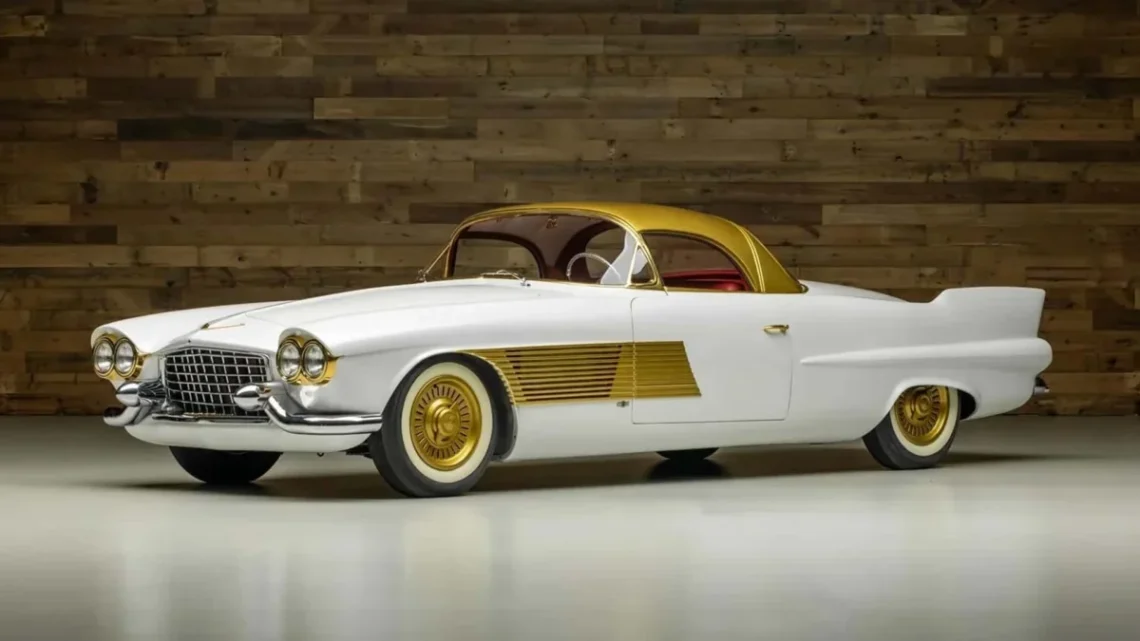
AUBURN, Indiana — In the rarefied upper echelons of automotive collecting, provenance, rarity, and raw theatricality dictate value. At a landmark sale hosted by Kruse Auctions in Auburn, Indiana, those forces converged on a single, astonishing lot. A one-off, gold-plated 1953 Cadillac Elegante hammered down for a staggering $1,275,000, setting a new all-time public auction benchmark for any Cadillac in automotive history.
The transaction obliterates the previous marque record of $940,000—established in 2023 by a 1934 V16 Fleetwood Aerodynamic Coupe—by more than $300,000. More importantly, it dragged a ghost from the mid-century coachbuilding era back into the blinding light of the modern collector market. Having spent roughly 73 years largely hidden from public view, the Elegante proved that the appetite for bespoke, hand-formed American luxury has reached an unprecedented fever pitch.
The Main Facts: Anatomy of a Record-Breaker
To understand why a mid-century Cadillac achieved figures typically reserved for European exotics, one must look beyond the standard assembly line. The Elegante is not a trimmed-out factory flagship; it is a transatlantic collaboration wrapped in 24-karat gold and peerless mid-century optimism.
Underneath its sculptural, pearlescent white skin lies a heavy-duty Cadillac Series 62 chassis. However, the bodywork is an entirely different story. Shaped by the skilled artisans of Carrozzeria Motto in Turin, Italy, the hand-formed aluminum body represents a masterclass in post-war design fusion, marrying Detroit proportions with European coachbuilding sensibilities.
Measuring just 4,331 documented miles on its odometer, the car crossed the auction block accompanied by an immaculate ownership history and a meticulously chronicled restoration file. Kruse Auctions marketed the headline lot with high praise, describing its design language as "inconspicuous luxury, exclusivity, and theatrics like no other." While many postwar customs relied on loud, garish modifications to attract attention, the Elegante achieved its impact through relentless, uncompromising detail.
Chronology: Seven Decades of Design, Disaster, and Rebirth
The story of the Cadillac Elegante is a winding historical narrative spanning more than 70 years, marked by ambitious corporate visions, catastrophic natural disasters, and an agonizingly patient resurrection.
The Genesis (1953–1955)
The roots of the Elegante trace back to the drawing board of legendary automotive designer Albrecht von Goertz. Early in his career, before penning icons like the legendary BMW 507, von Goertz put pencil to paper to draft the striking proportions of this grand tourer. Commissioned as an ultra-exclusive concept, the project was shipped to Italy, where Carrozzeria Motto required an astonishing 30 months to hand-beat the aluminum panels into shape.
In 1950s currency, the labor and material costs soared to roughly $30,000 for the single build—an astronomical sum at the time. The car finally made its grand public debut at the 1955 New York International Auto Show. General Motors initially contemplated a limited production run of 10 units, but the prohibitive costs and complex logistics of hand-building aluminum bodies in Italy rendered mass production impossible. The concept remained a lonely, one-off unicorn.

The Decades in Obscurity and Hurricane Andrew
Following its show circuit days, the Elegante slipped away from the public eye, tucked safely into private collections and hidden from automotive historians for decades. However, its quiet existence was violently interrupted by Hurricane Andrew, the devastating Category 5 Atlantic hurricane that tore through Florida and the Gulf Coast in 1992. The storm severely damaged the irreplaceable Cadillac, leaving its aluminum body and intricate interior in desperate need of salvation.
The 16-Year Restoration (1998–2014)
Recognizing the historical significance of von Goertz’s lost masterpiece, specialists embarked on a grueling, meticulously detailed restoration project. The painstaking process required 16 years of detective work, metal shaping, and mechanical overhaul. When the restoration finally wrapped up in 2014, the Elegante had been brought back to exact factory-prototype specifications, securing the pristine condition and low mileage that would eventually captivate bidders in Auburn.
Supporting Data: The Gilded Details
What elevates a million-dollar classic from a historical artifact to a rolling work of art is its execution. The Elegante is defined by a level of opulence that borders on the surreal.
- The Gold Standard: Everywhere the eye looks, precious metals are integrated into the design. The exterior door handles, the wraparound windshield frame, and various custom bronze components are heavily plated in gleaming 24-karat gold. This contrasts sharply against the pearlescent white exterior paint and a matching gold-finished roof.
- The Cabin: Opening the door reveals a deeply cocooning interior upholstered entirely in rich, supple burgundy Italian leather. The driver is greeted by a translucent Lucite steering wheel housing an illuminated Saint Christopher medallion—the patron saint of travelers.
- Mechanical Heart: Beneath the long, sweeping hood sits a robust 5.4-liter overhead-valve V8 engine generating approximately 210 horsepower. Power is routed through an automatic transmission, while an advanced electro-hydraulic mechanism operates the car’s retractable hardtop, showcasing forward-thinking engineering for the mid-1950s.
Official Responses and Market Reactions
The staggering $1,275,000 hammer price sent shockwaves through the classic car community, prompting industry experts to reassess how the market values American coachbuilding.
Kruse Auctions emphasized that the car’s unmatched pedigree and authentic history gave serious investors the confidence needed to shatter previous records. "It represents an era when styling houses and American manufacturers dared to dream without financial guardrails," noted one auction representative following the sale.
Industry analysts point out that while European coachbuilt classics from brands like Bugatti, Ferrari, and Mercedes-Benz regularly command multi-million-dollar figures, American bespoke cars have historically struggled to bridge the gap. The success of the Elegante signals a major market correction. Collectors are increasingly recognizing that mid-century American concepts crafted by Italian master coachbuilders represent incredible relative value compared to their European contemporaries.
Implications: What This Means for the Collector Car Market
The sale of the 1953 Cadillac Elegante is far more than a headline-grabbing auction result for a single wealthy buyer; it establishes a new paradigm for the entire hobby.
- Re-evaluating Postwar American Customization: For decades, heavily customized cars from the 1950s were often dismissed by purists as period pieces or "rod-and-custom" experiments detached from factory heritage. The seven-figure success of the Elegante proves that factory-backed or designer-penned coachbuilt concepts command the same respect as European grand tourers.
- The "Barn Find" and Hidden History Premium: With 73 years of relative seclusion, the Elegante reinforces the market’s obsession with unexposed provenance. Collectors are actively hunting for cars that avoided the modern restoration circuit for decades, viewing untouched or perfectly preserved historical lineage as the ultimate asset.
- Trickle-Down Valuation: While very few enthusiasts will ever possess the capital to bid on a million-dollar gold-plated Cadillac, the ripple effects will be felt in local garages and regional swap meets. Owners of lesser-known postwar customs, styling-exercise prototypes, and rare domestic trim variants are taking a second look at their own holdings. Vehicles previously written off as "just an old Cadillac" are now receiving the archival research and appreciation they deserve.
As the hammer came down in Auburn, Indiana, sealing the fate of the million-dollar Cadillac, it cemented a simple truth: true craftsmanship, historical significance, and a touch of gold will always find a receptive audience among those who shape the future of automotive collecting.