NEW YORK — When the Kremlin ordered the invasion of Ukraine in February 2022, shockwaves reverberated far beyond the borders of Eastern Europe. While Western capitals united in swift condemnation and unprecedented economic warfare against Moscow, major Asian democracies and rising economic powerhouses adopted a posture of strategic neutrality. At first glance, New Delhi and Beijing appeared to be walking in lockstep: both maintained robust diplomatic channels with the Kremlin, both capitalized on discounted Russian energy exports, and both steadfastly refused to join Western-led sanctions designed to isolate Russian President Vladimir Putin’s regime.
Yet, as the conflict grinds through its protracted fourth year, a deeper, more profound geopolitical divergence has broken the surface. Beneath the shared rhetoric of multipolarity and non-alignment lies a starkly different calculus. India desperately wants the war in Ukraine to end, viewing the prolonged bloodshed as a destabilizing force that accelerates Russia’s geopolitical decline and forces Moscow into a dangerous dependency on Beijing. China, by contrast, derives distinct economic and strategic utility from the continuation of the conflict.
This asymmetry stems less from how Beijing and New Delhi view Moscow, and much more from how they view each other. As Russia is steadily transformed into a junior partner in the Sino-Russian axis, India faces an existential strategic squeeze, threatening the foundational pillars of its foreign policy and upending the regional balance of power in South and East Asia.
Main Facts: The Great Power Realignment
The structural transformation of Russia’s foreign policy orientation since 2022 represents one of the most significant geopolitical shifts of the twenty-first century. Cut off from Western financial systems, high-technology imports, and traditional European energy markets, Moscow has turned eastward with historic urgency.
- The Sino-Russian "No Limits" Partnership: Formalized weeks before the invasion, Beijing and Moscow’s alignment has deepened into an asymmetric economic and military embrace. China has become the indispensable economic lifeline for the Russian Federation, absorbing vast quantities of sanctioned Russian oil and gas while flooding the Russian domestic market with manufactured goods, automobiles, and dual-use electronics.
- Russia as the Junior Partner: Decades of parity—or Russian dominance—in the Sino-Russian relationship have evaporated. Facing severe international isolation, Moscow has little leverage left in its dealings with Beijing, rendering it a resource-rich, politically isolated junior partner dependent on Chinese diplomatic cover at the United Nations and economic sustenance.
- India’s Balancing Act: Historically, New Delhi has relied on Moscow as a trusted counterweight to Beijing, a vital defense supplier, and a reliable partner in navigating regional security threats. The erosion of Russia’s autonomy threatens to dismantle this architecture, leaving India increasingly isolated as it faces an aggressive China across the contested Himalayan frontier.
Chronology of a Shifting Landscape: From Cold War Ties to the 2026 Reality
To understand the current crisis in New Delhi, one must trace the historical trajectory of Russia-India relations and the rapid acceleration of geopolitical events following the 2022 invasion.
1947–1991: The Cold War Foundation
Following its independence, India forged a close, pragmatic relationship with the Soviet Union, cemented by the 1971 Indo-Soviet Treaty of Peace, Friendship and Cooperation. This partnership provided New Delhi with diplomatic support during regional crises, vetoes at the UN Security Council, and the bulk of its military hardware, shielding India from a hostile U.S.-Pakistan-China alignment.
1991–2021: Post-Soviet Adaptation and the Strategic Partnership
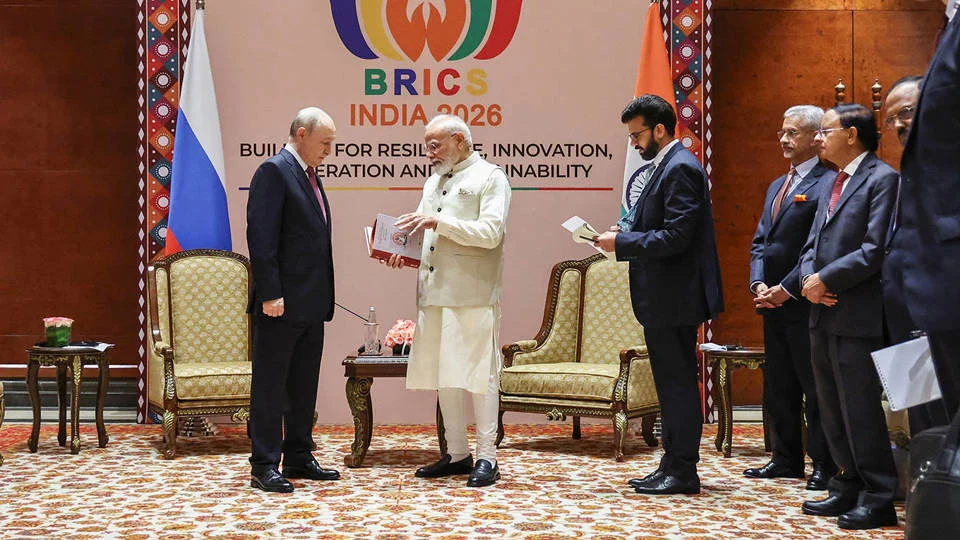
Following the collapse of the USSR, the Russian Federation inherited this strategic relationship. Despite India’s growing economic and security ties with the United States—typified by the foundational defense agreements and the elevation of the Quadrilateral Security Dialogue (Quad)—New Delhi maintained its historic defense and energy ties with Moscow. The annual summit between Indian Prime Ministers and Russian Presidents remained a cornerstone of Indian foreign policy.
February 2022: The Ukraine Invasion and the Initial Shock
The invasion of Ukraine presented New Delhi with an immediate diplomatic crisis. Balancing its burgeoning democratic partnership with the West against decades of dependence on Russian military spares and energy, India chose strategic autonomy. It abstained from UN votes condemning Russia and stepped up purchases of discounted Urals crude, earning Western criticism while stabilizing its own inflationary pressures.
2023–2025: The Deepening Chasm
As the war transformed into a grinding war of attrition, the divergence between China and India widened. Beijing’s economic exploitation of Russia’s isolation accelerated. Simultaneously, Moscow’s ability to supply India with advanced military hardware—such as additional S-400 air defense systems or spare parts—hit severe bottlenecks due to domestic Russian war production demands and Western component sanctions.
September 2026: A Junior Partner Realities Set In
Today, the geopolitical ledger shows a Russia irrevocably tethered to Beijing. For India, the illusion of Moscow acting as an independent great power capable of balancing Chinese ambitions has faded, prompting an urgent recalibration of New Delhi’s grand strategy.
Supporting Data: Economic and Strategic Indicators
The structural realities of this new era are laid bare by empirical trade, diplomatic, and defense data compiled over the course of the conflict.
Trade and Energy Flows
- Sino-Russian Trade: Bilateral trade between China and Russia shattered records in 2024 and 2025, surpassing $240 billion, driven primarily by Chinese energy imports and exports of industrial machinery.
- Russian Oil to Asia: Prior to 2022, the vast majority of Russian oil flowed westward. By 2026, over 90% of Russian seaborne crude exports are directed toward Asia, with China and India acting as the primary absorbers. However, China’s diversified economy absorbs these resources with far less systemic vulnerability than India’s developing market.
Defense Dependency and Supply Chain Pressures
- Military Hardware: Historically, India sourced approximately 60% to 70% of its military equipment from the Soviet Union and later Russia. By 2026, defense imports from Russia have plummeted as Moscow prioritizes its own armed forces in Ukraine and struggles to secure Western semiconductors and microchips necessary for advanced weapon systems.
- Technological Isolation of Moscow: With Russia effectively cut off from Western high-tech supply chains, its defense industry is increasingly reliant on lower-tier Chinese technological inputs, further binding Russian military capabilities to Beijing’s industrial ecosystem.
Official Responses and Diplomatic Posturing
The diplomatic rhetoric emanating from Beijing, New Delhi, and Moscow highlights the profound tensions underlying the current global order.
Beijing: The Rhetoric of Normal Trade
Official statements from China’s Ministry of Foreign Affairs consistently defend Beijing’s ties with Moscow as normal economic and diplomatic cooperation free from third-party interference.
"China and Russia maintain a comprehensive strategic partnership of coordination based on non-alignment, non-confrontation, and non-targeting of third countries," a Chinese foreign ministry spokesperson stated recently.
Privately and strategically, however, Beijing views the distraction of the West in Ukraine—and the resulting subjugation of Russian strategic independence—as a major geopolitical windfall that ties down American resources and secures China’s northern land border.
New Delhi: The Pursuit of Strategic Autonomy
India’s Ministry of External Affairs has maintained a disciplined silence regarding Russia’s junior-partner status, publicly emphasizing the enduring resilience of the "Special and Privileged Strategic Partnership" with Moscow. However, Indian External Affairs Minister Subrahmanyam Jaishankar has repeatedly underscored India’s independent worldview:
"India has a multifaceted set of relationships. We judge situations on their merits, and our primary objective is the protection of India’s national security and economic interests in a highly volatile multipolar world."
Behind closed doors, Indian diplomats express mounting anxiety over the prospect of a Moscow completely subservient to Beijing’s regional agenda, particularly concerning security architectures in Central Asia and the Indo-Pacific.
Moscow: Deflecting the Junior Partner Label
Russian officials vigorously reject the characterization that Moscow has become Beijing’s junior partner, framing the pivot to Asia as a long-term civilizational turn toward the Global South.
"Our relations with China are at an all-time high, characterized by mutual respect and absolute equality of interests," Russian Foreign Minister Sergey Lavrov asserted during a recent ministerial meeting.
Yet, economic reality tells a different story: without Chinese renminbi clearinghouses, dual-use technology imports, and massive commodity purchases, the Russian state budget would face catastrophic collapse.
Strategic Implications: What the New Axis Means for the Future
The consolidation of the Sino-Russian axis and the concurrent weakening of Russian sovereignty carry profound, long-term implications for global stability, Asian security, and Western diplomacy.
1. The Erosion of India’s Strategic Cushion
For decades, India relied on Moscow as a diplomatic backstop. If relations with Washington soured, India had Moscow; if tensions with Beijing boiled over, Russia could provide critical diplomatic balance and military hardware. With Russia now financially and strategically beholden to China, Moscow’s utility as a counterweight to Beijing has dropped precipitously. If a major border crisis erupts between India and China along the Line of Actual Control (LAC), New Delhi can no longer expect Moscow to remain neutral, let alone lean in India’s favor.
2. Acceleration of India’s Western Alignment
Ironically, Russia’s war in Ukraine is pushing India closer to the United States and its allies, despite New Delhi’s historical aversion to formal alliances. To offset the loss of Russian strategic depth, India is accelerating intelligence-sharing, defense procurement, and joint military exercises with the United States, Japan, and Australia through the Quad, as well as deepening bilateral security ties with France and the UK.
3. A Consolidated Eurasian Bloc
The deepening of ties between Beijing and Moscow creates a formidable, contiguous authoritarian bloc spanning across Eurasia. This bloc increasingly seeks to construct alternative financial, governance, and security architectures—such as expanding the BRICS bloc and the Shanghai Cooperation Organisation (SCO)—designed to bypass Western-dominated institutions. For India, participating in these forums becomes an exercise in delicate diplomacy: attempting to prevent China from turning these multilateral bodies into anti-Western, Beijing-dominated instruments.
4. Prolonged Global Instability
Because Beijing benefits strategically from a bogged-down West and a compliant, dependent Russia, any genuine, sustainable peace framework for Ukraine remains highly elusive. China’s economic oxygen keeps the Russian war machine viable, ensuring that the conflict will likely remain a chronic, low-intensity hemorrhage at the heart of European security—with ripple effects felt acutely from the markets of Mumbai to the mountain passes of the Himalayas.
Conclusion
The war in Ukraine has rewritten the geopolitical rulebook, transforming what was once a triangular balance of power among Washington, Moscow, and Beijing into a binary contest defined by a powerful Sino-American rivalry, with a subordinate Russia orbiting the Chinese core.
For India, this new reality is fraught with danger. As Russia’s autonomy fades, New Delhi finds itself stripped of a historic buffer against Chinese expansionism. Navigating this treacherous new terrain will require supreme diplomatic agility: balancing its immediate economic needs, maintaining strategic independence, and forging new alliances to secure its borders in an increasingly dangerous and polarized world.