
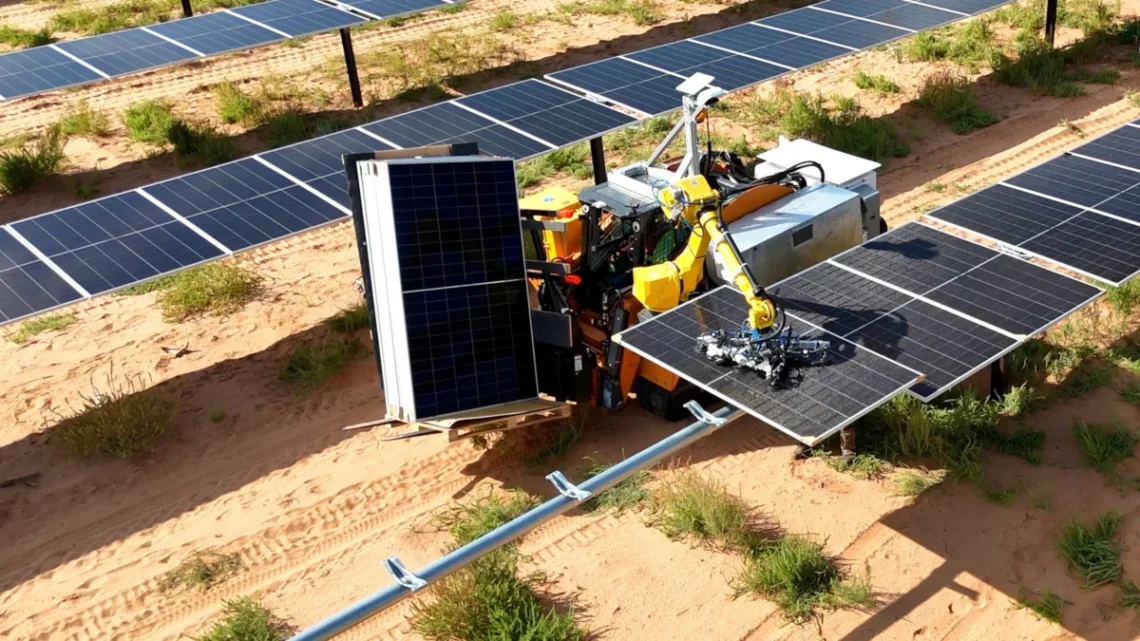
As the global transition to renewable energy accelerates, a profound logistical bottleneck has emerged: the physical construction of solar infrastructure. While world leaders and corporations scramble to deploy massive solar arrays to meet climate goals and achieve energy independence, the industry is hitting a wall—not of technology or capital, but of human labor.
To bridge this gap, a new wave of robotics companies is emerging, but one startup is taking a distinctively different approach. Gritt, a Carnegie Mellon-bred robotics venture, has officially exited stealth mode, armed with a $26 million Series A funding round and a mission to transform the chaotic, unstructured environment of construction sites into the next frontier for artificial intelligence.
The Core Challenge: Why Construction Sites Stymie Robots
Historically, industrial robotics have been confined to the "caged" environment of a factory floor—a world of static geometry, controlled lighting, and predictable workflows. Move a robot to a dusty, muddy, and perpetually changing solar construction site, and these systems traditionally fail.
The complexity of an outdoor build-site—where terrain shifts, weather changes, and materials are often placed haphazardly—has long been the "final frontier" for robotics. However, the meteoric rise of foundation AI models has fundamentally altered the math. By leveraging advanced machine vision and generalizable intelligence, Gritt is bypassing the need for perfectly controlled environments.
"Our thesis is that if we truly want to speed up construction, you need an intelligence which can work in the outdoor, chaotic environments of these construction sites," explains CEO Puneet Puri. "It has to be generalizable enough that it can work in these varied environments."
Chronology: From Academic Research to Industrial Scale
The journey for Gritt began within the hallways of Carnegie Mellon University, a global epicenter for robotics research. Co-founders Puneet Puri and CTO Vishal Dugar spent years honing the technical foundations that would eventually become the company’s "physical AI" platform.
- Early Development: The founders focused on creating software capable of interpreting unstructured data in real-time, allowing machines to adapt to the unpredictable nature of outdoor labor.
- Seed Funding: The company secured an initial seed round from high-profile investors, including First Round Capital, Climactic, Congruent Ventures, and VSC Ventures, providing the runway to move from simulation to field-testing.
- Stealth Expansion: Over the past two years, Gritt has been quietly refining its software, deploying units to active job sites to gather critical data on panel installation efficiency.
- Series A Milestone: On Tuesday, Gritt officially exited stealth, announcing a $26 million Series A led by Obvious Ventures, with participation from Union Square Ventures and Active Impact Investment. This brings the company’s total funding to $34 million.
- Current State: The company currently has two systems active in the field and is aggressively scaling, with plans to operate 48 systems within the next six months.
Supporting Data: Efficiency at Scale
The economic argument for Gritt is grounded in stark productivity metrics. In a traditional solar installation, an eight-person crew typically installs approximately 800 panels in a single workday. When augmented by Gritt’s robotic systems, that same crew can see their output surge to 3,000 to 4,000 panels per day.
This represents a nearly five-fold increase in productivity. These gains are currently being tested by three of the top 10 US power construction companies. With contracts already secured to assist in the installation of 2.8 gigawatts of solar capacity over the next 18 months, Gritt is moving quickly from a prototype operation to a critical player in the national energy grid build-out.
Official Responses and Strategic Vision
The investment community sees Gritt as a pivotal player in the "industrialization of the energy transition." Andrew Beebe, a partner at Obvious Ventures who led the Series A round, notes that the team’s background is a rare combination of high-level academic theory and the grit required for field work.
"There are people who used to build rockets that went into space and had infinite budget for the smallest little part, and then there are people who know what it means to get into dirty, dull, and dangerous jobs and scale them like mad," Beebe said. "These guys are in the second camp."
From the customer side, the enthusiasm is equally palpable. While many partners remain anonymous due to competitive sensitivity, their feedback highlights two major pain points Gritt solves:
- Labor Scarcity: It is increasingly difficult to attract and retain workers for remote, physically demanding solar sites.
- Safety and Longevity: By offloading the "dull, dirty, and dangerous" tasks—such as lifting 100-pound glass panels overhead repeatedly—the company is drastically reducing the risk of workplace injuries and long-term strain for human laborers.
Implications: A New Layer of Physical AI
Gritt’s competitive advantage lies in its "hardware-agnostic" software strategy. While rivals like Luminous Robotics, Cosmic, and China’s Trinabot are developing proprietary, purpose-built hardware, Gritt focuses on deploying its AI "brain" onto off-the-shelf industrial hardware, such as Kawasaki robotic arms and standard skidders.
The Power of Generalization
The most significant implication of Gritt’s technology is the ability to pivot between tasks. Five years ago, a robotics system would have required a complete software overhaul to switch from stacking cinder blocks to tying rebar. Today, the same underlying neural pipeline can be adapted to new tasks in a matter of days.
Beyond Installation: Site Management
Gritt’s founders view their current solar panel installation duties as merely the "entry point" into a much larger market. The company intends to expand into:
- Infrastructure Assembly: Drilling posts and constructing the mounting racks themselves.
- Civil Engineering Support: Tying rebar for concrete foundations.
- Site Management Intelligence: Using the robotic platform’s suite of sensors to act as a "site overseer."
Imagine a system that detects an open trench during a severe weather warning and alerts the human crew to protect components before damage occurs, or a system that automatically inventories missing hardware in real-time. By acting as a layer of "physical AI," Gritt is not just replacing manual labor; it is creating a real-time digital twin of the construction site.
Conclusion: The Path Ahead
As the world races toward a net-zero future, the physical reality of building millions of solar panels cannot be ignored. The "Gritt model"—utilizing off-the-shelf hardware powered by agile, generalizable AI—offers a scalable path forward that avoids the massive capital expenditures of proprietary robotics manufacturing.
By turning the chaos of the construction site into a data-driven environment, Gritt is positioning itself as the operating system for the next generation of civil infrastructure. Whether it succeeds in its ambitious goal of moving from solar panels to the broader construction industry will depend on its ability to maintain its lead in the "AI arms race" and the continued reliability of its systems in the field.
For now, the company has proven one thing: the future of building the world may not be in the hands of the machines alone, but in the intelligent, adaptive collaboration between human workers and the new generation of physical AI.