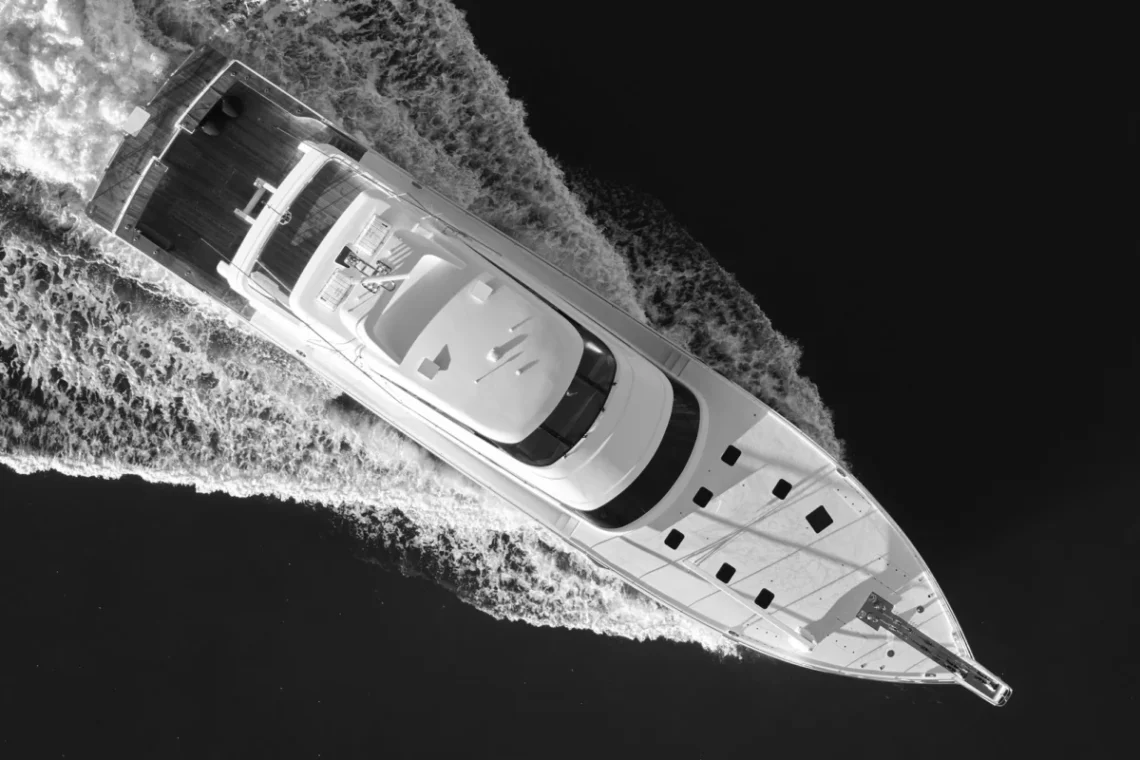
In the rarefied world of custom yachting, the true measure of a vessel is not found in the gloss of its finish or the prestige of its shipyard, but in the miles logged under the owner’s flag. For the 115-foot Gramac VII, a 2024 carbon-composite sport-fisher, that validation has arrived in the form of an exhaustive five-month shakedown cruise through the turquoise reaches of Fiji.
Constructed by the renowned New Zealand-based Yachting Developments, Gramac VII represents a paradigm shift in the sport-fishing segment. While many vessels in the 200-gross-ton class prioritize aesthetic silhouette over functional adaptability, Gramac VII challenges the status quo by marrying high-performance engineering with an unprecedented commitment to universal accessibility.
A Technical Powerhouse: Where Performance Meets Precision
At the heart of Gramac VII lies a propulsion package designed for those who demand both speed and reliability. Featuring twin MTU 16V 2000 M96L engines, the yacht commands a combined 5,200 horsepower. This raw power translates into a formidable top-end speed of 31 knots, allowing the vessel to chase down pelagic targets or navigate between Pacific archipelagos with remarkable agility.
However, power is only one facet of the Gramac VII narrative. The yacht’s performance is refined through a sophisticated suite of stabilization and control technologies. The vessel utilizes Humphree interceptors and active fin stabilizers to mitigate pitch and roll, ensuring that even at high speeds or in choppy seas, the onboard experience remains composed. Furthermore, the inclusion of Sleipner electric thrusters and precision-engineered Veem propulsion components demonstrates a holistic approach to naval architecture. These systems do not merely move the boat; they manage energy efficiency and mechanical harmonics, resulting in a ride that is as smooth as it is swift.
With a beam exceeding 25 feet, the vessel provides a stable, wide-platform footprint. This generous volume, crafted from advanced carbon-composite materials, allows for a structural rigidity that supports both the heavy mechanical requirements of a sport-fisher and the expansive, light-filled interior volumes expected of a modern luxury cruiser.
Accessibility as a Design Pillar
Perhaps the most revolutionary aspect of Gramac VII is its interior philosophy. In an industry where multi-level layouts often rely on steep staircases and narrow companionways, Gramac VII stands as a beacon of inclusivity. The design, spearheaded by Warwick Yacht Design, integrates a custom-engineered elevator that services every deck of the yacht.
This is not a retrofit or an afterthought; it is a fundamental element of the vessel’s DNA. Full wheelchair accessibility across all decks ensures that the yacht is a home without barriers. This focus on accessibility extends to the interior circulation paths, which have been widened and optimized to allow for easy maneuverability without sacrificing the high-end finishes or the intimate "home-away-from-home" feel of a custom sport-fisher.
For the owner, who has a hands-on relationship with the vessel, this level of accessibility extends to the technical spaces. The yacht features a private access route leading directly from the master stateroom into the engine room. This design choice serves as a testament to the owner’s direct engagement with the mechanical heart of his vessel, allowing for inspection and oversight without the need to traverse public or crew-only zones.
Chronology of a Pacific Shakedown
The story of Gramac VII began in the design offices of Warwick Yacht Design, where the brief called for a vessel that could handle the demands of professional-grade sport-fishing while functioning as a comfortable, long-term living space.
- 2023: Construction reaches peak intensity at the Yachting Developments facility in New Zealand. The carbon-composite hull is cured, and the complex integration of the hydraulic elevator system begins.
- Early 2024: Sea trials commence. The vessel hits its target speeds of 31 knots, and the stabilization systems are calibrated to the specific weight distribution of the custom interior.
- Mid-2024: Delivery to the owner. Shortly after taking possession, the yacht begins its maiden voyage, departing New Zealand for the South Pacific.
- Late 2024: The "five-month marathon." The owner spends an unprecedented amount of time aboard, cruising the waters of Fiji. This period serves as the ultimate "live-aboard" test, confirming that the electrical, plumbing, and climate-control systems can withstand the rigors of sustained tropical use.
The Professional Perspective: Ian Cook on Validation
For Ian Cook, the managing director of Yachting Developments, the performance of Gramac VII in the South Pacific is the ultimate career milestone. In a field where projects often spend more time in marinas than on the open ocean, the intensity of this owner’s usage is a rare luxury for a shipbuilder.
"Extended owner use is the ultimate validation of a custom yacht," says Cook. "When you build a project of this complexity, you are essentially building a bespoke ecosystem. Gramac VII was designed to be lived on and trusted, not just displayed. Her time cruising the Pacific has confirmed the strength of the concept, the engineering execution, and the dedication of the craftsmen who brought it to life."
Cook emphasizes that the feedback loop established during these five months has been invaluable. "We have seen how the boat handles the heat, the humidity, and the daily demands of a high-performance lifestyle. To see the owner utilizing the elevator, the master-to-engine room passage, and the deck layouts exactly as we envisioned them—it proves that we hit the mark."
Implications for the Future of Sport-Fishing
The success of Gramac VII sends a powerful message to the luxury yachting industry: the market for high-performance vessels is evolving. Owners are increasingly looking for yachts that offer the performance of a sport-fisher without the physical limitations of traditional naval layouts.
1. Universal Design as a Luxury Standard
The inclusion of an elevator and wheelchair-accessible corridors in a high-performance 115-footer suggests that "accessible" no longer needs to mean "clinical." By blending these features into the aesthetic design, Yachting Developments has demonstrated that inclusivity can coexist with, and even enhance, the luxury experience.
2. Carbon Composite Efficiency
The reliance on carbon composite for a vessel of this size is a forward-looking choice. It allows for a higher power-to-weight ratio, which directly influences the 31-knot performance. As environmental regulations and fuel efficiency become more pressing concerns, the structural techniques utilized in Gramac VII—maximizing strength while minimizing weight—provide a roadmap for future builds.
3. The Owner-Engineer Paradigm
The inclusion of a private access route to the engine room suggests a growing trend of "owner-operators" who want to be intimately familiar with their yacht’s mechanical systems. This shift implies that future luxury yachts may need to incorporate more intuitive diagnostic interfaces and safer, more ergonomic maintenance access points to cater to owners who view their yacht as a mechanical extension of themselves.
Conclusion
Gramac VII is more than just a 115-foot sport-fisher; it is a blueprint for the future of custom yachting. By successfully integrating high-speed performance with a commitment to universal accessibility and long-term livability, it stands as a testament to what is possible when an owner’s vision meets uncompromising engineering. As it continues its tenure in the South Pacific, the vessel remains a floating laboratory—a testament to the fact that the most impressive luxury a yacht can offer is the ability to perform flawlessly, wherever its owner chooses to drop anchor.