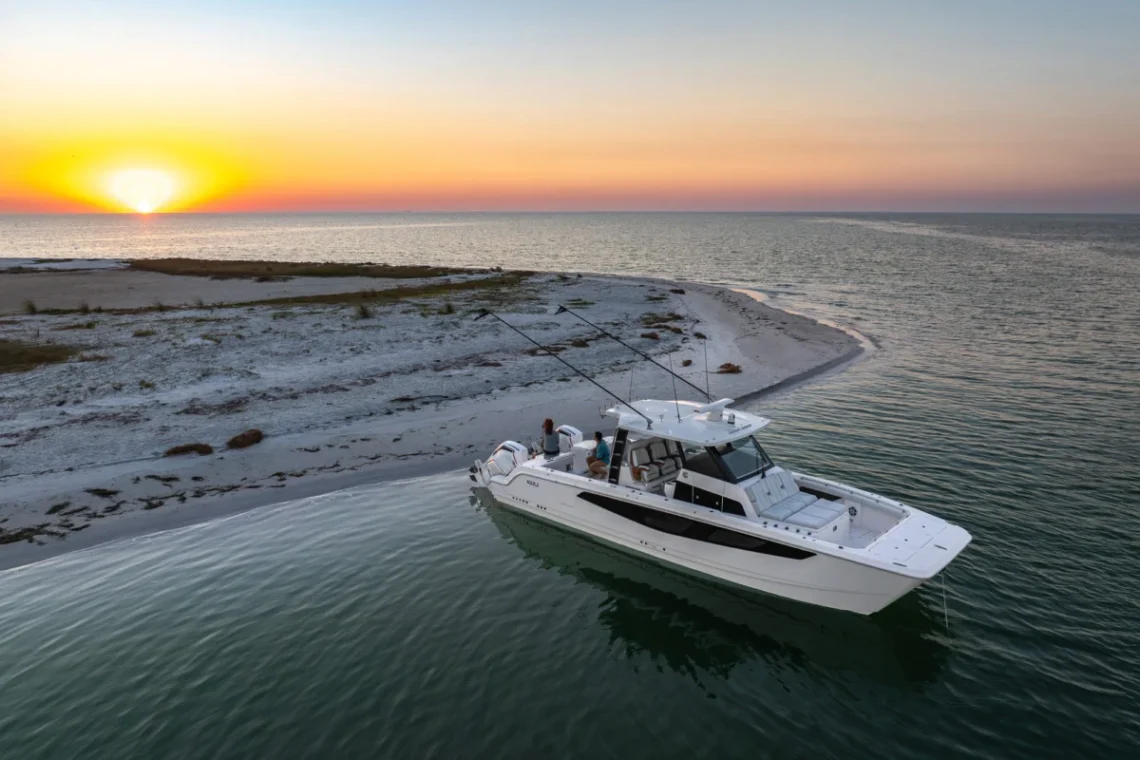
In the highly competitive world of offshore sportfishing, the catamaran has long been championed for its superior lateral stability and rough-water handling. However, the category has often been split between utilitarian, "bare-bones" fishing machines and luxury cruising vessels that shy away from the rigors of tournament life. With the launch of the Aquila 36 Molokai, the builder has successfully bridged this chasm, delivering a vessel that pairs yacht-level fit-and-finish with a relentless, tournament-grade fishing architecture.
Positioned strategically between the agile 28-footer and the commanding 47-foot flagship, the 36 Molokai is not merely an exercise in filling a size gap. It is a calculated refinement of the power catamaran concept, leveraging Aquila’s extensive heritage in building large-scale luxury yachts—some reaching 70 feet—to elevate the standard of what a mid-sized fishing platform can achieve.
Main Facts: Engineering the Molokai Advantage
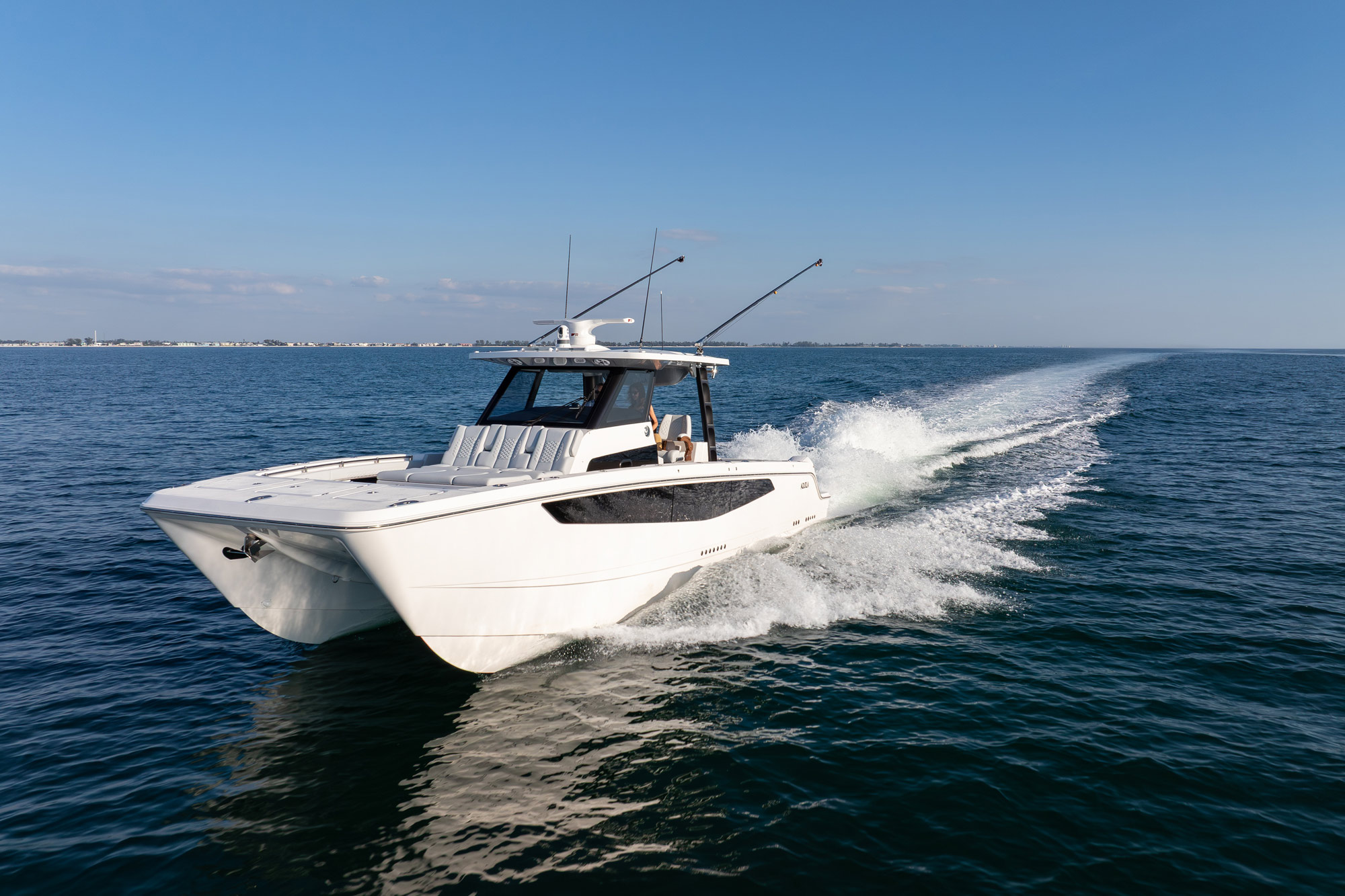
The 36 Molokai is built upon a foundation of hydrodynamic precision. Unlike traditional monohulls, which rely on deadrise and beam to manage sea states, the 36 utilizes a high-tunnel catamaran design. This configuration minimizes the "pounding" sensation common in rough conditions and, crucially, eliminates the "sneezing" (water trapped in the tunnel being ejected forward) that plagues inferior twin-hull designs.
Key Specifications at a Glance
- LOA: 36 feet (approx.)
- Power: Twin Mercury 300hp standard; optional Mercury 400hp or 425hp V10 outboards.
- Fuel Capacity: 508 gallons.
- Range: Approximately 370 nautical miles at cruise.
- Performance: Top speed of 49.7 knots with 400hp power; 43-knot fast cruise.
The vessel’s build quality is immediately apparent in the structural integrity of its components. From the carbon-fiber hardtop to the nylock-nut hardware securing the stainless-steel fittings, every inch is designed to withstand the vibration and salt-spray intensity of high-speed offshore transit.
Chronology: A Sea Trial in the Atlantic
To understand the true capability of the 36 Molokai, one must look at its performance in the crucible of the Florida Atlantic. During a recent sea trial off Jupiter, Florida, conditions were deliberately challenging. A 15-knot northeasterly breeze had churned the inlet against an outgoing tide, creating a chaotic, "confused" sea state of 3- to 5-foot whitecaps.
For many vessels in the 36-foot class, this environment would necessitate a significant reduction in speed to avoid damage or discomfort. The Aquila, however, tracked with clinical precision. Most impressive was the lack of "bow steering"—a phenomenon where one sponson grabs the water during a turn or in quartering seas, forcing the bow to veer unexpectedly. The 36 Molokai remained predictable and stable, allowing the helmsman to maintain a brisk pace without the constant micro-adjustments often required of lesser catamarans.
Supporting Data: Tournament-Grade Fishing Systems
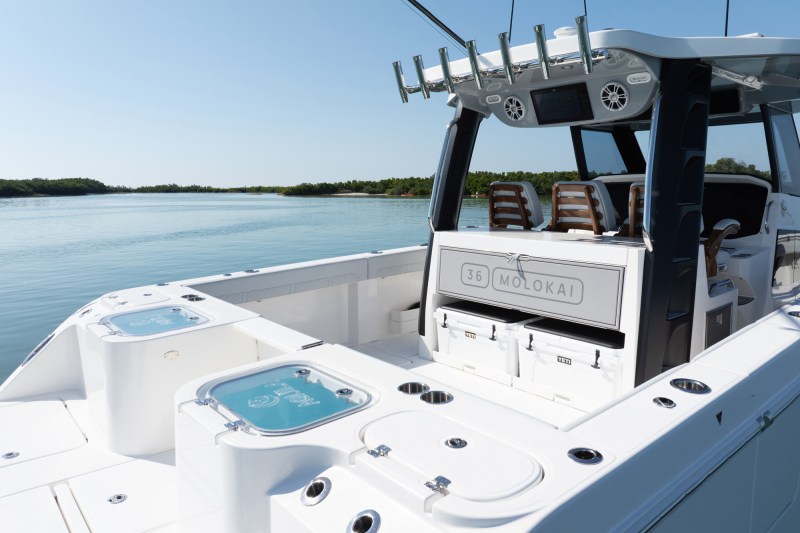
Aquila did not design the cockpit for the casual weekend angler; they designed it for the tournament professional. The bait-management system is perhaps the most advanced in its class, featuring a trifecta of storage: dual 53-gallon transom livewells and a 58-gallon in-deck well.
The Bait-Prep Command Center
The aft-facing rigging station serves as the heart of the cockpit. It is equipped with:
- Hooker Pump Integration: Fed via a custom sea chest with high- and low-speed pickups.
- Precision Flow Control: Variable-speed controls at the helm allow captains to dial in water flow based on the sensitivity of specific bait species.
- Modular Storage: Dual Yeti coolers on sliding mounts provide flexible seating or extra stowage, disappearing when the deck needs to be cleared for action.
Beyond bait, the vessel boasts 32 rod holders and a seven-rod rocket launcher integrated into the carbon-fiber hardtop. For the bottom-fishing enthusiast, the in-deck fish boxes extend deep into the sponsons, providing cavernous, insulated storage for large pelagics like wahoo or tuna.
Official Responses and Systems Integration
Aquila’s philosophy regarding electronics and systems is one of "smart redundancy." The boat utilizes CZone digital switching for streamlined operation, yet it retains physical overhead switches. This is a critical design choice: in heavy seas, touchscreens can be difficult to operate, and having physical controls ensures that critical functions—like bilge pumps or navigation lights—remain accessible.
"We worked closely with Mercury to ensure the hull design and the V10 power plants operate in perfect symbiosis," a company representative noted during the launch. By standardizing on Mercury, Aquila has ensured that every owner benefits from optimized propeller pitches and engine mapping, which is reflected in the boat’s impressive 49.7-knot top end.
Furthermore, the option for a lithium-ion battery bank marks a shift in how mid-sized boats are utilized. This system provides up to eight hours of silent, emission-free power for air conditioning and pumps, allowing for overnight stays or extended drift-fishing sessions without the need to run a generator.
Implications for the Market
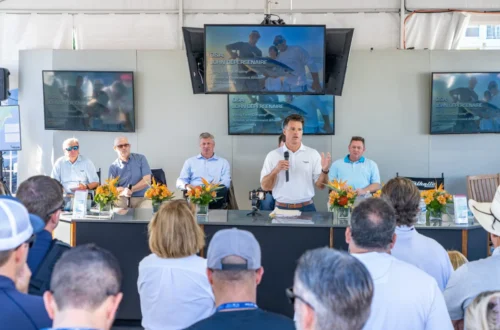
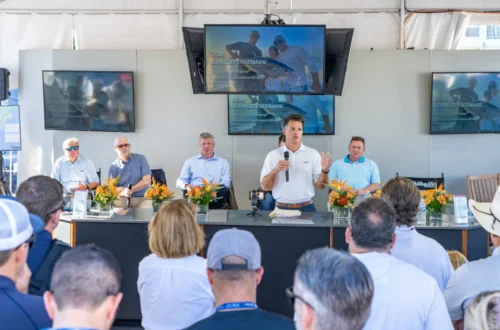
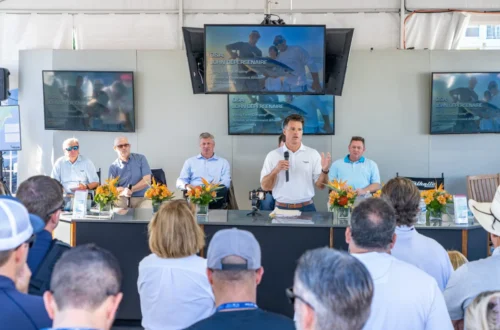
The arrival of the 36 Molokai has significant implications for the offshore market. It signals that the "luxury-fishing" crossover is no longer a niche concept but a new baseline. The success of the Aquila team in the 2025 Big Dog Fat Cat KDW Tournament—where they bested over 200 competitors—provides the empirical evidence needed to back up the marketing claims.
Why This Boat Changes the Game
- Versatility: By including a climate-controlled V-berth and a wet head inside the console, the boat transitions from a tournament weapon to a comfortable family cruiser in minutes.
- Serviceability: The emphasis on accessible bilge hatches and logically routed electrical systems suggests that Aquila has listened to long-term owners who value low maintenance overhead.
- Stability: The catamaran platform offers a "fishing platform" that feels 5–10 feet larger than a monohull of equivalent length, providing a stable, level deck that reduces fatigue during long days on the water.
Conclusion: A New Standard
The Aquila 36 Molokai is a masterclass in compromise-free engineering. It does not force the owner to choose between the adrenaline of a tournament run and the refined comfort of a weekend cruise. Instead, it offers both, wrapped in a package that is as structurally sound as it is technologically advanced.
For the serious angler who demands that their boat be as capable as their skill set, the 36 Molokai represents a compelling evolution. It is a boat that feels, in every regard, "big, smart, and polished"—a rare trifecta in a category that often prioritizes one at the expense of the others. Whether you are chasing pelagics over the horizon or hosting guests for a sunset excursion, the 36 Molokai provides the confidence to go further and the comfort to stay there longer.
As the offshore segment continues to evolve, the Molokai series is setting the pace, proving that the future of fishing lies in the intelligent application of catamaran design. With the 36, Aquila has not just built another boat; they have built a benchmark.