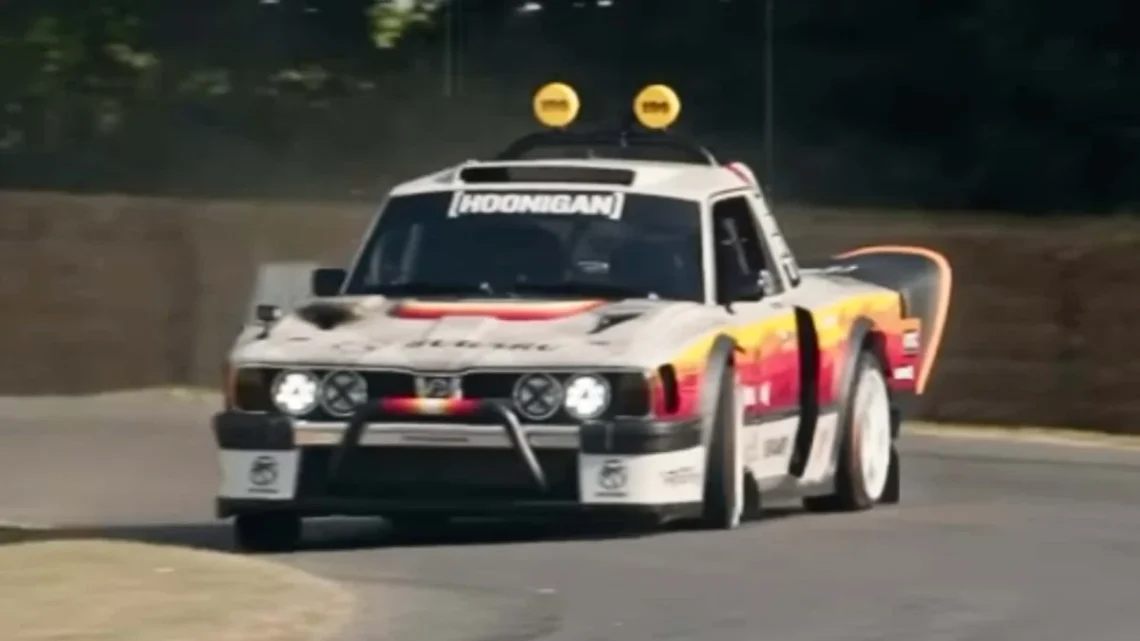
The Goodwood Festival of Speed has long served as the ultimate proving ground for automotive engineering, where history, prestige, and raw, unadulterated speed converge on the narrow, tree-lined driveway of the Duke of Richmond’s estate. This year, the focus of the motorsport world is fixed on a singular, snarling machine: the Subaru "Brataroo." Behind the wheel is none other than Travis Pastrana, the daredevil-turned-precision-driver whose relationship with the Goodwood hillclimb has evolved from a spectacular exhibition of showmanship to a calculated, high-speed assault on the record books.
With 670 horsepower coursing through a custom, carbon-fiber-clad frame, the Brataroo is more than just a nod to the nostalgic Subaru Brat of the 1970s; it is a technological statement of intent. As the festival builds toward Sunday’s final timed shootout, the question on every enthusiast’s mind is whether Pastrana can translate his penchant for sideways aggression into the fastest run of the weekend.
The Anatomy of the Brataroo
The Brataroo is a masterclass in modern custom fabrication. Inspired by the utility and distinct profile of the original Subaru Brat, this one-off machine has been stripped of its utilitarian roots and repurposed into a track-devouring weapon. Underneath the bodywork lies an engineering suite designed specifically to handle the undulating, unforgiving 1.16-mile Goodwood course.
The 670-horsepower output is channeled through a chassis that balances extreme power with the agility required for the hillclimb’s tight, technical sectors. Unlike traditional GT3 cars that prioritize aerodynamic downforce for high-speed cornering, the Brataroo is built for the "Pastrana style"—a combination of rally-honed car control and brute force. During recent practice runs, observers noted the machine’s ability to initiate rotation early, allowing Pastrana to power through the apexes with the car pitched at angles that would make a conventional racer shudder.
A History of Sideways Progress: Pastrana’s Goodwood Chronology
To understand the significance of this year’s attempt, one must look at the trajectory of Pastrana’s Goodwood journey. Since his debut in 2021, the relationship between the driver and the hill has been defined by an relentless pursuit of time, punctuated by both record-breaking performances and heart-stopping moments.
2021: The Airslayer Benchmark
In his inaugural high-intensity run, Pastrana brought the "Airslayer" STI, an 862-horsepower beast that set the tone for his tenure at the event. Posting a blistering 46.20 seconds, he demonstrated that he was not merely at Goodwood for the spectacle; he was there to compete. The Airslayer run remains a benchmark in his career, establishing the standard against which all his future efforts would be measured.
2023: The Family Huckster Incident
By 2023, the stakes had escalated. Pastrana arrived with the "Family Huckster," a custom, heavily modified Subaru GL wagon. While the machine was a marvel of engineering, the event proved that even a master of the craft is subject to the whims of the Goodwood course. During a practice session, a miscalculation resulted in a dramatic crash. While the vehicle sustained damage, the incident underscored the inherent risks of pushing a high-horsepower, short-wheelbase machine on a road that offers zero margin for error. Despite the setback, he managed a respectable fast lap of 49.32 seconds.
2024: Redemption and Evolution
The 2024 event served as a testament to Pastrana’s resilience. Returning with the repaired and refined Family Huckster, he found his rhythm, shaving precious time off his previous efforts to post a 47.50-second run. This improvement was not just about the car; it was about the driver’s intimate understanding of the course’s changing grip levels and elevation shifts.
Supporting Data: The Physics of the Hillclimb
The Goodwood hillclimb is deceptive. Stretching 1.16 miles, it features an elevation gain of nearly 300 feet. The road is narrow, flanked by flint walls, hay bales, and spectators, creating a claustrophobic environment that demands total concentration.
The performance of the Brataroo is analyzed through three primary metrics:
- Power-to-Weight Ratio: With 670 hp, the Brataroo benefits from its carbon-fiber construction, keeping the curb weight significantly lower than standard production vehicles. This allows for rapid acceleration out of the tight Molecomb corner, a section that often decides the fate of a lap.
- Torque Vectoring and Drivetrain: Subaru’s rally pedigree is evident in the drivetrain. The system is tuned for instant response, allowing Pastrana to modulate the car’s position mid-corner.
- Tire Thermal Management: Given the short duration of the run, the tires must reach optimal operating temperature almost immediately after the start line. Pastrana’s practice runs suggest that the team has optimized the tire compound to match the specific asphalt texture of the Goodwood estate.
Official Perspectives and Technical Implications
The partnership between Subaru and Travis Pastrana represents one of the most successful collaborations in contemporary motorsport. From the perspective of Subaru’s engineering team, the Brataroo project is not just about a single weekend of racing; it is an R&D exercise in extreme chassis dynamics.
"The goal is always to push the envelope of what a Subaru can do," says a team representative. "When we build these one-offs, we aren’t just creating a show car. We are stress-testing concepts that translate to our rally and rallycross programs. Travis provides the feedback loop that turns theoretical engineering into real-world performance."
For the wider automotive industry, the success of the Brataroo highlights the enduring appeal of the internal combustion engine pushed to its limits. In an era increasingly dominated by EV acceleration, the visceral experience of a high-horsepower, manual-intensive machine like the Brataroo provides a contrast that fans at Goodwood have shown they deeply appreciate.
The Implications of a Record Run
Should Pastrana succeed in setting a new course record this Sunday, the implications will extend beyond the mere acquisition of a trophy. It would cement his status as the most versatile driver to ever grace the Festival of Speed. While many drivers come to Goodwood to preserve their heritage cars, Pastrana comes to break them—and in the process, he has turned the "timed shootout" into a must-watch event.
Moreover, a record-breaking performance would validate the "Brataroo" platform. It would suggest that the design philosophy—prioritizing driver engagement and mechanical feedback over autonomous or heavily driver-assisted systems—is still the most effective way to navigate the complexities of a real-world track.
Conclusion: The Final Shootout
As the festival reaches its climax, the atmosphere at the start line will be electric. The Brataroo sits idling, its engine note a sharp contrast to the surrounding greenery of the West Sussex countryside. Pastrana, ever the showman, has made it clear that while he respects the history of the event, his objective is singular: to be faster than he was yesterday.
For fans unable to be at the event, the live stream offers a window into the precision required to navigate the Goodwood hill. Whether the Brataroo finds its way into the record books or simply provides another spectacular display of car control, one thing is certain: Travis Pastrana’s performance will remain the focal point of the Goodwood Festival of Speed.
In the world of high-stakes motorsport, where technology and human courage collide, the Brataroo is a reminder of why we watch. It is about the pursuit of the impossible, the roar of the engine, and the absolute focus of a man who refuses to take a corner in a straight line if there’s a faster, more exciting way to do it. Sunday’s shootout is not just a race; it is the culmination of years of development, failure, and triumph. And if history is any guide, the road to the finish line will be taken entirely sideways.